
Deprecated: mb_convert_encoding(): Handling HTML entities via mbstring is deprecated; use htmlspecialchars, htmlentities, or mb_encode_numericentity/mb_decode_numericentity instead in /mnt/storage/stage/builds/pugpig-site-subs-server/latest-1.2.0-1753096337.768322/pugpig-site-subs/content.php on line 225
OCR special
Absolutism and relativism
Jon Mayled explains ethical absolutism and relativism

All boards: Ethics options
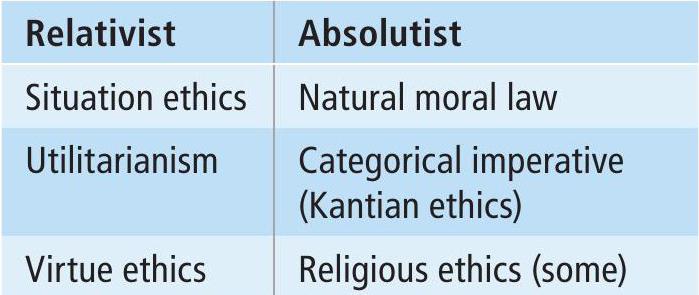
Textbooks often provide what appear to be two divided lists of absolute and relative ethical theories (which is not necessarily helpful), as shown in Table 1.
Ethical relativism
Ethical relativism states that there are circumstances and situations in which certain actions or behaviours that are usually considered to be ‘wrong’ can be considered to be ‘right’.
There are two types of ethical relativism:
■ individual relativism: right and wrong, and good and evil, are seen as relative to the preferences of an individual person
■ cultural relativism: right and wrong, and good and evil, are seen as relative to a culture or to a way of life that is practised by a group of people
If two people disagree about what is ‘right’ or ‘good’ based on these positions then there is no real basis for discovering the truth. In some ways it could be argued t hat these are the only two truly relativist theories.
Where and when did relativism begin?
The answer to this, in the Western world, i s the city states of ancient Greece. Being ‘good’ 800 years BCE meant being a good warrior who was courageous and strong. Developments of this idea are found in the work of Socrates, Plato and Aristotle. Within 200 years these ideas had changed as Greek society came into contact with other civilisations that had different interpretations of ‘good’. In the fifth century CE, travelling teachers (sophists) taught that all truth and morality were in fact matters of opinion.
Socrates, Plato and Aristotle were opposed to relativism, and taught that people should not just follow others but consider ultimate truths that are not limited by their own time and culture.
Cultural relativism
In today’s world it is obvious that different countries, faiths and cultures have different moral and ethical codes. This is called the diversity thesis — there is so much diversity that it is not possible to lay down one moral truth or set of values even though there are probably some specific areas on which most people would agree. We cannot judge any of these societies because, from within our own culture, we necessarily lack objectivity.
People who hold absolutist views believe they are right — such as the nineteenthcentury Christian missionaries who travelled to Africa and Asia in an attempt to replace local cultures with their own. Some common practices from the past are largely judged as unacceptable today — for example, slavery is generally illegal.
‘Slaves, obey your earthly masters in everything, not only while being watched and in order to please them, but wholeheartedly, fearing the Lord.’
Colossians 3:22
If we simply regard all morality as cultural then we cannot also argue that there are universal moral principles.
Weaknesses of relativism
Relativism can present some problems.
■ How can we evaluate practices which seem cruel to people or animals?
■ It can get very near to being purely subjectivism.
■ People need rules and society cannot function without laws.
■ It is much harder to apply relativist theories.
■ What do you do if two relativists disagree?
Normative relativism
The three normative relativist theories commonly studied at A-level are utilitarianism, virtue ethics and situation ethics. However, it is important to remember that none of these is completely relativist in the sense that cultural relativism is. They all have absolute principles as their basis:
■ utilitarianism: greatest happiness principle
■ virtue ethics: eudaimonia — human flourishing
■ situation ethics: agape
Ethical absolutism
Ethical absolutes are true for all time, everywhere and in every situation. Ethical absolutism regards some things as objectively ‘right’ or ‘wrong’ and these cannot be changed to suit the circumstances.
If we agree that murder is wrong, both relativists and absolutists would initially seem to be happy. However, what happens if killing one person would save the lives of thousands of others? Now relativists and absolutists are likely to disagree. This is a deontological approach to ethics that accepts a universal set of absolutes which may be seen as coming from eternal and divine law.
It is straightforward for a religious person to say that these laws and therefore ethical absolutism come from God. The situation is not so simple for atheists, and these ethical absolutes appear to be a priori.
Religious ethics
Many, if not most, religions take moral absolutist positions because they view these laws as coming from a god or gods. This can be seen clearly in Judaism, Christianity and Islam among others.
Graded absolutism
Graded absolutism suggests that we are not necessarily simply confronted with opposites in making moral decisions. When there is a conflict between two absolutes, the correct decision is to follow the higher one: first is duty to God, then other people and finally property. Therefore, lying to save life could be seen as acceptable by placing the sixth commandment before the ninth.
Normative absolutism
The three absolutist theories in Table 1 are natural moral law, categorical imperative (Kantian ethics) and religious ethics (some).
Natural moral law, with its basis in Aristotle, is generally viewed as a religious theory while Kantian ethics are based on reason. The Roman Catholic Church sees natural moral law and the conscience as the ways in which ethical decisions are to be made.
‘Conscience thus formulates moral obligation in the light of the natural law: it is the obligation to do what the individual, through the workings of his conscience, knows to be a good he is called to do here and now. The universality of the law and its obligation are acknowledged, not suppressed, once reason has established the law’s application in concrete present circumstances. The judgment of conscience states ‘in an ultimate way’ whether a certain particular kind of behaviour is in conformity with the law; it formulates the proximate norm of the morality of a voluntary act, ‘applying the objective law to a particular case’.’
‘Veritatis Splendor’ (19 93)
Although Kantian ethics may be seen as truly absolute there are some objections to this, growing from Kant’s claim in the Critique of Pure Reason that the only world we can know or talk about meaningfully is one that has been shaped by the human mind. On Kant’s view, the concept of ‘objective reality’ cannot legitimately be used to explain reality, as it is independent of our own experience of it. This concept was further developed by philosophers such as Hegel, Marx and Nietzsche.
In relation to natural moral law, however, Aquinas says we should try to fulfil our God-given purpose. This is teleological, as it is interested in our design or ‘end’. The primary precepts — worshipping God, living in an ordered society, reproducing etc. — are teleological and all our actions should be aimed towards these. The secondary precepts can allow more graduated conclusions.
Strengths of absolutism
■ Absolutism appears to supply a fixed morality by which things can be judged.
■ Absolutism appears to mean that one culture can judge another without reference to diversity.
■ Absolutism supports universal laws such as the United Nations Declaration of Human Rights.
Weaknesses of absolutism
■ Absolutism does not take circumstances into account.
■ It is very difficult to know what these absolute morals are because everything is open to human interpretation, even those morals which some people maintain come from God.
■ Absolutist ethics are inflexible.
■ It puts rules before people.
■ Following absolutist rules does not necessarily lead to a better society.
■ Sometimes the end does justify the means.
This ‘OCR special’ is the responsibility of RELIGIOUS STUDIES REVIEW and has been neither provided nor approved by OCR.