
Deprecated: mb_convert_encoding(): Handling HTML entities via mbstring is deprecated; use htmlspecialchars, htmlentities, or mb_encode_numericentity/mb_decode_numericentity instead in /mnt/storage/stage/builds/pugpig-site-subs-server/latest-1.2.0-1753096337.768322/pugpig-site-subs/content.php on line 225
PROSPECTS
A degree with drama
Taking a higher education course involving drama could bring future career benefits. Charlotte Purkis offers some perspectives on what is involved in studying drama alongside English

Several things might prompt you to consider a degree involving drama. You may be active as a performer or be involved backstage in local productions, and you might already be studying drama alongside English. But you can take drama post-18 regardless of such experiences. If you particularly enjoy studying plays in your current English course, and are also interested in the contextual and historical study of drama in society, consider courses combined with drama, or a single honours drama degree. Higher education providers will be interested if you show a passion for theatre and have a clear idea why you are interested in developing the range of skills that result from the study of drama.
English with drama
A survey of courses currently available reveals an expectation that studying literary texts, particularly plays, can deepen theatre practice, and that drama can offer a deeper sense of how all texts communicate. English and drama students operate as literary critics and also learn about drama from the inside. For example, Northampton University describes this aim as developing literary and dramatic ways of thinking. Putting plays ‘on their feet’ and performing both informally and in public offers a deeper knowledge of what drama is than the audience viewpoint or the historical perspective that comes from English can. And, with opportunities for creative, critical and professional writing blooming within both fields of study, this is also an ideal combination of subjects for anyone who likes to write.
But drama in higher education these days is about far more than reading, reviewing, analysing and staging plays. It empowers students to explore their own ‘creative identity’, as Bath Spa University suggests. Drama study today often includes an ‘applied’ element involving exploration of drama in social contexts, with options to work in community settings with specific groups facilitating workshops in, for example, schools, prisons and care homes. Increasingly, placements and other industry-facing opportunities are offered to engage students with real-world contexts. Experiences like these, recognising the arts as ‘wellbeing’ as well as entertainment, could empower you to make career choices which will shape the cultural landscape of the future.
Drama skills
Communication, creativity and collaboration are all key skills that employers in a wide range of occupations are looking for in graduate applicants to jobs or further training across myriad professions. Drama courses are usually located as part of ‘creative arts and industries’ departments in higher education, although some are housed within English departments and have developed from literary studies.
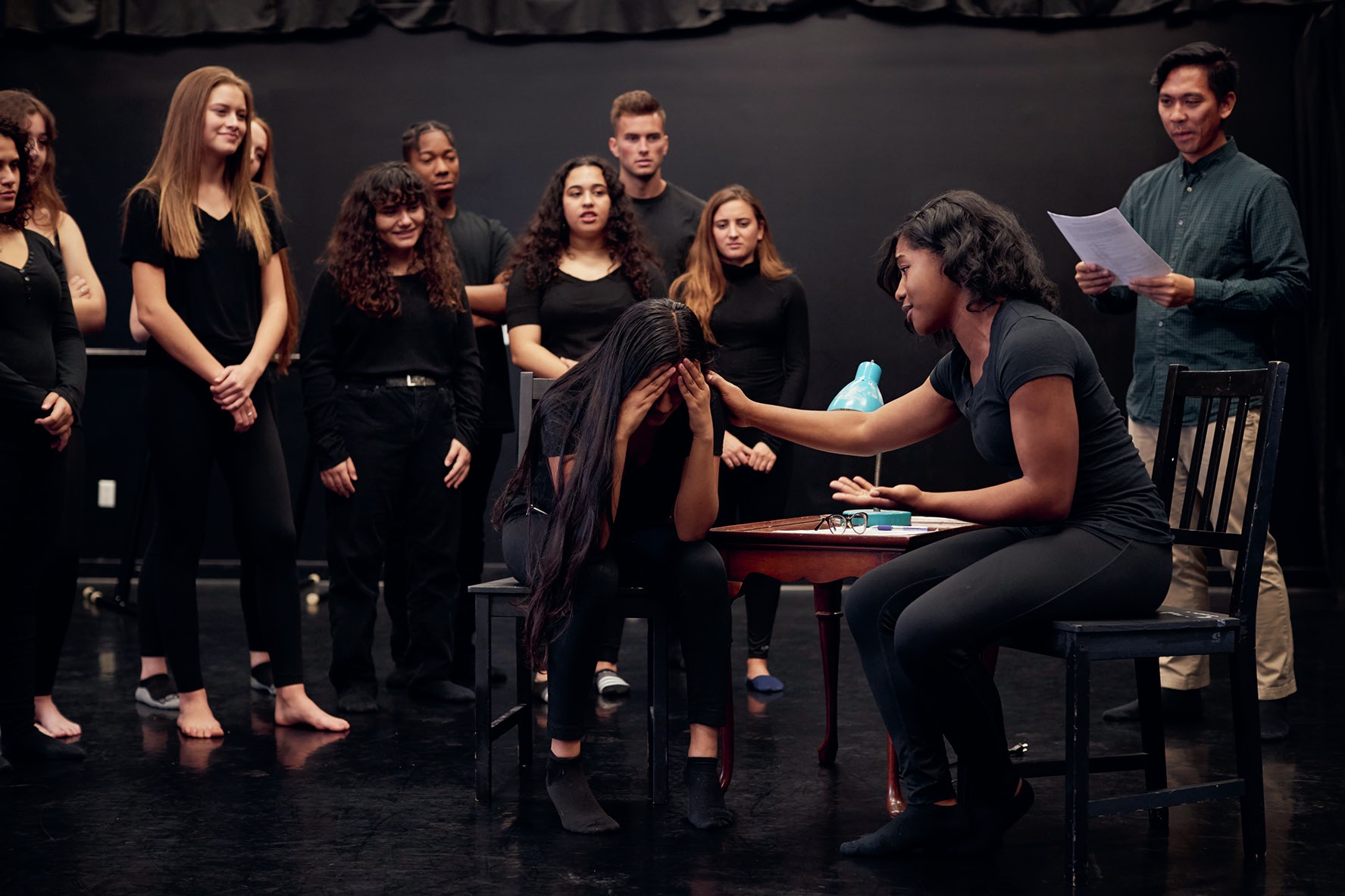
Because of the connections between drama, other performing arts, media, film and technology provision these days, drama courses tend to be delivered by creative practitioners who will encourage you to join in practical activities working in teams. It is this exposure to creative problem-solving in small groups, improvising responses and ideas, exploring theoretical concepts through devising new work or stage happenings that, whether or not you are ‘good’ at performing, could end up putting you in a stronger position for careers involving communication than graduates without a collaborative, entrepreneurial mindset.
Before you apply
Reflect on what characterises your current involvement with drama. Think about what you have not had the opportunity to do that you are intrigued by. As drama A-level and BTEC courses become less available in schools, extracurricular experiences and out-of-school qualifications (such as LAMDA level 3 qualifications) are valid preparation. Admissions tutors will be looking for enthusiasm demonstrable by evidence of theatre-going, watching performance on screen, being alert to how the performing arts can impact on society as entertainment, but also as therapy, and a force for social change. Perhaps there is a teacher you could talk to in your school or college who studied drama but may not currently be teaching the subject.
You will need to decide how vocational a study you want. Courses with ‘Acting’, ‘Performing Arts’, ‘Theatre and Performance’ and ‘Drama’ as titles will cover a range of practice, both training and academic study, or a combination. A further consideration is whether there is any screen component if practical production or media studies fit your ambitions.
Drama course options may be broader than you think if you have so far only studied English. Many of the newer courses have grown not from English, but from performing and fine arts, and they thus emphasise practice. Generally, you will encounter huge flexibility to develop personal interests because creative arts courses are student-led and offer independence in how to work, when to work and who with.
Assessment
The assessment approach will depend on the nature of the course you select. Mixed-mode teaching practices involving discussion and workshop and including digital and live learning are common. Although there will be textual study, there is less dependence on lecture and seminar learning, more standard still in English. Devising work is an established feature of all drama provision in the UK today and this encourages self-exploration, plus awareness of the wider world, its social values and histories. This leads to creative work that goes far beyond the production or adaptation of existing plays.
There will always be some written work, but essays have become less common and other forms of writing, such as critical commentaries, blogs, journals, portfolios and annotated digital documentation, are replacing them. You will also find presentations involving a combination of performance and theorising, staged and improvised live or recorded debates and group research fora for which marks are often awarded for how students interact with one another and manage the process.
Such assessment types rely on peer learning. Look carefully at what is expected to be sure that meeting up out of class to prepare assignments unsupervised will suit you. Be sure that you can cope with assessments that happen in real time under exam conditions.
Some courses may not assess your acting and performance skills as such, although they will be looking for how successfully you communicate ideas. You could be asked to demonstrate an understanding of acting by explaining what you have explored and how, and evaluating the skills gained. For example, you might produce a devised work in a group communicating conceptual ideas, demonstrate how to facilitate a workshop in schools, or document what is involved in putting on a show. Understanding the process of ‘practice-as-research’ using performance to test and demonstrate ideas is core to the drama part of Anglia Ruskin’s BA Drama and English Literature degree in year two, and also underpins the joint degree at the University of Winchester.
There are some courses where you will be assessed for your creative practice and your level of skill in doing and making, perhaps comparing this with the work of practitioners who have inspired aspects of your work. If the course teaches performance skills, such as Edinburgh Napier University’s ‘Acting and English’ four-year training, then you will be assessed to a pre-professional performance standard.
Workload in a combined degree
A combined degree does not necessarily bring a heavier workload, but it can be challenging to engage in the approaches and methodologies of more than one discipline. Taking drama is likely to mean that you will become involved in producing or acting in plays and spend time attending the plays fellow students are involved in, as well as having to meet up outside class to produce coursework. You may be given higher contact hours on the drama part of the course because you will need to work in groups and rehearse in studio spaces. Both drama and English will involve a lot of reading and viewing too.
Crossovers in teaching
Will the two subjects actually connect, or be taught separately? Opportunities for crossover project work may occur, especially in your third year. This could take the form of a thematic dissertation across genres, or a group practical involving devising from or producing a play. Choices of modules may be broader selecting from a menu across two subjects, and you may have the chance of working in stimulating multidisciplinary groups of students taking different awards. Teaching staff tend to be assigned to one subject or another and so it may be more likely that you will be the one connecting the two subjects.
Different courses use various terms: ‘drama’, ‘theatre’ or ‘performance’. So, it is worth looking into the departmental framework to assess the nature of the provision. For example, you could consider screen studies at a university that brings film and theatre teaching staff together, as at Royal Holloway, University of London, or the highly vocational ‘creative industries’ approach to both English and drama offered at the University of the West of England.
Joint, major, minor or ‘option’?
It is worth finding out the proposed pattern of the subjects. For example:
■ Is there a major/minor combination?
■ Can you opt into only one of the two subjects you started with, and at what points?
■ Do the subjects actually connect with any jointly taught modules or interdisciplinary modules? The University of Manchester is one university with a ‘flexible honours’ scheme that allows you to combine subjects in a range of ways.
Choosing what and where
Look very carefully at the descriptions offered. It is best to look at the broad sweep and character of the degree to get a flavour for the type of course that is on offer, and you could review blog posts from current students and recent graduates. If you are not able to actually visit to meet staff and ask questions there are often other ways to get in touch, for example via email, live chat or webinars. Ask about any highlighted ‘transferable skills’ and examples of how these are actually produced from the course, because these could open up a wide range of careers in the cultural industrial sector.
It is also worth researching the local expertise of the staff team and any contacts the institution has with specific theatres or writers. For example, the Queen’s University Belfast course connects specifically to the heritage of drama in Northern Ireland, using its Brian Friel Theatre complex as a core teaching space. The University of Reading has a Samuel Beckett Research Centre. It is usual now to see links to local theatres. Shakespeare studies are ubiquitous in all English and drama courses, dealing in questions of ideology, globalisation and sociocultural practice across time and contexts, but they have an edge in locations close to Stratford-on-Avon. Coventry University has specialised in ‘telepresence in theatre’ and offers students digital international work in collaboration with European partners through a ‘Shakespeare Portal’. Birmingham University collaborates actively with the Royal Shakespeare Company, and Warwick has developed a unique ‘Shakespeare without Chairs’ experience.
Wider career opportunities
Of course, your chosen degree and university experience may lead you into a career on stage, if you end up becoming really involved in making performance. You may also pursue careers in arts administration and supporting the creative industries in various ways, building on experiences from your theatre work. But for most graduates the options are far wider. Look into opportunities to work with the public, such as in customer care or selling where you can use practised persuasive skills, and think especially about any jobs involving working in teams or involving communication skills such as making presentations and running workshops. With some universities, for example Loughborough and Exeter, now offering a placement year or module, you could have the chance to explore career prospects in that year.
Teacher training is one professional path where having specialist expertise from two subjects is an advantage. Teaching appointments in secondary schools commonly ask for drama combined with English and so a joint qualification could actively help you gain a training place over someone with a pure drama degree. Drama may also have developed your media skills. Primary schools require recruits with English as a core subject, but also welcome creative practitioners.
Don’t forget teaching options are wider than school teaching. You might become an education officer at a theatre or run a branch of a national children’s theatre school. In fact, as opportunities to teach creative arts are currently on the decline in the state sector, they are growing in private and leisure education, and feature in childcare schemes too. If you have also opted for some creative writing modules on the English side of your degree you could be well-placed to work as a multi-arts practitioner or examiner — for example, for Arts Award — alongside developing a freelance writing, directing or publishing career.
Pure drama
If your search for a combined course attracts you to a pure drama option, go for it. Don’t be deterred if you have not taken drama in your 16–18 curriculum as a stand-alone subject. At your interview and audition workshop you will be observed and assessed afresh on your suitability. If you are under 19 you can apply for a foundation course at some further education colleges. Some higher education providers also offer a foundation year and guarantee you a place on their degree course on completion. St. Mary’s Twickenham has a progression onto either acting or English and drama. Some universities offer free taster days and summer schools.
A drama degree without English will still incorporate some literary and language textual study. It will make you a generic arts/humanities graduate, able to enter a wide range of careers, but could also open doors into a specific theatre career in the creative industries. If you decide you want to act, don’t hesitate to choose professional training. These days there is a bounty of conservatoire-style courses aiming to prepare actors in diverse ways, beyond the established courses at the specialist drama schools.
Whatever you decide, always make sure your personal statement reflects your range of choices and don’t be afraid to refer to experiences beyond school or college if drama has not been on offer for you in your 16–18 curriculum.
RESOURCES
CDMT: https://cdmt.org.uk
CiC, ‘Creative industries growth surge continues’: www.tinyurl.com/r4furh6
Discover Creative Careers: https://discovercreative.careers/# QAA, ‘Subject benchmark statements’: www.tinyurl.com/yxx9hmb2
UCAS, ‘Learn about uni on a taster course’: www.tinyurl.com/t3wzkox
UniTasterDays: www.unitasterdays.com
For a student’s view of an English and drama degree course, see ‘Taking the next step’ in ‘Prospects’, ENGLISH REVIEW, Vol. 26, No. 1 (September 2015).