
Deprecated: mb_convert_encoding(): Handling HTML entities via mbstring is deprecated; use htmlspecialchars, htmlentities, or mb_encode_numericentity/mb_decode_numericentity instead in /mnt/storage/stage/builds/pugpig-site-subs-server/latest-1.2.0-1753096337.768322/pugpig-site-subs/content.php on line 225
Introducing Marx and religion
Jon Mayled looks at Karl Marx’s sociological association with religious issues

OCR: H573/03 Developments in Christian Thought
The sociology of religion is a fascinating area of study that raises many interesting questions about the origin of religion and the function that it serves in society.
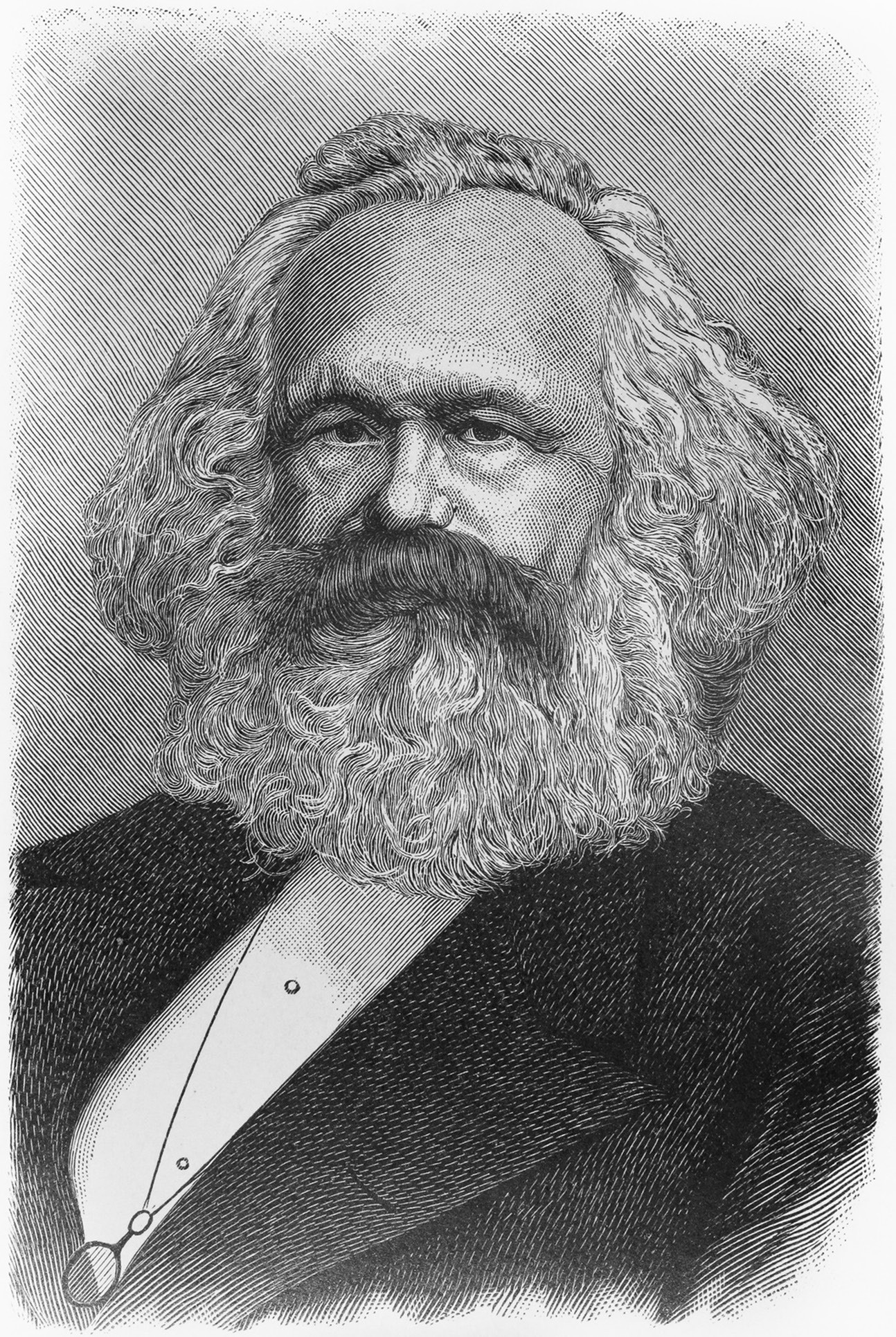
Karl Marx
Karl Marx (1818–83) has been associated with sociological challenges to religious claims. Marx was an economist, journalist, philosopher, revolutionary socialist and sociologist. He was born into a middle-class family in Prussia and studied political economy and Hegelian philosophy. In adulthood Marx left Prussia and spent most of his life in London. Here he worked with Friedrich Engels (1820–95). Together they published several books and the pamphlet the ‘Communist Manifesto’ (1848). His work has since substantially influenced intellectual, economic and political history.
Marx’s theories, now generally referred to as ‘Marxism’, hold that human society works through a class struggle. This conflict is between the ruling classes (bourgeoisie) and the working classes (proletariat). Marx used an approach known as historical materialism. His view was that capitalism created social relations, though he put forward the theory of base and superstructure, asserting that the cultural and political conditions of society, as well as its notions of human nature, are largely determined by obscured economic foundations. Through his theories of alienation, value, commodity fetishism and surplus value, Marx argued that capitalism facilitated social relations and ideology by treating people as commodities, and through inequality and labour exploitation. These ideas are found in his writings, such as Capital, Volume I (1867).
Marx believed that every country is run in favour of the ruling classes while claiming that they are working for the common interest. He also thought that capitalism would eventually self-destruct and be replaced by socialism and the establishment of a classless communist society. Although few countries have tried to adopt all of Marx’s proposed systems, these ideas have created much of our understanding of labour relations and economic thought. He is often described as one of the principal architects of modern sociology.
Religion and society
Many sociologists have argued that religion and religious experience have their origins in society. Therefore, if someone believes they have had a religious experience it will reflect the society in which they live.
Marx was influenced by the Young Hegelians, a philosophical movement that believed religion was a form of ‘alienation’ from one’s real self. Religion was all about mythological beliefs and a non-existent god that distracted people from reality in the physical world.
Marx sees the social function of religion in terms of highlighting and preserving the political and economic status quo and inequality. In
Box | Marx on religion
The foundation of irreligious criticism is: Man makes religion, religion does not make man. Religion is, indeed, the self-consciousness and self-esteem of man who has either not yet won through to himself, or has already lost himself again. But man is no abstract being squatting outside the world. Man is the world of man — state, society. This state and this society produce religion, which is an inverted consciousness of the world, because they are an inverted world. Religion is the general theory of this world, its encyclopaedic compendium, its logic in popular form, its spiritual point d’honneur, its enthusiasm, its moral sanction, its solemn complement, and its universal basis of consolation and justification. It is the fantastic realisation of the human essence since the human essence has not acquired any true reality. The struggle against religion is, therefore, indirectly the struggle against that world whose spiritual aroma is religion.
Religious suffering is, at one and the same time, the expression of real suffering and a protest against real suffering. Religion is the sigh of the oppressed creature, the heart of a heartless world, and the soul of soulless conditions. It is the opium of the people.
The abolition of religion as the illusory happiness of the people is the demand for their real happiness. To call on them to give up their illusions about their condition is to call on them to give up a condition that requires illusions. The criticism of religion is, therefore, in embryo, the criticism of that veil of tears of which religion is the halo.
MANY SOCIOLOGISTS HAVE ARGUED THAT RELIGION AND RELIGIOUS EXPERIENCE HAVE THEIR ORIGINS IN SOCIETY.
1840 Marx had begun to work with the German philosopher and historian Bruno Bauer (1809– 82) on editing Hegel’s Philosophy of Religion. At the same time, he was also working on his doctoral thesis, ‘The Difference Between the Democritean and Epicurean Philosophy of Nature’, which has been described as:
‘…a daring and original piece of work in which Marx set out to show that theology must yield to the superior wisdom of philosophy.’
Wheen 1999
Marx saw religion as a form of societal oppression and control organised by the Church. He believed, therefore, that religion had to be overthrown. In particular, he criticised the power of the clergy (priests, monks and nuns) in reinforcing the Church as a form of social control of behaviour: Christian teaching about heaven, hell and punishment after death comforted people and helped them to cope with being treated badly, as the people responsible would go to hell.
Criticisms of Marx
Karl Marx did not accept the idea that, for many people, religion is much more than a comfort like a drug. People who are religious argue that their faith is a relationship with God. For them, God is a real, existing being, and is not simply a product of society.
Although it is true that many religions have oppressed people in the name of a god, nevertheless they have also given many people a source of strength, hope and comfort in their daily lives. It is also well established that during times of warfare or natural disasters religious beliefs and practices become more important to people (as shown, for example, with increased church attendance).

Religion has been a force for change in society in many countries, and not simply a way of controlling and oppressing people. For example, Martin Luther King Jr’s belief in equality came from his strong Christian faith and upbringing and led him to fight for black people’s civil rights in the USA.
It is also established that attempts to implement Marx’s ideas in society, such as was done by Lenin in Russia, Mao Zedong in China and Fidel Castro in Cuba, have not brought about universal happiness and have caused a great deal of suffering. Also, many former communist countries have abandoned Marx’s doctrines, and those that remain communist have adapted and changed them in the last 50 years, beginning with the so-called 1968 Prague Spring in Czechoslovakia led by the first secretary, the reformist Alexander Dubček.
In the USSR, a Marxist–Leninist atheism was encouraged, which taught the acceptance of atheism and abolition of all religion. Outside of the USSR, particularly in Latin America, some non-Soviet Marxists opposed the antireligious stance of this philosophy. The growing liberation theology movements completely rejected the idea of a political doctrine based on atheism.
Following the break-up of the USSR in 1991 the Russian stance changed significantly with the passing of a 1997 law that identified the importance of Buddhism, Christianity, Islam and Judaism in Russian history. This would appear to show that societies and individuals with power or vested interests do not want to abandon the model of the bourgeoisie and the proletariat, despite Marx’s idea that this would lead to true equality and happiness.
Because of what people regard as being the atheistic nature of communism, some have accused it of persecuting religion. A further criticism is that communism is, in itself, a religion.

References
Marx, K. (1976) Introduction to A Contribution to the Critique of Hegel’s ‘Philosophy of Right’, Collected Works, Vol. 3. See Box 1 for extract and www.tinyurl.com/marx-intro for full text.
Wheen, F. (1999) Karl Marx: A Life, Fourth Estate.