
Deprecated: mb_convert_encoding(): Handling HTML entities via mbstring is deprecated; use htmlspecialchars, htmlentities, or mb_encode_numericentity/mb_decode_numericentity instead in /mnt/storage/stage/builds/pugpig-site-subs-server/latest-1.2.0-1753096337.768322/pugpig-site-subs/content.php on line 225
Theosophy (from the Greek theos, God + sophia, wisdom — literally ‘God’s wisdom’)
Theosophy is usually viewed as part of esotericism and is concerned with investigation of the nature of divinity.
Today the name Theosophy usually refers to the teachings of the Theosophical Society, which was founded in New York in 1875. Theosophy now has societies in more than 52 countries, so its popularity continues.
Antoine Faivre (born 1934) is an important French scholar of Western esotericism and has written extensively on modern Theosophy. He argues that there are three clear characteristics of Theosophy:
■ Divine/Human/Nature Triangle: Theosophists study the relationships between these three, looking at the interplay between them as found in the processes of the mind.
■ Primacy of the Mythic: this is a universal reality realised by the creative mind which links the creative imagination with the external world of symbols.
■ Access to Supreme Worlds: there is a special human ability which can create a connection between humans and the divine world. This can enable humans to experience an inner awakening.
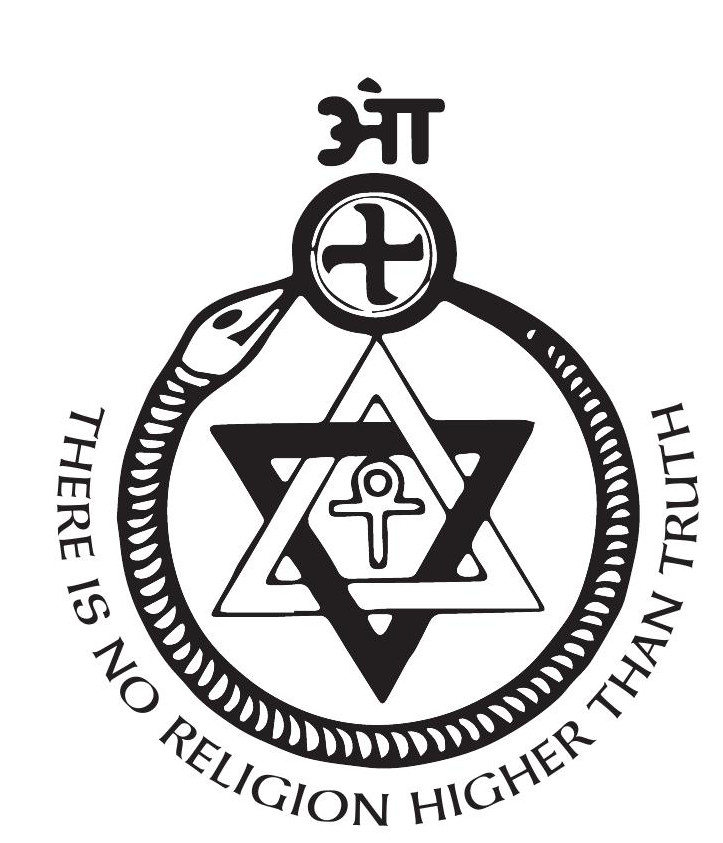
The Theosophical Society was founded in 1875 by Helena Petrovna Blavatsky (1831–91), Henry Steel Olcott (1832–1907) and William Quan Judge (1851–96). Its motto was ‘There is no Religion higher than Truth.’
The aims of the society were to:
■ form a nucleus of the Universal Brotherhood of Humanity, without distinction of race, creed, sex, caste or colour
■ encourage the study of comparative religion, philosophy and science
■ investigate the unexplained laws of nature and the powers latent in man The symbol of the society contains:
■ the motto of the society
■ a serpent biting its tail
■ a swastika
■ a hexagram
■ the cruxansata (ankh)
■ Om (the sacred symbol and sound representing the ultimate; the most sacred of Hindu words)
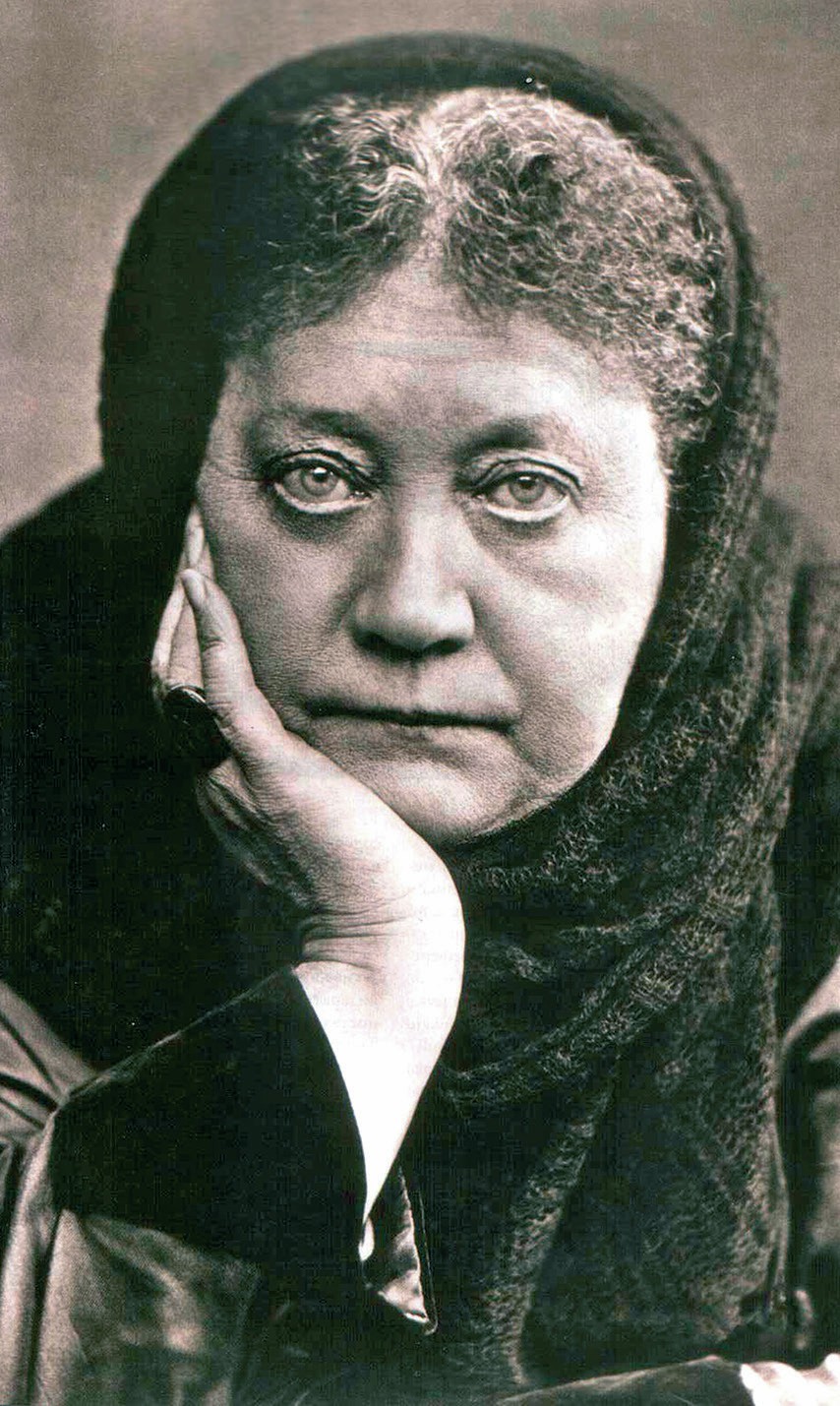
Helena Petrovna ‘Madame’ Blavatsky
Probably the best-known Theosophist, Madame Blavatsky was an occultist, medium and author. She became the leading theoretician of the movement.
Blavatsky was a controversial but charismatic individual, born into an aristocratic Russian–German family. She later wrote that in her early years she had visited Europe, the Americas and India. Apparently, she was then sent to Tibet where she was trained to develop her psychic powers. However, there is no evidence for any of this.
When she was 17, she agreed to marry Nikifor Vladimirovich Blavatsky, the vice governor of Erivan province in Armenia. She made many attempts to escape and return to her family, to which her husband agreed. She was due to travel back to St Petersburg with her father but claimed that she escaped from him and bribed a ship’s captain to take her to Constantinople (Istanbul).
She claimed that while in Constantinople she saved an opera singer, Agardi Metrovitch, from being murdered and appears to have become his mistress.
After allegedly making trips to various eastern countries, she came to London in 1854 and claimed that she was a musician with the Royal Philharmonic Orchestra.
In the 1870s she was involved in spiritualism, though she argued that the spirits she contacted were not those of the dead.
Then, in 1873 she moved to the USA, where she lived in a women’s housing cooperative, did piece-work sewing and designed advertising cards. Soon afterwards, she inherited a considerable fortune following the death of her father. A man from Georgia, Mikheil Betaneli, begged to marry her, which eventually she did. Her first husband was still alive at the time so this was bigamy, but as she would not consummate the marriage Betaneli divorced her.
She then befriended Henry Steel Olcott. She became a well-known medium but there were always accusations of fraud made against her.
Starting Theosophy
Together with Olcott and William Quan Judge she co-founded the Theosophical Society in New York. Her first book, Isis Unveiled (1877), laid out her worldview.
Blavatsky and Olcott moved from New York to Bombay, India, in 1878 and established the international headquarters of the society in Adyar, Madras. While in Ceylon (Sri Lanka) she and Olcott became the first Euro–Americans to convert to Buddhism.
Poor health (she had Bright’s disease) caused her to return to Europe in 1885. She settled in London and set up the Blavatsky Lodge. While there she published The Secret Doctrine, which she claimed to be a commentary on rare and ancient Tibetan manuscripts. She also learned an ancient language called Senzar, and translated a number of old texts written in this language that had been preserved by monks. In 1891 she died of influenza at the home of her successor, Annie Besant.
‘[Blavatsky] talked incessantly in a guttural voice, sometimes wittily and sometimes crudely. She was indifferent to sex yet frank and open about it; fonder of animals than of people; welcoming, unpretentious, scandalous, capricious and rather noisy. She was also humorous, vulgar, impulsive, and warm-hearted, and didn’t give a hoot for anyone or anything.’
Washington, P. (19 93)
Blavatsky was known for wearing loose robes, and many rings on her fingers. She was a heavy smoker throughout her life. However, she lived simply and would never accept money in return for teaching. As Paul Johnson (1994) said, ‘The Western esoteric tradition has no more important figure in modern times.’
Theosophy splits
When Blavatsky died in 1891 there was a series of splits and schisms in the movement (although the original society still exists as the Theosophical Society, Adyar). Several new schools were established between 1895 and 1909 in the USA.
After her death the leadership of the society became convinced that an emissary from the spiritual hierarchy was about to appear. Initially this world teacher (Maitreya) was claimed to be a 14-year-old, Jiddu Krishnamurti (1895–1986). Krishnamurti was prepared for this messianic role, and the Order of the Star in the East (OSE) was formed in 1911 to support him.
Internal feuds followed for years. In 1929, Krishnamurti announced that he was not the messiah, disbanded the OSE, and left Theosophy.
Annie Besant
In 1907 Annie Besant (1847–1933) became the international president of the society.
In order to develop her work in Theosophy, Besant travelled to India. In 1898 she helped establish the Central Hindu College, and in 1922 the Hyderabad (Sind) National Collegiate Board.
She then became involved in Indian politics and joined the Indian National Congress. With the outbreak of the First World War in 1914, she helped launch the Home Rule League, which campaigned for democracy in India and dominion status within the empire. In 1917 she became president of the India National Congress. In the 1920s she travelled to the USA with her now adopted son Krishnamurti. After the war, she carried on the campaign for Indian independence as well as fighting for the causes of Theosophy, up to her death in 1933.
Anthroposophy
Rudolf Steiner (1861–1925) was head of the German branch of the Theosophical Society in the early twentieth century but disagreed with the Adyar-based leadership of the society over the World Teacher Project. In 1913 he left the Theosophical Society and promoted his own philosophical system, which he called Anthroposophy.
Steiner was the founder of Waldorf education. At first he was a private tutor and history lecturer for the Berlin Arbeiterbildungsschule, an educational facility for working-class adults. He became interested in child education, and in 1907 published an essay called ‘The Education of the Child’. His education principles centred on Theosophy/Anthroposophy, and the first school based on his ideas opened in 1919 in Stuttgart, Germany, to provide for the children of employees of the Waldorf-Astoria Cigarette Factory. This is the source of the name Waldorf, which is now trademarked in some countries in association with the method. The school was coeducational and the first comprehensive school in Germany, serving children from all backgrounds.
Today there are 150 Steiner schools in the USA, 33 in the UK and 20 in Canada, as well as new ones that have opened in parts of Europe and China. In this way, the central tenets of Theosophy have been kept alive.
New Age movement
The New Age movement owes much to Theosophy. As Melton (1990) put it: ‘No single organization or movement has contributed so many components to the New Age movement as the Theosophical Society… . It has been the major force in the dissemination of occult literature in the West in the twentieth century.’
THE NEW AGE MOVEMENT OWES MUCH TO THEOSOPHY.
India
As noted above, the Adyar Theosophical Society had close links with the Indian independence movement. Many leaders of the Indian National Congress were associated with Theosophy, including Gandhi. On the other hand, the famous Hindu spiritual teacher and leader Swami Vivekananda (1863–1902) criticised Theosophy and the Theosophists.
References
Johnson, K. P. (1994) The Masters Revealed: Madame Blavatsky and the Myth of the Great White Lodge, State University of New York Press.
Melton, G. (ed.) (1990) ‘Theosophical Society’, New Age Encyclopedia, Gale Research.
Washington, P. (1993) Madame Blavatsky’s Baboon: Theosophy and the Emergence of the Western Guru, Secker & Warburg.