
Deprecated: mb_convert_encoding(): Handling HTML entities via mbstring is deprecated; use htmlspecialchars, htmlentities, or mb_encode_numericentity/mb_decode_numericentity instead in /mnt/storage/stage/builds/pugpig-site-subs-server/latest-1.2.0-1753096337.768322/pugpig-site-subs/content.php on line 225
AQA special
Muslim practice The Five Pillars (part 1)
Richard Gray begins a series looking at the Five Pillars of Islam
RSReviewExtras
Go online (see back cover) for a PowerPoint to help you take this ‘AQA special’ further.
AQA AS Unit K World religions 2: Islam 1 The way of submission
Over the next few issues of RELIGIOUS STUDIES REVIEW we will consider each of the Five Pillars of Islam and explore their practical and theological nature. The final column will provide a consideration of the collective importance of the Pillars, their significance for Muslims and for developing the ideal Muslim and Muslim community (Ummah). This first column will deal with the concept of ‘Pillar’ and the first Pillar: shahadah.
AO1 checklist
• Concept of ‘Pillar’.
• The Five Pillars.
• The significance of the Five Pillars for Muslims, including their contribution to the development of the ideal Muslim character and the Ummah.
The concept of ‘Pillar’
The Five Pillars of Islam are the basis of Muslim faith. Widely recognised as the central features of Islam, collectively they provide an adequate answer to the question ‘What does it mean to be a Muslim?’
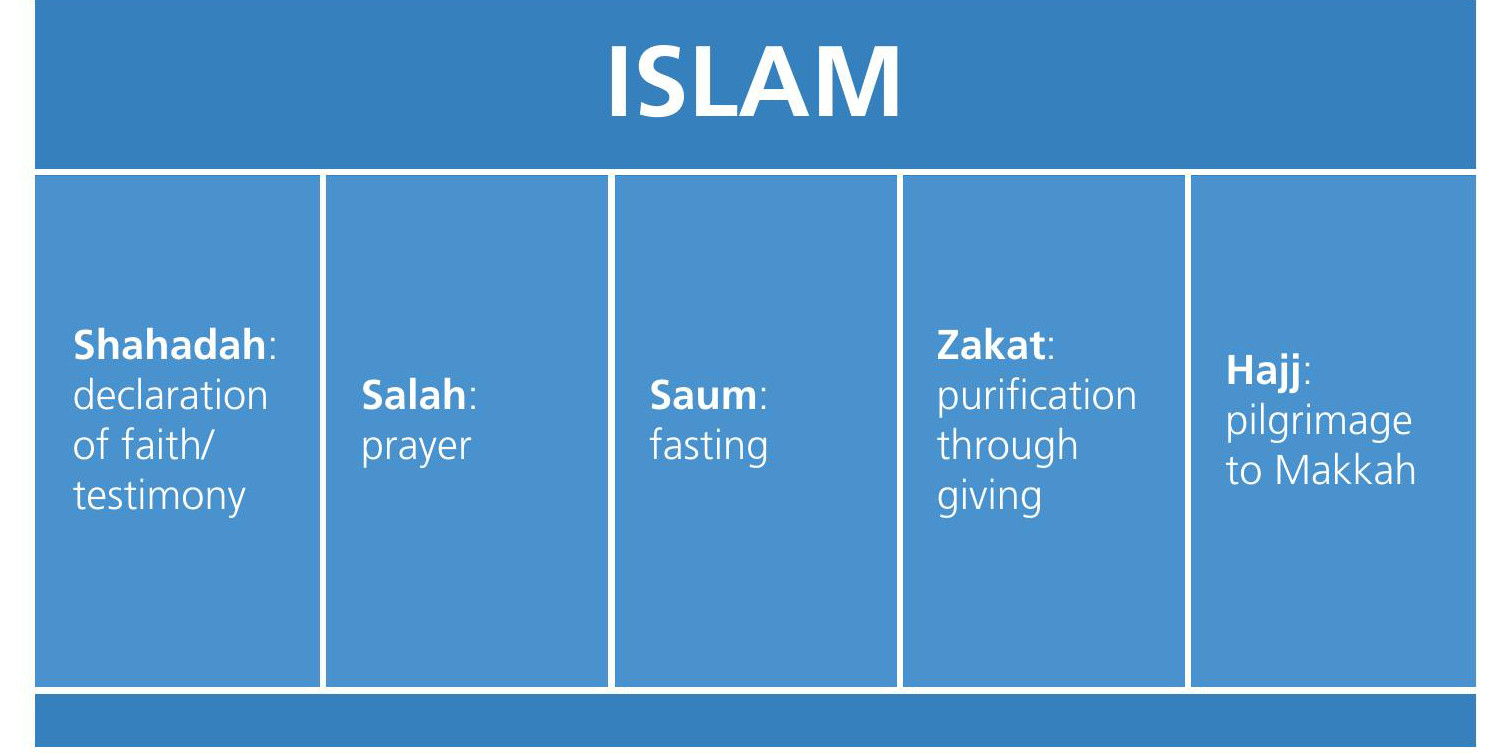
The Five Pillars of Islam are:
1 shahadah (declaration of faith/testimony)
2 salah (prayer)
3 saum (fasting)
4 zakat (purification through giving)
5 hajj (pilgrimage to Makkah)
There is no intentional hierarchy, despite the first being the central tenet of Islam. Each Pillar is interrelated and acts as support for the others. The imagery of the pillar suggests strength, stability and support, and together the Five Pillars conjure up the idea of a safe haven beneath which the Islamic faith can flourish (Figure 1).
All Five Pillars are obligatory (fard) acts for a Muslim (although there are specific exceptions for hajj, explored in a later column). All Pillars are specific acts of worship (ibadah) and underline the notion of submission to Allah, the quintessential ideal of Muslim spiritual identity.
A Muslim, then, is one who submits to Allah. In this sense, for a Muslim, all life is worship to Allah and not just the five specific practices identified in the Pillars. However, a Muslim would say that every aspect of life is linked to the Pillars in some way or another. This is especially the case for the declaration of faith, as a Muslim life should be constantly aware of the divine (taqwa). Indeed, Islam does not differentiate between religious and non-religious actions. Every action should be righteous and a Muslim should be constantly God-conscious (taqwa).
Integral indicators
Therefore, it is often said that Islam is a complete way of life (din). In fact, each of the Pillars serves as a basis for life in its broadest sense. That is, while aspects of the Pillars may be specific to certain times, their underlying influence and impact influences the rest of a Muslim’s life.
‘One should not think that prayer, fasts, the payment of alms and the pilgrimage to Mecca are ends in themselves…[they] are in a sense mnemonic devices: they embody actions, behaviour and ritual performances which are designed to bring about remembrance…of the true state to which he is always expected to aspire.’
Colin Turner
The Five Pillars are not dogmatic statements of belief that are imposed upon Islam to drive it and make it work. Quite the opposite is the case; they are extracted from the whole of Islamic life and serve as indicators of what Muslims ‘do’ to become more God-conscious. This only reinforces the identity of faith and practice within Islam.
In addition, the Pillars are not necessarily recognised as separate doctrinal elements within Islam by all who practise the faith. Indeed, some Muslims may be unaware of the phrase ‘Five Pillars’ but are nonetheless devoted practitioners of Islam! The reason for this is that the practices and beliefs contained in the Pillars are the basis of all Islam and integral to all elements of the religion. A Pillar is not necessarily isolated and focused upon. Even during the month of Ramadan the Pillar of fasting is supported by other Pillars. A more familiar term for Muslims for the Five Pillars, as David Waines indicates, would be ‘the duties of worship’ or ‘ibadat’.
Why five?
While more elements from the practice of Islam could be extracted, these five are widely identified as the crucial aspects to practise and the ones that, when consistently applied, most effectively demonstrate submission to Allah.
‘Why are there Five Pillars in Islam? Why not six, or ten, or twenty-five? More importantly, why are there any pillars at all?’
Colin Turner
It would be a mistake to think of the Five Pillars as specific teachings established by Allah in the same way as the Ten Commandments were revealed in Judaism or the Four Noble Truths were discovered in Buddhism. There is really no significance to the number. To consider numerical significance would be to draw a Muslim away from the message within the Pillars themselves.
Indeed, this is substantiated by the fact that the Pillars are never presented in a systematic manner and explained in depth. The Pillars are simply a reflection of the ideals of Islam and in studying them it is clear that many more doors of exposition, religious instruction and spiritual significance are opened. They are, in essence, the basis of practice.
The Qur’an
The Pillars are mentioned in the Qur’an several times, although not collectively. Again, in the Hadiths there is no systematic exposition of all five together. This is important because it underlines the fact that the message of Islam through the Qur’an and Hadiths is not meant to be a theological statement. The message of Islam is much more embracing and incorporates all aspects of life. Belief in Islam is directly related and proportional to practice that epitomises Muslim behaviour.
In terms of clarity, the Qur’an tends to offer the basic understanding of each Pillar at both a theological and practical level. The shortest surahs tend not to deal with the Pillars other than the idea of faith in one God and the prophethood of Muhammad. The larger surahs (e.g. Surah 2 The Cow) mention each of the Pillars, although not as ‘Pillars’ but as issues in their own right.
THE TERM ‘SHAHADAH’ LITERALLY MEANS WITNESS, EVIDENCE OR TESTIMONY.
It is with the Hadiths that further development of understanding is sought, often addressing practical implications and situations. Put in simple terms, the Qur’an tends to give the commands of what to do correctly and the Hadiths tend to expound upon the way in which that command needs to be fulfilled.
To summarise:
■ The Five Pillars are widely acknowledged as the clearest statement of what it means to be a Muslim.
■ The term ‘Pillar’ is significant for the imagery it suggests, such as strength, stability, support and a place of sanctuary to express Muslim practice.
■ The Pillars signify a way of life.
■ The Pillars are not belief; the emphasis is on application of belief.
■ The number five has no real significance.
■ The Qur’an and Hadith offer no systematic analysis of the Five Pillars.
The first Pillar: shahadah
The first Pillar is a simple but very powerful statement of belief. In this statement, the heart of Islam is exposed.
The shahadah is as follows:
‘I declare that there is no God but Allah and Muhammad is the messenger of Allah. (Transliteration: Ash-shadu an la ilaha illallah wa Muhammadarrasulullah’
The theology of shahadah
The term ‘shahadah’ literally means witness, evidence or testimony. It is derived from ‘ash-shadu’ above (‘I declare’ or ‘I bear witness’). Once again, the Muslim scholar John Esposito reminds us: ‘To become a Muslim, one need only make this simple proclamation.’
Shahadah is the ultimate declaration of faith for Islam. It is more than a creed or statement of belief. It is not just a matter of personal and private belief; it is also a public testimony of truth.
The shahadah is the declaration of uncompromising monotheism and the acceptance of Muhammad as the final messenger of Allah. The shahadah not only recognises the truth of Islam but also, when spoken with conviction, is a means by which conversion to Islam takes place. However, it is only when speaking this statement with true intention (niya) to become a Muslim that a person becomes Muslim. Without true sincerity the shahadah is just an empty statement.
Moreover, the shahadah has further implication for Muslim life. As the writer Elias describes it, it ‘so perfectly encapsulates the essence of Islamic faith’ as a foundation for the other Pillars. It is argued that shahadah brings together all the other four Pillars. Reza Aslan comments: ‘This deceptively simple statement is not only the basis for all articles of faith in Islam, it is in some ways the sum and total of Islamic theology.’
Viewed in this way it is directly related to the teaching of the seven articles of faith:
1 tawhid (oneness, unity of God)
2 risalah (message of God, belief in messengers i.e. prophets)
3 malaikah (belief in angels)
4 kutubullah (belief in the infallibility of the Qur’an)
5 yawm al-din (belief in the day of judgement)
6 al-qadr/jabr (belief in predestination)
7 akhirah (belief in life after death)
The practical aspects of shahadah
The shahadah, then, is used as a means of recognising conversion. A convert must repeat the shahadah twice with intent in front of witnesses to become a Muslim. In this sense it is, as Colin Turner writes, ‘an important psychological mechanism’ reflecting a ‘transition from one state of being to another…from one way of seeing to another.’
Despite being crucial to the act of conversion it is also vital that this state of mind be maintained and a disciplined approach to life follow from it. It is often returned to and ‘renewed’ daily by Muslims. It forms a powerful driving force in the psyche and helps a Muslim to live a life according to Islamic principles.
The shahadah is also used in ceremonies throughout life. For example, in the aqeeqah (birth ceremony). Elias comments: ‘It is the first thing that is whispered into a baby’s ears…the utterance that Muslims try to have on their lips at the moment of death…the formula by which one converts to Islam.’
It is for Muslims a reflection of eternal fact and not simply a ‘belief’. Converts repeat this statement twice with sincerity and then they belong to Islam. The scholar Sultan argues: ‘More than just a simple declaration, this Pillar represents a serious commitment that seeks to transform life and society…by following the divine way, known as the “straight path”.’
The modern Muslim writer Maqsood observes: ‘It involves far more than words; your whole life must back up what has been declared.’ This can be seen in the practice of Islam as well. For example, the constant awareness or mindfulness of God can be seen in the use of the shahadah in the call to prayer five times every day.
It is clear, then, that the implications of shahadah run much deeper for a Muslim than a simple statement of faith would imply.
It would therefore be a mistake to think of the shahadah as simply something that is there to declare oneself Muslim. The shahadah is there as a constant reminder of the oneness of God, the crucial role of Muhammad as ‘seal’ of the prophets but most importantly to facilitate Godconsciousness.
Colin Turner writes: ‘It actually implies an intellectual, emotional and spiritual approach to the world and to everyday life that needs to be nurtured constantly and continuously.’ The shahadah, therefore, puts Allah above all. God is first in one’s life as a Muslim. A constant, mindful awareness of this in every aspect and action of daily life is the goal of every Muslim devotee.
‘It is incumbent on all Muslims, regardless of whether they are ‘born Muslims’ or ‘converts’, to make the shahadah part of their mental make-up.’
Colin Turn
Although a short statement, the shahadah encapsulates everything about Islam and being a Muslim.
This ‘AQA special’ is the responsibility of RELIGIOUS STUDIES REVIEW and has been neither provided nor approved by AQA.