
Deprecated: mb_convert_encoding(): Handling HTML entities via mbstring is deprecated; use htmlspecialchars, htmlentities, or mb_encode_numericentity/mb_decode_numericentity instead in /mnt/storage/stage/builds/pugpig-site-subs-server/latest-1.2.0-1753096337.768322/pugpig-site-subs/content.php on line 225
Shortcuts to dystopia
Julian Thompson demonstrates how reading dystopian short stories can enrich your understanding of longer dystopian texts
Exam links
AQA (A): Paper 2 Modern times
AQA (B): Paper 2 Texts in genres: Elements of political and social protest writing
Edexcel: Paper 2 Prose: Science and society
OCR: Paper 2 Comparative and contextual study: Dystopia
Studying one or two examples of a particular type of text introduces you to a genre but may leave you with a narrow set of reference points. When pushed for time, it can be hard to get a full picture by reading around your set text. Reading short stories is one time-efficient way to expand your horizons and develop your understanding. If you are studying dystopian texts, for example, reading some dystopian short stories offers a wider view. By exploring these other examples, you can encounter dystopian writing more broadly as a literary genre and a versatile imaginative experience.
The stories discussed below explore key dystopian themes which might be familiar from the longer works you’ve studied:
■ the pretence of regimes or individuals to possess almost god-like power
■ the tendency of human beings to conform to tyrannies rather than challenge them
■ the problem of over-population in the modern world
■ dystopian regimes which work not by punishment but by rewards (consumer goods and sexual freedoms)
■ the need to control history in dystopian texts
■ the impact of scientific progress and whether scientists inevitably get above themselves (and us)
Playing God
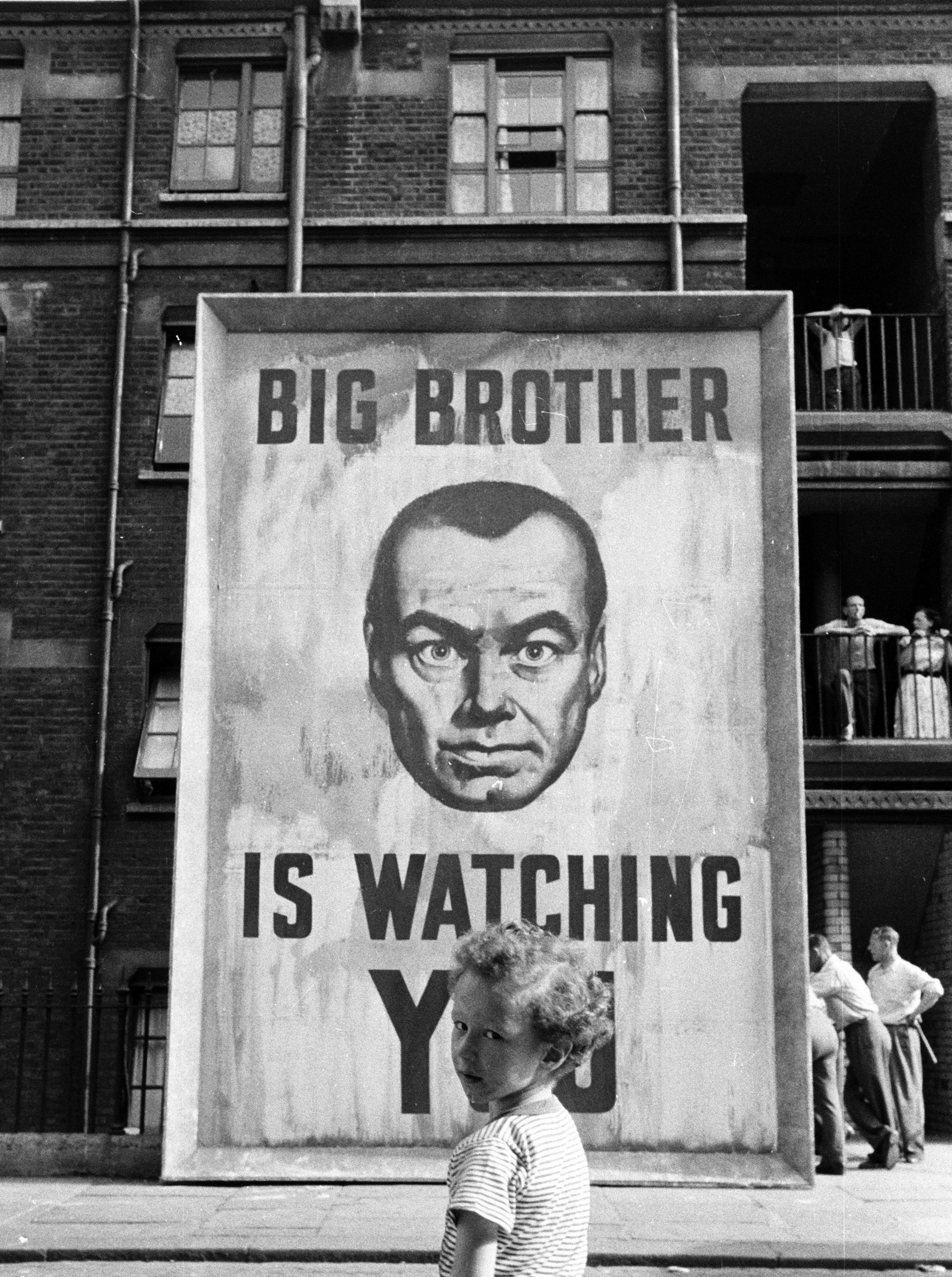
Orwell’s Big Brother is like a god. He is apparently omnipotent but no one in the novel has actually seen him and it looks as if he will never die. Many dystopian leaders have similarly omniscient powers. One of the most chilling is the three-yearold Anthony, in Jerome Bixby’s ‘It’s a Good Life’ (1953), who can read thoughts and work miracles. If little Anthony thinks you’re happy and good, he smiles benignly, if not he strikes you dead. No wonder everyone is afraid of him. Anthony is a very basic sort of god, with a primitive and brutal sense of right and wrong. You have to tell him you love him, and placate him with worship, even at his most cruel. Quite like Big Brother in fact. In dystopian regimes, God may ostensibly be dead, but there is usually someone around to fill that God-shaped hole.
An arbitrary and vindictive God may lie behind the ghastly ritual of Shirley Jackson’s ‘The Lottery’ (1948). But there is no need of Him. Jackson’s point, flawlessly and concisely made, is that so much of religion, or politics for that matter, needs only human cowardice and inertia to produce a perfect dystopian result. Jackson’s story shows how useful scapegoats are to keep human beings in order and share the guilt around. A scapegoat is something or someone blamed for the sins of others. In the story, an innocent victim is identified by lottery. He or she is communally stoned to death, supposedly to ensure the prosperity of the whole community. Then life proceeds with no questions asked. It requires no more than the dystopian tyrant’s greatest asset, the human tendency to conform and keep out of trouble, rather than agitate or complain. ‘The Lottery’ is written in the style of a community journalist, keen to get in all the distinctive local features.
Something similar happens in Ursula K. Le Guin’s fable ‘The Ones Who Walk Away from Omelas’ (1973), set in a legendary city where everyone’s happiness depends on persecuting one innocent child, as if Christ’s agony on the cross were prolonged indefinitely. Only a few have the courage to walk away. No one walks away from Jackson’s stoning, or the participative slaughters (‘Particicutions’) in The Handmaid’s Tale. The reworking of attitudes to religious rites in these stories may reflect the way Fascist and Communist leaders, who were supplanting the faiths that had heretofore controlled human destiny, began to exert God-like power over whole populations after the First World War.
Too many proles
Dystopia is good at getting rid of unwanted individuals: it is the genre of genocide. In ‘The Lottery’, the victims are crunched out one by one. In more ambitious dystopian texts, the sacrifice required can grow to thousands, or even millions. Nineteen Eighty-Four chooses attritional warfare on distant fronts, while The Handmaid’s Tale invites participation in exemplary executions. In Philip K. Dick’s novella The Unteleported Man (1968), the less productive members of the community (the young, the idealistic, the unattached) are persuaded to start again with a few acres and a few sheep on a recently discovered planet orbiting a distant star. They’re told by the admen it would be like reclaiming the Wild West, all over again. But no one is ever teleported back. There’s a grim scene in which a would-be teleportee is asked to strip by Teutonic doctors and given a preparatory shower, suggesting a one-way trip to Nazi-style gas chambers.
As it turns out, it isn’t quite as bad as that. After 15 minutes in teleportation the victims rematerialise at a forced labour camp. ‘It’s work camps,’ a rebel girl explains. ‘The Soviet, not the Third Reich, model. Forced Labour.’ So the solution to over-population is grimly utilitarian: to work the would-be emigrants to death, making the new Big Brother, Big Business, a tidy profit out of them in the process. As always Dick writes up the contexts of technology in glossy detail, while profoundly distrusting its power. Dystopian genocide, as in The Unteleported Man and Nineteen Eighty-Four, often resembles Stalin’s famines, purges and labour camps of the 1930s and 40s, with an accompanying bureaucracy modelled on the meticulous accounting of the Nazi Holocaust.
Mr Nice Guy
In Orwell’s Nineteen Eighty-Four, you are taught to love Big Brother through torture in Room 101. Aldous Huxley always claimed that Orwell’s jackboot-in-the-face view of history was arbitrary and inefficient, that ‘the ruling oligarchy will find less arduous and wasteful ways of governing and of satisfying its lust for power’ (letter to Orwell 1949). In Huxley’s 1932 novel Brave New World, he describes some of those easier and more efficient ways to control the masses. People, he claims, will do anything for toys and treats and can be easily and painlessly trained to eat out of the dictator’s hand. Huxley is less interested in the rise of Fascism or Stalin’s famines, more in benign (and very popular) features of the 1930s: the silver screen, mass production and the Americanisation of culture via the burgeoning Disney Empire.
In Huxley’s wake appeared a lot of cosy dystopias. A good example of such a soft regime is that in John Wyndham’s ‘Consider her Ways’ (1956), where a drugged woman wakes up in a distant future. All she needs to do is reproduce asexually — men seem to have died off. Her existence is in some ways antlike, rigidly hierarchical, as so often in feminist dystopias, but Wyndham’s creepier point is that these women are living lives effectively very like those of a 1950s housewife, super-conscious of domesticity, pampered and petted, but often obsessed with the overriding purpose of breeding. Wyndham’s prose is tuned to the importance of domestic detail, the story being mostly narrated in the first person from the point of view of the 1950s woman who has woken up in this strange world.
Alternative pasts
Nineteen Eighty-Four is not unusual in showing how easily the past may be falsified, and thus apparently altered. If history lives only in the pages of the party newspaper, then it can be changed to suit every new development, or just at whim. It can thus never be stabilised. This has led to a subgenre of dystopian writings that deal with history as a series of paths not taken, or not taken yet. There are the counterfactual novels, in which nightmare outcomes of past conflicts are faithfully realised. In Ward Moore’s Bring the Jubilee (1953), the Confederates inflict misery by winning the US Civil War and becoming a Superpower to rival Nazi Germany. Something similar happens in Philip K. Dick’s The Man in the High Castle (1962), recently a mini-series hit for Amazon where, after the Allies lose the Second World War, the United States is divided into a Japanese Pacific territory and German Eastern States.
As alternative pasts are realised, the concept of history itself, and therefore the authority of historical records, becomes fragile. This regularly happened in the Communist bloc, as discredited leaders were airbrushed out of old photographs. In The Handmaid’s Tale revisionist academics bicker long after the major events of the novel over whether Offred’s manuscript can be trusted, or whether there ever was a Handmaid rebellion at all. In Ray Bradbury’s ‘A Sound of Thunder’ (1952), tiny changes far in the past decide between a favourable outcome (democracy) and a less desirable one (Fascism). The story imagines a theme park back in the Cretaceous period. Wellheeled time travellers can go there and shoot a dinosaur, as long as they keep to a levitated walkway and always hit the designated target beast, which is about to die anyway. Unluckily (but inevitably) someone clumsily treads on a butterfly during a brief excursion from the walkway, and the result in our time, millions of years later, is the reversal of the result of a keenly contested presidential election. The story has given rise to the term ‘butterfly effect’ to describe the unintended consequences of modest human intervention in the cosmos.
Rule of the boffins
Bradbury’s dinosaur walkway was dreamed up by a scientist with more brains than sense. He is a version of the mad scientist, a stereotype present at the beginning of literary dystopia, as Frankenstein testifies. Stevenson’s Dr Jekyll and Wells’ Dr Moreau are also well-known versions of the type. In dystopia, when social systems have broken down, the resulting underclass tends to look to the technical expert for inspiration, as in the ‘cyberpunk’ novels of William Gibson and Pat Cadigan. In one of the shortest dystopian stories, Roald Dahl’s ‘In the Ruins’ (1964), a doctor, minus white coat, continues to know best and exert his threadbare authority in the post-apocalypse world. The four-year-old girl trusts the doctor, as most of us do. He amputates his own leg, gives some to the girl to eat, and tells her she must pay it back later. Welcome to medically approved cannibalism.
Tom Godwin’s ‘The Cold Equations’ (1954) posits a world in which the scientists have calibrated everything to the microgram. Calculation has crushed the possibility of tempering justice with mercy. Everyone is better than good in this story, which reads like the timid Young Adult fiction of the time, all motives squeaky clean. The 18-year-old schoolgirl wants to visit her brother on a distant star-system, so she stows away on a spaceship run by a sensitive astronaut with excellent pastoral skills. He is also doing vital work: carrying medical supplies in a time of epidemic. He explores all the alternatives, feels pity for her, then shoots her out via the airlock into the depths of space, without spacesuit or oxygen. That is the dictate of the ‘cold equations’, the rule of science in an age that split the atom regardless of military consequences: exactly calculated payload, no room for sentiment, no thoughts of collateral damage. In a world without waste, a generous human impulse means you’re wasted. This is the consummation of the vision of efficiency cherished by technicians and accountants, and where science, not Big Brother, is the only God.
Constructing dystopias
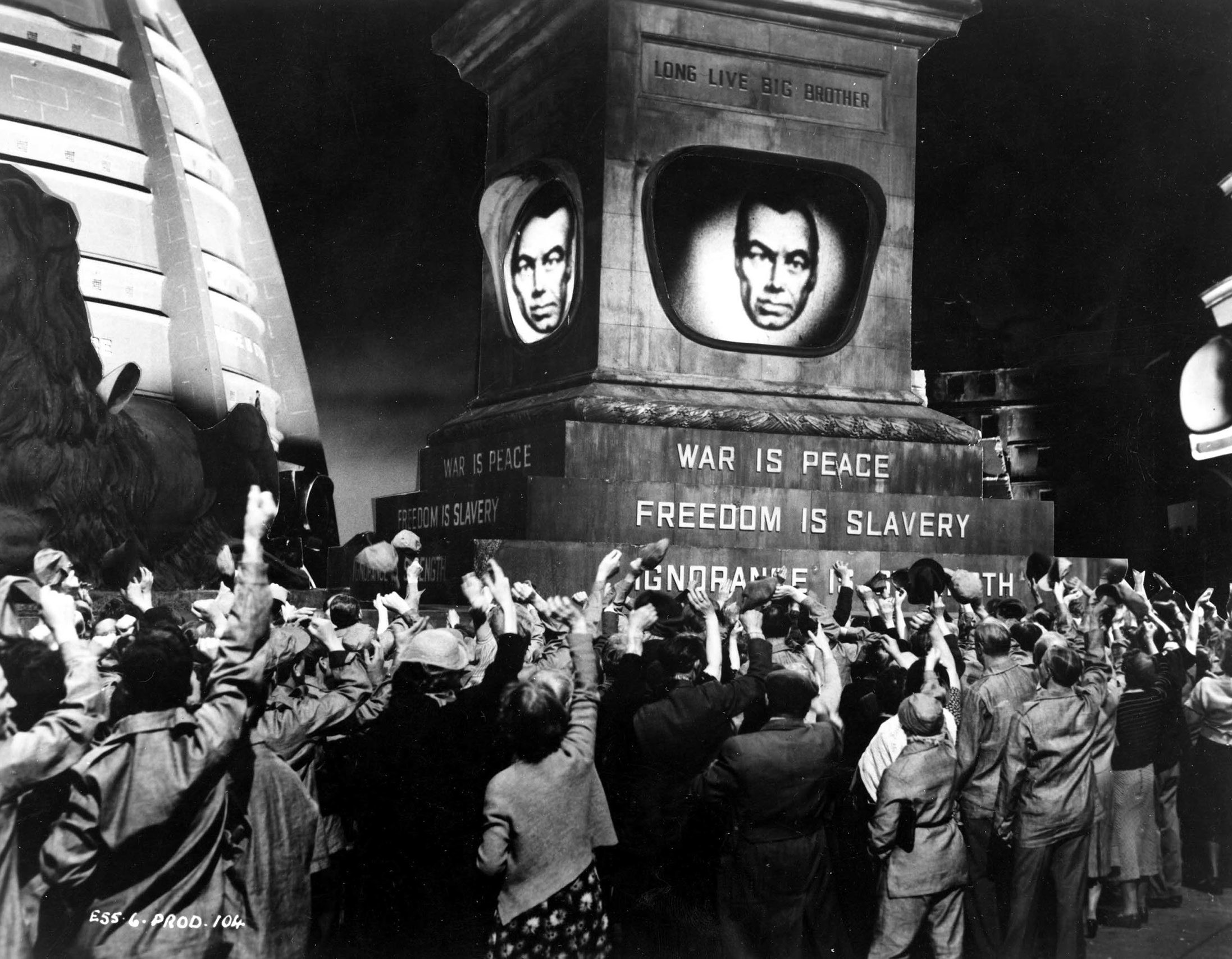
Many of the elements discussed above will be familiar from novels such as Nineteen Eighty-Four, Brave New World or The Handmaid’s Tale. Totalitarian regimes in dystopia become theocracies (rule according to God’s law), recalling repressive Caliphates in Islam or efforts to police thought in Christianity, such as the Spanish Inquisition. Rituals, such as Atwood’s ‘Particicution’ or Orwell’s ‘Two Minutes Hate’, are often modelled on religious rites. Huge bureaucracies control population by means of unnecessary wars, in Orwell, or enforced exile, as in Brave New World. That novel is a model for all dystopias that offer carrots rather than sticks as a means of social conditioning, often by advertising the ‘must have’ qualities of the American consumer lifestyle.
Dystopian regimes also like to rewrite history so that it conforms to their own policies and concerns, as Winston Smith tampers with the public record, or Offred’s account of Gilead must fight to be heard by future generations through a smokescreen of propaganda. And as Orwell pointed out, in the battle to turn civilisation into dystopia, never trust the scientist: ‘The physicists of half a dozen great nations,’ he wrote in 1945, ‘all feverishly and secretly working away at the atomic bomb, are a demonstration of this’ (Orwell 1970, p. 12). The great causes of literary dystopia, it seems, are exaggerated respect for science, rather than the humanities, the abolition of hard-won human freedoms, like those of first-and second-wave feminism, and the disappearance, or more accurately the human appropriation, of God-like powers. Some regimes give you the opportunity to ‘walk away’ from the disgusting rituals that result. Others do not.
PRACTICE EXAM QUESTION
‘Writers of dystopian fiction warn about the present more than the future.’
By comparing The Handmaid’s Tale with at least one text prescribed for this topic, explore how far you agree with this view.
(30 marks, OCR-style)
EnglishReviewExtras
Get guidance for your answer at www.hoddereducation.co.uk/englishreviewextras
RESOURCES
Aldous Huxley’s letter to George Orwell (1949): www.tinyurl.com/7oucstx
Orwell, S. and Angus I. (eds) (1970) The Collected Essays, Journalism and Letters of George Orwell: Volume 4, In Front of Your Nose 1945–50, Penguin.