
Deprecated: mb_convert_encoding(): Handling HTML entities via mbstring is deprecated; use htmlspecialchars, htmlentities, or mb_encode_numericentity/mb_decode_numericentity instead in /mnt/storage/stage/builds/pugpig-site-subs-server/latest-1.2.0-1753096337.768322/pugpig-site-subs/content.php on line 225
Lost in Translations
Luke McBratney considers the practical, philosophical and political complexities of how Friel presents language in the play
Exam links
AQA (A): Paper 1 Modern times
In her 2018 Booker prize-winning novel Milkman, Anna Burns explores the deep-seated divisions between those with an Irish and those with a British identity during the Northern Ireland conflict (1969–98):
As regards this psycho-political atmosphere with its rules of allegiance, of tribal identification, of what was allowed and not allowed, matters didn’t stop at ‘their names’ and ‘our names’, at ‘us’ and ‘them’ … Other issues had similar directives as well … There was food and drink. The right butter. The wrong butter. The tea of allegiance. The tea of betrayal … Placenames. What school you went to … How you pronounced your ‘haitch’ or your ‘aitch’. (Burns 2018, p. 25)
Beneath the comedy of Burns’ list lies the point that, during the conflict, people had to mind their language and keep to the cultural choices of their tribe: ‘There was the fact that you created a political statement everywhere you went and with everything you did, even if you didn’t want to’ (Burns, p. 25). This article explores how Translations presents languages and the cultures they embody, asking whether it offers more than ‘a threnody [lament] on the death of the Irish language’ (Friel in Coult 2003, p. 88) and whether its portrayal of language ultimately fuels anti-British feelings.
A rich language
Translations is a love story in which the primary object of affection is the Irish language. This love is shared by playwright, most of the characters and many audiences. Indeed, in an interview, Friel commented that the play ‘should have been written in Irish’ (Delaney 2000, p. 146). But, if it were to have been, virtually no one would understand it. Ireland’s Central Statistics Office notes that today only 1.7% of people use Irish daily. This decline is nothing new. In 1911, 82% spoke no Irish, and despite initiatives in the Republic of Ireland, such as compulsory secondary education in the language since 1929, proficiency in Irish remains the preserve of only a small proportion of the population.
Friel’s way of solving this problem is to make the audience members think they are listening to Irish: the Irish characters use Irish accents and Hiberno-English (the variety of English spoken in Ireland). This, combined with the English characters speaking Standard English with marked English accents, creates the illusion of two languages being spoken onstage. It also evokes a linguistic divide, where Irish sounds more beautiful and is culturally superior to its linguistic neighbour. Indeed, Irish is given the status of Ancient Greek or Latin. Jimmy Jack mentions Irish mythological figures in the same breath as Greek ones and the hedge schoolmaster Hugh dismisses English with comments like ‘our own culture and the classical tongues make a happier conjugation’.
For the purposes of commerce
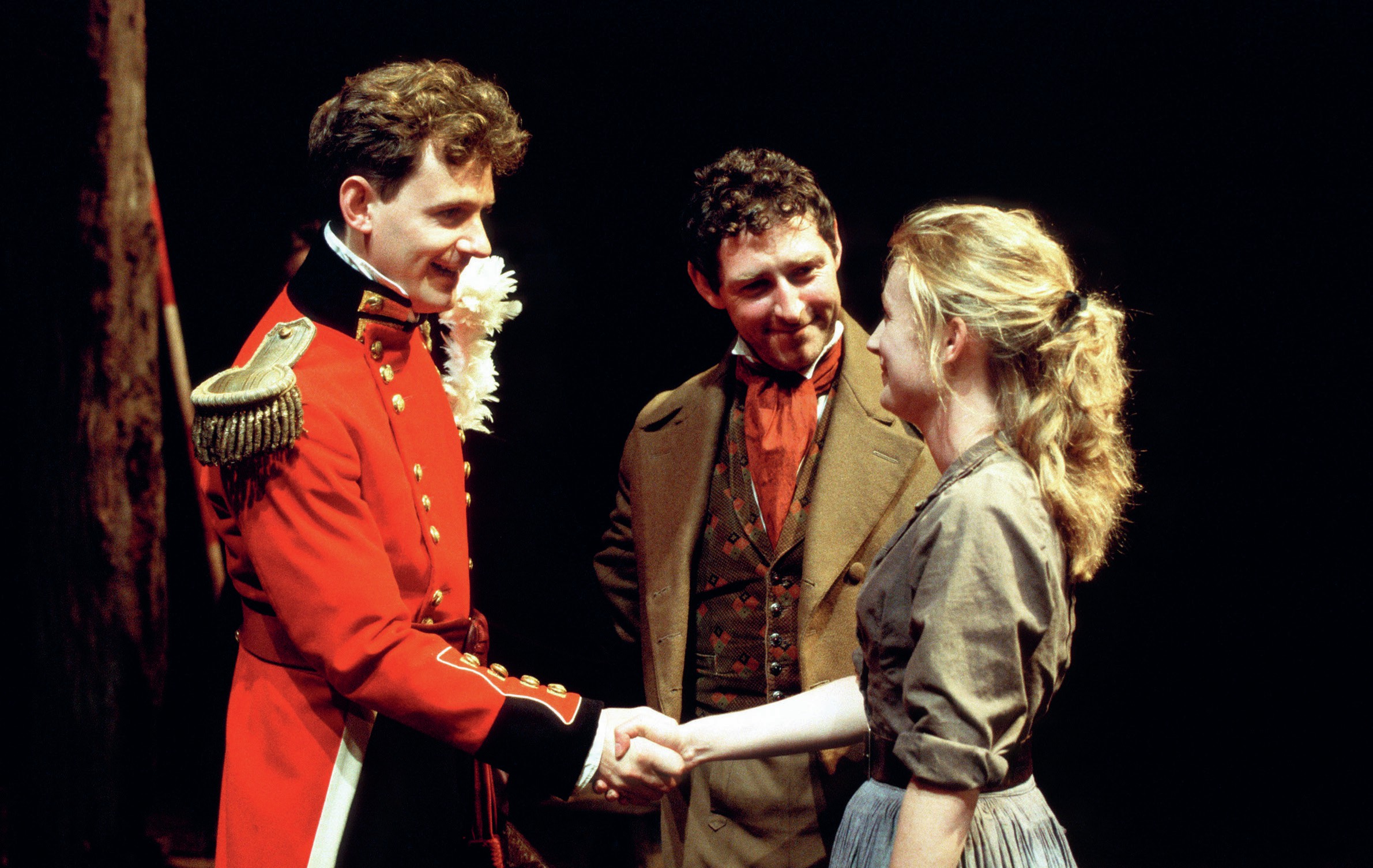
To elevate Irish, Friel appears to denigrate English. For example, Maire, who wants to learn English and emigrate, displays her only words of English: ‘In Norfolk we besport ourselves around the maypole.’ This sentence — with its archaic verb and sense of English culture being represented by a quaint tradition of maypole dancing — raises laughs in the theatre. The idea of it being useful to the ambitious young woman is amusing, as is the dramatic irony — the characters onstage don’t understand her words, but the audience does. English also generates crude physical humour when Jimmy Jack then displays his only word of English — ‘Bos-som’ — accompanied with a gesture.
Further comedy at the expense of English is generated when the Royal Engineers arrive. The captain, whose lance-like name is redolent of precision and war, cannot find the correct register to communicate with the Irish people. When he speaks in a haltingly simple manner, he provokes onstage ‘sniggers’. Then, as his explanations become complex and wordy, humour is derived from Owen’s succinct translations. In addition to such comical examples, Friel elevates the status of Irish by having the polyglot Hugh mock the monoglot Lancey about the limitations of his language: he says that English ‘couldn’t really express us’, as it is not poetic, but ‘particularly suited’ to ‘the purposes of commerce’.
Philosophies of language
Yet to label Friel’s exploration of language as wholly anti-British would be an oversimplification. For example, when Yolland speaks of Wordsworth, we are surely meant to recognise that English is suited to more than transactional utterances, and perhaps when Hugh dismisses Romantic poetry with comments like ‘I’m afraid we’re not familiar with your literature, Lieutenant. We feel closer to the warm Mediterranean’, Friel expects us to acknowledge that Hugh’s pronouncements sometimes display ignorance rather than erudition. In addition, the character is used as a vehicle to develop complex philosophical ideas about the nature of language and translation, some of which criticise Irish implicitly.

Friel derived these ideas from George Steiner’s After Babel (1975, 1998), an ambitious study of language and translation. He even included an epigraph from this book in the programme notes to the original production of Translations: ‘Man acts as though he were the shaper and master of language, while in fact language remains the master of man’, Martin Heidegger (Steiner 1998, p. v). This implies that the play should be viewed in the context of academic discourse on language as much as in political contexts. At the heart of Act 1 Scene 2, the discussion shifts from the congruence of Irish and the Classics to critical comments about Irish culture and general linguistic truths.
Embedded quotes
In some of Hugh’s most celebrated statements are embedded quotations from Steiner. Consider the following examples (I embolden the parts that are common to both After Babel and Translations). First, the idea that Irish cultural and linguistic richness compensate for material poverty: ‘Often, cultures seem to expend on their vocabulary and syntax energies and ostentations entirely lacking in their material lives’ (Steiner 1998, p. 57). And second, the idea that language can lose its usefulness and become stuck in the past: ‘Instead of acting as a living membrane, grammar and vocabulary become a barrier to new feeling. A civilisation is imprisoned in a linguistic contour which no longer matches, or matches only at certain ritual, arbitrary points, the changing landscape of fact’ (Steiner 1998, p. 22). This second example is given additional weight as it is the last word in the discussion and the conclusion of Hugh’s exit speech.
Harmonious communication
The philosophical dimensions of language are not only expressed through Hugh. They emerge as Owen and Yolland translate local place-names from Irish into English. Friel’s ideas about language are given a dramatic arc in Act 2 Scene 1, beginning seriously with communication difficulties and ending comically with idealised communication. Steiner’s conception of language as a means to exclude is voiced by Yolland. Steiner describes how a range of historical and political undertones are embedded in ordinary French expressions —a ‘“chord” of associations which anyone acquiring the language from outside will never fully master’ (Steiner 1998, p. 180). Yolland expresses this idea memorably:
Even if I did speak Irish I’d always be an outsider here, wouldn’t I? I may learn the password, but the language of the tribe will always elude me, won’t it? The private core will always be… hermetic, won’t it? (Act 2 Scene 1)
Note how Friel contrasts the simple ‘password’ with the complex ‘language’ and ‘an outsider’ with ‘the tribe’. The linguistic zone into which Yolland may never enter is triple locked: it is ‘private’, it is a ‘core’ — not only a central part, but perhaps the essence of the culture — and it is ‘hermetic’, sealed, private — even sacred. Friel has transformed the objectivity of academic discourse into immediate, passionate and dramatic questionings. By the scene’s climax, fuelled by high spirits, good humour and poteen, Yolland and Owen have moved from Steiner’s model of language as forming barriers to one without barriers. Their excited observations reflect Steiner’s description of the fabled Ur-Sprache.
Ur-Sprache
This is the ancient language (or protolanguage) that existed before different languages evolved: one that expressed everything perfectly and was understood by all. It might be thought of as the original language referred to in the Bible that enabled hubristic humans to cooperate and build the massive Tower of Babel, which would enable them to reach heaven. To punish this, God scattered them, making them speak in different languages so that they could not work together to rise against him again (see the Bible, Genesis 11:1–9). The Ur-Sprache was kind of linguistic Garden of Eden, when language was perfect and, as Steiner puts it, ‘words and objects dovetailed exactly’ (Steiner 1998, p. 61). The excitement at the power and potential of such language is rendered dramatically by Friel through Yolland and Owen’s harmonious and elated dialogue. And perhaps this, in turn, might suggest that with purity of linguistic communication can come harmony in Anglo–Irish relations:
YOLLAND: ………..Welcome to Eden!
OWEN: Eden’s right! We name a thing and — bang! — it leaps into existence!
YOLLAND: Each name a perfect equation with its roots. OWEN: A perfect congruence with its reality. (Act 2 Scene 1)
Communication breakdown
While it is easy to explore the idyllic possibilities of language and, by extension, the possibilities of real communication and companionship between the British and Irish when we study the play, it is difficult to escape pessimism about the Irish language and Anglo–Irish relationships when we see the play performed. The mood of optimism crashes into despair after the disappearance of Yolland in Act 3. Communication breaks down in Act 3, and it could be argued that Friel blames Britain for this and for the consequent near-destruction of the Irish language and culture. He prepares the audience for tragedy through elements of production. The lighting darkens, ‘It is raining’ and Owen translates alone — a task for which he has ‘neither concentration nor interest’. Irish place-names no longer appeal — Owen calls the Murren a ‘very unattractive name’.
Comic relief
Even comic relief is underscored by a sinister subtext. Bridget and Doalty while ‘brimming over with excitement and gossip and brio’, report the actions of the British army searching for Yolland comically: Doalty recounts Hugh shouting: ‘“Visigoths! Huns! Vandals!”’ By using bywords for ruthless, destructive invaders, Friel evokes the ravaging effects of British rule. The exclamation ‘Huns!’ is interesting too. Not only is ‘Huns’ a term for Nazis or invaders of Europe in the fourth and fifth centuries, more pointedly, ‘Hun’ is a pejorative name for a Protestant in Northern Ireland. Even the play’s final use of comic relief has a tragic undertow. Jimmy Jack translates the Greek term ‘exogamein’ meaning ‘to marry outside the tribe’, the consequence of which is ‘both sides get very angry’. Yolland, owing to his involvement with Maire, is most likely a fatal victim of such anger, and Irish audiences are reminded of couples in ‘mixed marriages’, who in extreme cases during the conflict had their homes burned down or were targeted by gunmen.
Turning to tragedy
The translations scene with Lancey provokes ill-feeling towards the British in a direct and stirring way. The comedy of translation in Act 1 has turned to tragedy, with the former go-between, Owen, repudiating his work for the British and searching for those who will fight against Britain. Even the quieter reflection on British occupation in the play’s final speech provokes antipathy. Hugh translates part of Book 1 from Virgil’s Aeneid, recounting the fall of Carthage and the rise of Rome. It is difficult for an audience to fully grasp the literal meaning of this speech — especially given the false start, its unfinished nature and the fading of the lights as it peters out. Yet it carries a palpable emotional meaning. The people ‘springing up…to overthrow’ might remind audiences of republicans rising against the British. Or the cultured ‘ancient city’ of Carthage might suggest Ireland and Irish culture, with the people ‘of broad realms and proud in war’ who come to destroy it representing the British. Either way, Friel ends the play with a swelling of anti-British sentiment.
Even-handedness
Yet, away from the dramatic experience, the text demonstrates elements of even-handedness. Yolland is presented as a likeable Englishman, and it is easy to deconstruct the simplistic English vs Irish binarism. As Maire reminds us, English was seen as necessary for progress by many, including the republican leader, Daniel O’Connell. Even the ‘Irish’ in the play is less Irish than it seems. Friel’s Hiberno–English contains many features of the other tradition of language in Northern Ireland, the one associated with Protestant settlers: Ulster–Scots. For example, dialect words like ‘wee’ (for little) and ‘eejit’ (for idiot) are from Scotland.
Relevant today
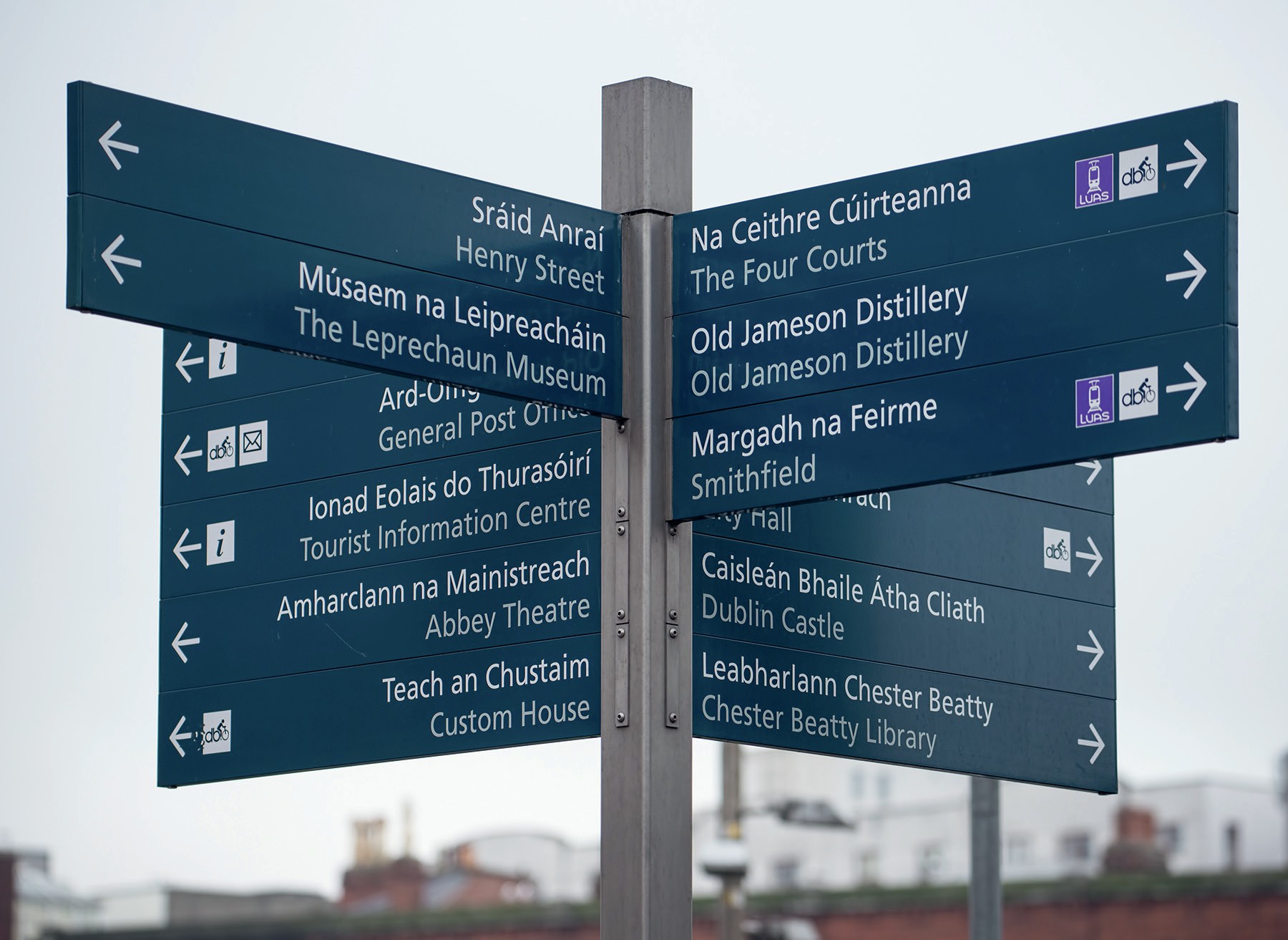
Friel’s play contains a rich plurality of language, which is very relevant today. The Northern Ireland Assembly was suspended for two years, partly owing to disagreements over the Irish Language Act, which promotes the Irish language. This Act also makes provision for Ulster–Scots. But, for those studying Friel’s play, perhaps the most interesting aspect of the act is its requirement — resembling Translations in reverse — that signage in Northern Ireland be changed to include Irish. Will those with a British identity in Northern Ireland be able, like Hugh, to adapt and say: ‘We must learn where we live. We must learn to make them our own. We must make them our new home’; or might they feel, as Yolland did, that ‘something is being eroded’?
RESOURCES
Burns, A. (2018) Milkman, Faber and Faber. Coult, T. (2003) About Friel: The Playwright and His Work, Faber.
Delaney, P. (ed.) (2000) Brian Friel in Conversation, The University of Michigan Press.
Steiner, G. (1975, 1998) After Babel: Aspects of Language and
Translation, Oxford University Press.