
Deprecated: mb_convert_encoding(): Handling HTML entities via mbstring is deprecated; use htmlspecialchars, htmlentities, or mb_encode_numericentity/mb_decode_numericentity instead in /mnt/storage/stage/builds/pugpig-site-subs-server/latest-1.2.0-1753096337.768322/pugpig-site-subs/content.php on line 225
Chasing the American Dream The Great Gatsby
Katie McGettigan explores different understandings of this American ideal in the interwar context and relates these to F. Scott Fitzgerald’s novel
Exam links
AQA (A): Paper 1 Love through the ages
AQA (B): Paper 1 Tragedy
OCR: Paper 2 American literature 1880–1940
At the close of F. Scott Fitzgerald’s The Great Gatsby (1925), the narrator, Nick Carraway, contemplates two different dreams. The first is the dream of a vast and unspoilt new world, ‘the last and the greatest of all human dreams’ (Ch. 9) held by Dutch sailors who settled the territory that would become the United States. The second is Jay Gatsby’s dream of winning back Daisy Buchanan, a dream that ‘must have seemed so close that he could hardly fail to grasp it’ (Ch. 9) when he moved into a house across the water from hers. Gatsby’s ‘wonder’ at the green light on Daisy’s dock that symbolises his dream echoes the ‘fresh, green breast of the new world’ meeting the sailors’ ‘capacity for wonder’.
Illusory
But both dreams are ultimately illusory. The America settled by white Europeans was not an uninhabited land of natural abundance. Settlement was a struggle for early colonists and displaced indigenous peoples. Similarly, Gatsby fails to repeat the past. Daisy remains married to her boorish and cruel, upper-class husband, Tom Buchanan, and Gatsby ends his quest for Daisy’s love lying dead in his own swimming pool.
By associating Gatsby’s story with the myth of America itself, Fitzgerald encourages readers to approach The Great Gatsby not just as one man’s story, but as a parable about the promises and failings of the American Dream. But the American Dream was — and remains —a term that is hard to define. It encompasses a series of sometimes contradictory ideals, rather than a single goal. As such, we must consider the complex history of the phrase before applying it to Fitzgerald’s novel, and explore how Gatsby engages with competing definitions of the Dream.
Defining the American Dream
No one is sure who coined the phrase ‘American Dream’. It was used in the nineteenth century to refer to the political aims of the United States. Only in the early twentieth century did writers begin to use ‘American Dream’ to refer to the hopes and ambitions of Americans, and they did so inconsistently.
1900
Literary critic Sarah Churchwell (2018, p. 21) cites a writer in the New York Post from 1900 who feared that small numbers of very wealthy people might start being treated differently from the rest of the population, creating ‘the end of the American dream’. This writer suggests that individual wealth would be incompatible with the promise, in America’s Declaration of Independence (1776), that ‘all men are created equal’ and have equal rights to ‘life, liberty and the pursuit of happiness’.
1917
In contrast, the American novel Susan Lenox: Her Fall and Rise (1917), written by David Graham Phillips and made into a 1931 film starring Greta Garbo and Clark Gable, refers to ‘the possible rise of fortune that is the universal American dream’, materialising this rise in the heroine’s surroundings: a restaurant with ‘the softened lights, the thick carpets, the quiet elegance and comfort of the furniture’ (Vol. 1, Ch. 23). Here, the dream refers to an increase in individual wealth, not collective prosperity. But this dream is a facade. Susan’s visit to the luxurious restaurant only emphasises the precariousness of her everyday life, showing how the American Dream is often evoked alongside fears of falling in status and wealth.
1931
The phrase ‘American Dream’ achieved real traction in 1931, when the popular historian James Truslow Adams argued, in his Preface to The Epic of America, that American history was defined by
that American dream of a better, richer, and happier life for all our citizens of every rank, which is the greatest contribution we have as yet made to the thought and welfare of the world. (Preface, p. viii)
While Adams framed the Dream as abundance for all, rather than individual success, there are still conflicts in his definition. The goals of a ‘better, richer, and happier life’ might not be compatible with one another. Although Adams claimed the Dream belongs to ‘citizens of every rank’, not everyone had an equal chance to be a US citizen. New immigration laws passed in the 1920s banned immigration from Asia, and introduced quotas that favoured white, northern European countries.
Adams’ book was published in 1931, so it did not influence The Great Gatsby. But considered alongside the other sources above, it shows that the nature of the American Dream was a subject of debate when Fitzgerald wrote his novel. The American Dream sometimes referred to improving national prosperity, and sometimes to individuals gaining higher status in society and greater wealth — aims which could conflict with one another. It is these conflicts within the American Dream, rather than any one version of it, that The Great Gatsby explores.
Individual achievement
Through Gatsby’s rags-to-riches life story, Fitzgerald suggests that America offers unrivalled opportunities for individuals to rise. Nick describes Gatsby as displaying a ‘resourcefulness of movement that is so peculiarly American’ that meant that Gatsby was ‘never quite still’ (Ch. 4). Americans, Fitzgerald suggests, are constantly driving forwards towards new opportunities, like the frontier settlers of the nineteenth century.
However, The Great Gatsby does not fully celebrate these possibilities for individual advancement. Nick observes the American manner that Gatsby exemplifies comes from ‘the absence of lifting work or rigid sitting in youth, and, even more, with the formless grace of our nervous, sporadic games’ (Ch. 4). In other words, the spirit that drives forward American success does not come from honest hard work, but from ‘games’ that Nick presents as destabilising. Nick is describing American football, which became immensely popular at the turn of the twentieth century and which the novel associates, negatively, with Tom Buchanan’s brutishness and violence (Ch. 1).
While Nick is wrong about Gatsby’s idle youth, he is right that Gatsby’s wealth does not come from honest labour. As a bootlegger (a trader in alcohol during Prohibition), Gatsby’s money comes from a substance that is illegal, and that burns away into nothingness, or is consumed absolutely, leaving behind only hangovers — hardly a solid basis for prosperity. To return to Adams’ definition of the Dream, Gatsby is ‘richer’ but not necessarily ‘better’ or ‘happier’.
The meaning of greatness
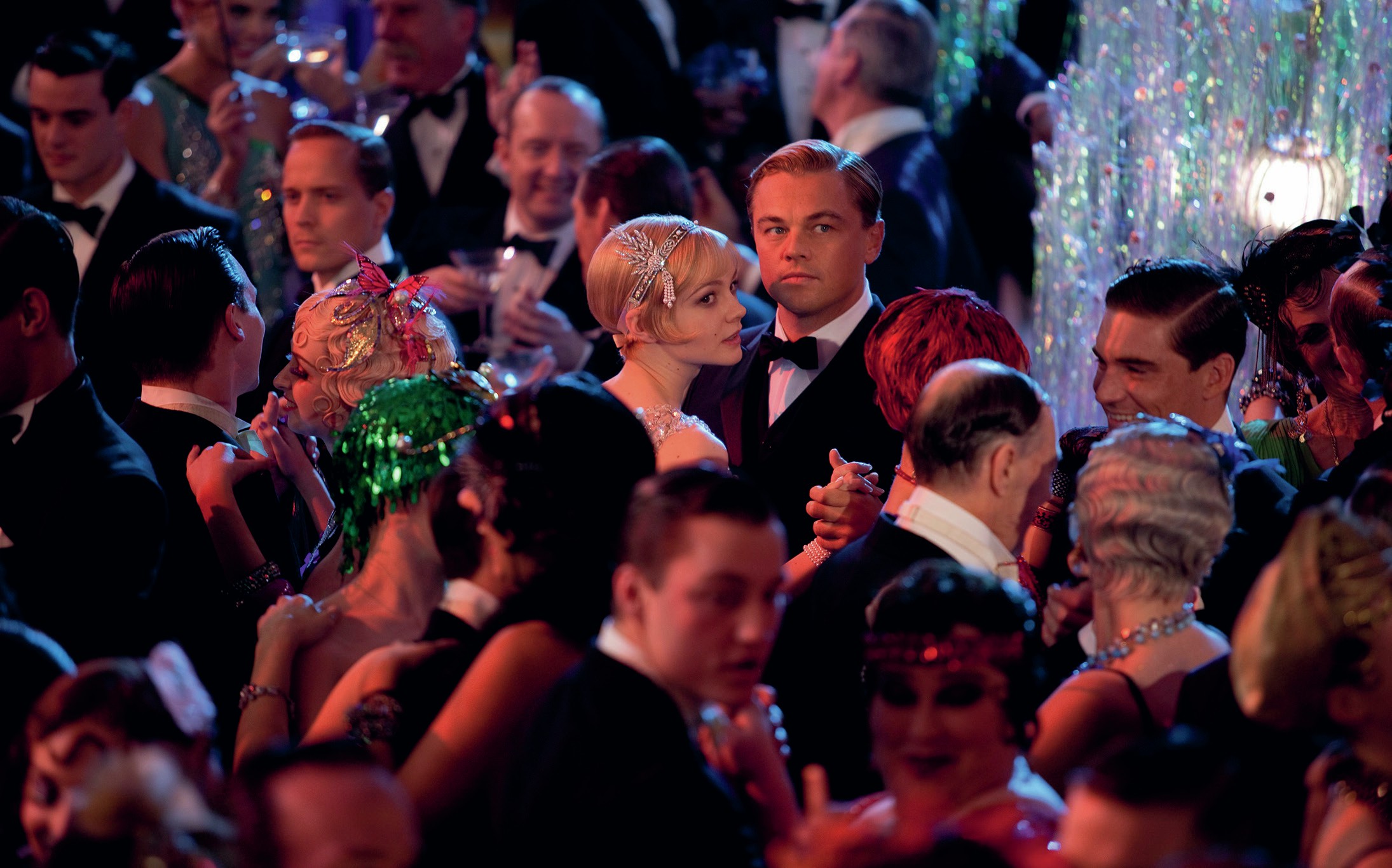
Gatsby achieves the American Dream of individual wealth, but does so through criminal activities. For Nick, these activities taint Gatsby’s rise, inviting us to consider whether the titular adjective — ‘Great’ — is meant sincerely or ironically. Gatsby’s party guests consider his wealth as the source of his greatness, but Nick’s snobbishness and antisemitism (he takes an instant dislike to Gatsby’s associate, Meyer Wolfsheim) mean that he finds Gatsby’s activities sordid. Fitzgerald, however, suggests that Gatsby’s trade in illegal alcohol is no worse than the activities of others looking to profit quickly in 1920s New York. For example, the Englishmen that Nick sees at Gatsby’s parties are trying to sell ‘bonds or insurance’, insubstantial commodities that exist on paper alone, ‘or automobiles’ (Ch. 3), which burn liquid into fumes and prove to be the source of the novel’s tragic climax.
The Great Gatsby also suggests that greatness comes from more than wealth and rank, and asks us to consider whether Gatsby has moral greatness. Gatsby’s activities are criminal, but his motivation — love for Daisy — is noble. Nick laments that this moral greatness goes unrecognised. After his death, Gatsby is unmourned by his supposed friends, who choose to avoid the taint of scandal rather than demonstrate the loyalty that Gatsby himself showed. However, by criticising Gatsby’s hangers-on, and claiming to recognise his friend’s true greatness, Nick can demonstrate his own worth. When reading The Great Gatsby, we need to remember that Nick is not an objective narrator, but instead is concerned with proving his own moral superiority, as well as memorialising his friend. Ultimately, the novel asks us to think not only about who is and is not ‘great’, but to reflect on the criteria by which we judge greatness, and the evidence that allows us to make those judgements.
Progress for all
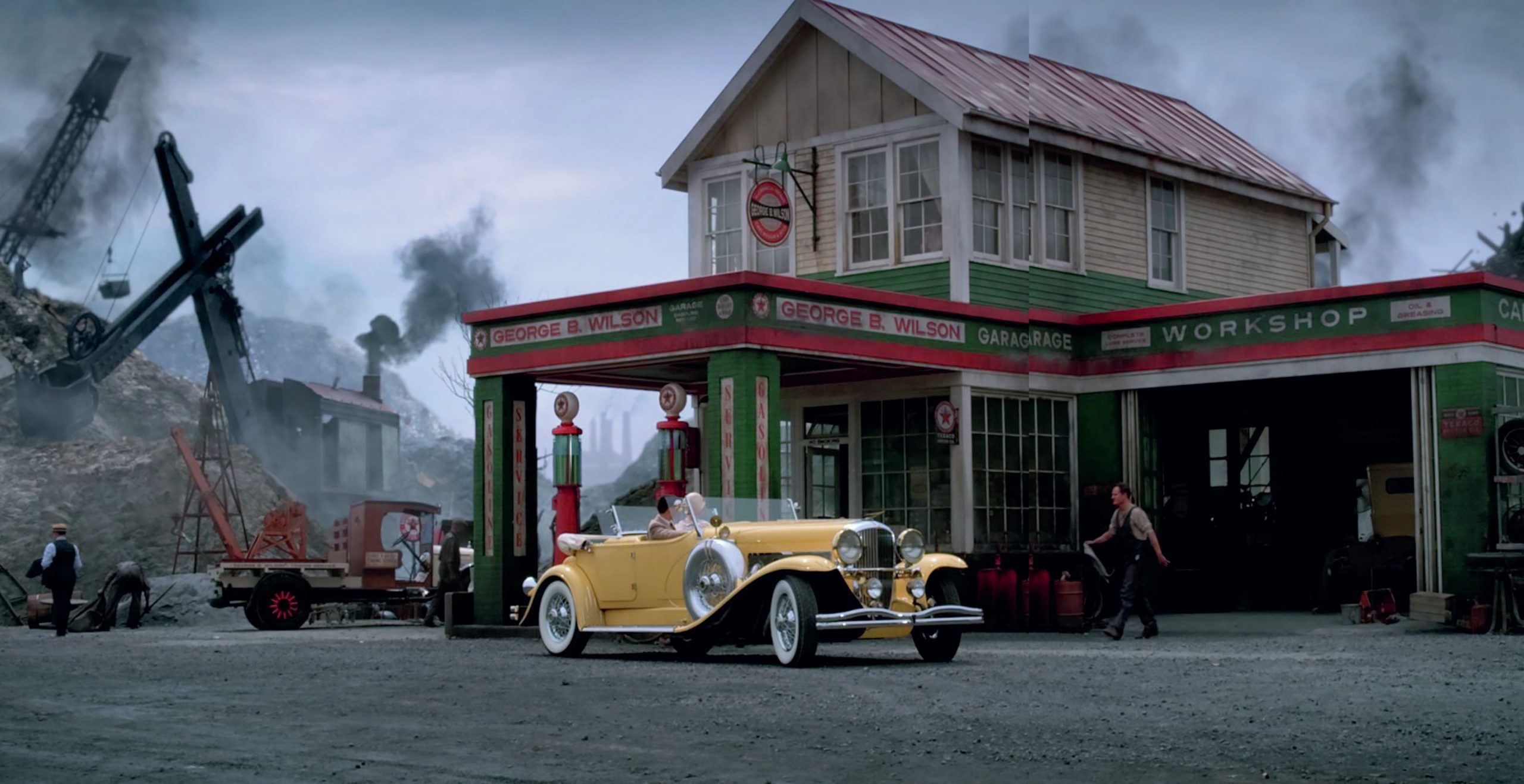
If Fitzgerald is sceptical that a rise in individual fortune is compatible with moral greatness, he is even more sceptical about the compatibility of individual riches and a good standard of living for all. Fitzgerald juxtaposes extreme wealth and opportunity with extreme poverty in the love triangle between Tom Buchanan, his mistress Myrtle Wilson, and her husband, and in the settings of West and East Egg and the ‘valley of ashes’. The description of Gatsby’s house that opens Chapter 3 emphasises the forward motion of the motorboats that ‘slit the waters’ and the motor vehicle that ‘scampered’ to meet guests. The ease and comfort afforded by these new technologies are only available to the wealthy. Fitzgerald also associates Gatsby’s house with light by comparing his guests to ‘moths’. However, because moths are hurt when drawn too close to light, this metaphor inverts the usually positive associations of light, giving a sense of foreboding (Ch. 3).
Nevertheless, Gatsby’s house is a pleasant contrast with the ashes, where motion stops altogether as ‘a line of gray cars crawls along an invisible track, gives out a ghastly creak, and comes to rest’ (Ch. 2). There is no technological progress for those, like the Wilsons, who live here. Indeed, for Myrtle, the thrill of the motor vehicle turns to tragedy as she is killed by Daisy, driving Gatsby’s car.
Dichotomy
By placing these two descriptions of settings at the openings of consecutive chapters, Fitzgerald emphasises the dichotomy between them, but also their interdependence. The residents of the Eggs pass through the ashes to get to New York, as do the supplies for Gatsby’s lavish parties. As the home of his mistress, Myrtle Wilson, the ashes are also the source of Tom’s sexual satisfaction. Yet the affluence of the Eggs never flows outwards, and the Wilsons’ dealings with their wealthy neighbours lead to tragedy while Tom and Daisy’s old money keeps them above such consequences. As such, Fitzgerald not only denies the possibility of prosperity for all, but suggests that extremes of individual wealth enable a carelessness and callousness that damages society as a whole.
Fears of social mobility
While some early twentieth-century writers wanted a nation in which all could prosper, Tom Buchanan is fearful of uninhibited social mobility. He believes that the rise of certain groups will bring about the fall of others. Tom asks Nick if he has read ‘“The Rise of the Colored Empires” by this man Goddard’ (Ch. 1), a fictional book based on The Rising Tide of Colour by Lothrop Stoddard (1920). A racist and eugenicist, Stoddard argued that white supremacy, which he saw as desirable, would collapse due to rising non-white populations, and he advocated further restrictions on non-white immigration to the US. Tom is similarly convinced of white supremacy, claiming that ‘Nordics’ like himself, Daisy and Nick, have produced ‘all the things that go to make civilisation’ (Ch. 1). Yet Tom remains fearful that allowing non-whites to access America, and its possibilities for prosperity, will upend this racial hierarchy. Fitzgerald therefore suggests that the prejudices of those who hold wealth and power are another barrier to a Dream of prosperity for all.
Irony
Matthew Teutsch (2018) argues there may be an irony to Tom’s claims of Nordic supremacy: Tom’s name. Buchanan suggests Scottish, not Nordic, ancestry. However, Gatsby’s original Germanic surname, Gatz, and his birth in North Dakota, a state with a high German population, suggest that he is of Nordic heritage, adding further irony. If success was racially determined, then Gatsby could rise to Tom’s level, but that does not happen. Teutsch notes that Tom ‘sees himself as a superior specimen, but in actuality, his superiority stems from “the advantage” he has received throughout his life’ (2018). In The Great Gatsby, inherited wealth and status assure future success —a depressing fact that undermines the American Dreams of individual rise, and of prosperity for all.
A dream of progress or return?
Historian Lawrence Samuel argues that the various meanings of the American Dream can be grouped together as ‘variations on […] its progressive, utopian character’ (2012, p. 6). The American Dream does initially seem to be about moving forwards and growing — as individuals or as a group — to be ‘better, richer, and happier’. However, as Churchwell observes, ‘the American Dream is usually imagined today as a nostalgic return to some golden past of national prosperity and harmony’ (2018, p. 30). The American Dream might best be described as a paradox, in which return is progress and we move forwards to go back, an idea captured in Donald Trump’s 2016 election promise to ‘Make America Great Again’.
It is this paradox in the American Dream that Gatsby’s own dream of Daisy best represents. Nick suggests that Gatsby’s green light symbolises ‘the orgastic future that year by year recedes before us’, offering the worrying premise that moving forwards actually leaves less space for progress, and more space to be occupied by pasts that cannot be changed. Yet, like other versions of the American Dream, returning to a nostalgically imagined past proves to be impossible, and striving towards this dream ends in tragedy. As The Great Gatsby’s famous final line suggests, the past can neither be repeated nor escaped: ‘So we beat on, boats against the current, borne back ceaselessly into the past’ (Ch. 9). American dreams of nostalgia, of individual progress, or of society’s development appear equally unlikely to come true.
PRACTICE EXAM QUESTION
Compare the ways in which unattainable love is presented in two texts you have studied.
Write about at least two poems in your response as well as the novel you have studied.
(25 marks, AQA-A style)
EnglishReviewExtras
Get guidance for your answer at www.hoddereducation.co.uk/englishreviewextras
RESOURCES
Adams, J. T. (1931) The Epic of America: www.tinyurl.com/t4pwz99
Buell, L. (2014) The Dream of the Great American Novel, Harvard University Press.
Churchwell, S. (2018) Behold, America: A History of America First and the American Dream, Bloomsbury.
Office of the Historian, ‘The Immigration Act of 1924 (The Johnson-Reed Act)’: www.tinyurl.com/qe2tnuw
Samuel, L. (2012) The American Dream: A Cultural History, Syracuse University Press.
Teutsch, M. (2018) ‘The Master Race? Xenophobia and Racism in F. Scott Fitzgerald’s The Great Gatsby’: www.tinyurl.com/r2s49pv
Thompson, M. (2015) ‘Why the American Dream Will Never Die,’ The Atlantic: www.tinyurl.com/vrbmx4v
ONLINE ARCHIVE
Relevant articles in past issues of ENGLISH REVIEW are listed below. Ask your teacher if your school subscribes to the ENGLISH REVIEW Online Archive.
Grindlay, L. (2016) ‘Always the bridesmaid: Jordan Baker in The Great Gatsby’, Vol. 27, No. 1
Haldenby, M. (2012) ‘Romantics, aesthetes and The Great Gatsby’, Vol. 22, No. 4
Stavely, P. (2014) ‘Fear and loathing in West Egg: identity and fulfilment in The Great Gatsby’, Vol. 25, No. 1