
Deprecated: mb_convert_encoding(): Handling HTML entities via mbstring is deprecated; use htmlspecialchars, htmlentities, or mb_encode_numericentity/mb_decode_numericentity instead in /mnt/storage/stage/builds/pugpig-site-subs-server/latest-1.2.0-1753096337.768322/pugpig-site-subs/content.php on line 225
stretch and challenge
Steps to the recovery of the self
Peter Manning continues his analysis of the complex issues of free will, determinism and the self
It is ironic that through the reflective processes involved in science and philosophy, arguments are developed that deny any unity to the self that created the arguments.
As Mary Midgley points out in her book Are You an Illusion? (2014), why should we accept the idea that we are an illusion when the very idea is being put forward by a supposedly deconstructed self whose unity is itself an illusion? It would seem that much modern thought has tied itself in knots.
Phenomenology and the irreducible self
While the substance dualism of Descartes looks like a failure, Descartes’ affirmation of ‘I think therefore I am’ in his Discourse on Method (1637) recognises that if we do not exist it is absurd to suggest that we can be deceived about existing. So, we have to ask whether the idea of the self as an illusion really makes any sense. As Midgley rather acerbically observes, we have let the Pythagorean exaltation of mathematics trump concepts like mind and free will that seem unable to pay it homage by opening themselves fully to mathematical causal modelling. As the philosopher John Searle remarks in his book Mind (2005, p. 34),
‘There is a sense in which materialism is the religion of our time, at least among most of the professional experts in the fields of philosophy, psychology, cognitive science, and other disciplines that study the mind.’
We are left with a reductive understanding of science, that eats all before it, which is often referred to as ‘scientism’. Yet without mind what reality do mathematics and physics have? Can consciousness and mind be so easily dismissed?
In denying a dualism between mind and brain, materialism seems to leave us with a split-minded, even dualistic approach to life. Knowledge gives us physically reductive explanations while we continue to live with the illusion of the self because it is ‘useful’ to us. Morality and social justice need us to continue an attachment to notions of self, free will and personal responsibility. Indeed,
Descartes’ division of the world between mental and non-mental substances allowed the sciences to develop without challenging our humanity or the religious worldview with its belief in the human soul. This was culturally valuable but eventually has caused its own problems, as we can see today.
Following in the phenomenological tradition of Edmund Husserl (1859–1938), philosophers such as Paul Ricoeur (1913–2005) have refused to give up on the conscious self and its experience of mind and free will. There has been a firm commitment to subjective experience as being at the heart of what it means to be human.
Soft determinism and redefining free will
William James (1842–1910), as a philosopher and psychologist, explored mental activity in what he termed the stream of consciousness, from each present moment to the next. In his essay ‘The Dilemma of Determinism’ (1884), James argued that free will was real despite determinism.
James found room for choice in the notion of chance rooted in the physical world as illustrated by Darwin’s theory of evolution.
For Darwin, chance drove variations that were selected for by the environment to promote the evolution of species. Taking his cue from this, James saw the chance creation of alternative possibilities for the mind to consider in its actions toward the world as creating the conditions of freedom. Chance breaks the chain of predictable causality within hard determinism. Newtonian physics had led to an almost clockwork view of the material world. It is part of the genius of Darwin that he rejected this. James followed Darwin’s lead.
For William James, the will chooses between the chance-generated alternative possibilities presented to the mind. But the will is not the point of freedom, for the will chooses according to the nature of the person. This nature is created and determined by past experience, already present inner convictions, desires and wants. To act according to your nature is to act freely. To be coerced or forced to act against your wishes and inclinations is a denial of free will. Free will is always caused but it is not coerced.
The physical world and non-determinism
To embrace soft determinism (sometimes called compatibilism) is to accept determinism and change the meaning of free will. However, with the development of quantum mechanics over the last 100 years we now understand that there is an indeterminacy that makes causal relationships at the most fundamental level of reality non-deterministic. We can make statistical predictions but there is a random element that leaves outcomes unsettled until they happen. If nature is not physically deterministic all the way down, maybe we have a good reason to be open to the possibility that animated life systems might be structured in such a way that causally sufficient reasons are not always needed for the decision-making processes of the self. Darwin’s commitment to chance in the natural world looks like an inspired insight that has found further expression in biology through genetic horizontal gene transfer, epigenetics and mutations.
Emergent properties and their boundary conditions
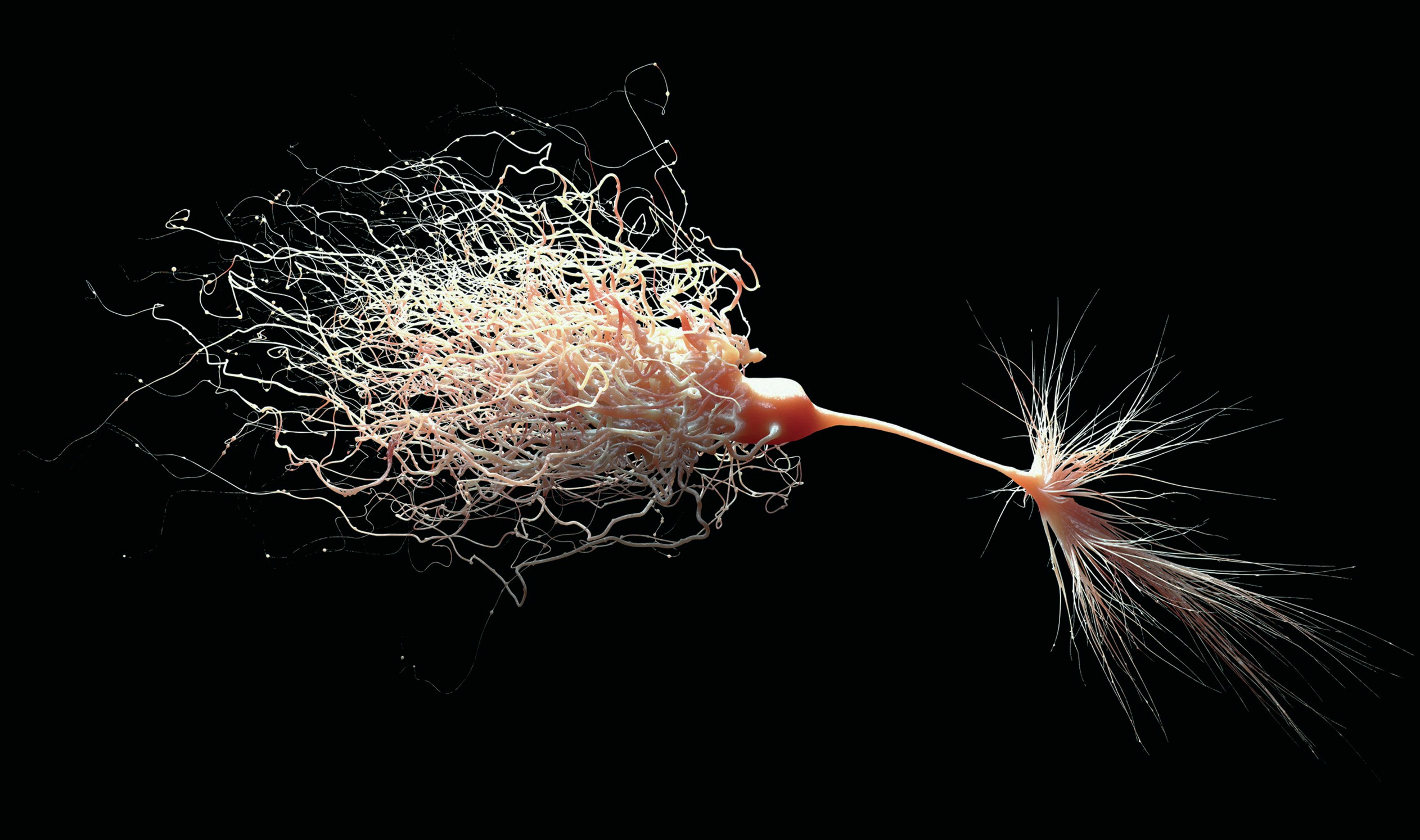
In his 1968 essay ‘Life’s Irreducible Structure’, Michael Polanyi argued against biological reductionism. Such reductionism assumes that as organisms are mechanisms constructed by physical and chemical laws, they must also be fully explained by those laws. But physical and chemical interactions create higher levels of organisation within the life structure that creates its own boundary conditions to which those laws must now relate. Larry Arnhart’s Darwinian Natural Right (1998) pursues this point in relation to evolutionary theory and human nature. It is possible to make the case for emergent properties and the top-down influence of boundary conditions without asserting a dualism between mind and brain.
It is possible to argue that emergent properties at different levels of the neural network may operate, as complex signal pathways interconnect, exchange information and express themselves in brain and body states. Causation is both bottom-up and topdown at multiple levels within the organism.
An illustration of this can be found in how thoughts and images can change brain cells. The research of Maguire and Woollett, published in 2011, focused on London taxi drivers learning the complex road map of central London. The amount of grey matter in the hippocampi of those who qualified increased compared to those who failed. Mental life causes physical change.
Benjamin Libet
The cognitive experiments of Benjamin Libet are sometimes used to deny free will in favour of epiphenomenalism and show that physical causation causes mental activity. In his 1983 finger-flicking experiment, for example, the level of electrical activity in the brain was measured in relation to a decision to move the finger, and its actual movement. The results showed a rise in brain activity before the decision to move the hand takes place. This has sometimes been taken to show that conscious willing is determined by prior causal activity in the brain and therefore makes free will impossible.
However, Mary Midgley remarks in Are You an Illusion? that such an interpretation assumes that the 300 milliseconds of rising brain activity before reported awareness of the decision to act are not involved in helping generate the decision to act.
Prior related thoughts such as ‘waiting to act is getting dull’ or ‘I’ve waited long enough’ could be leading to the decision to act. Decisions manifest themselves within a motivational context. In other words, decisions and their processing are part of complex interactions that should guard us against jumping to over-simplified explanations and correlations between brain states and mental thoughts. The same may be said of brain imaging techniques that tend to highlight areas of increased activity above a threshold of brain activity, below which it becomes less easy to obtain and interpret data.
In Self Comes to Mind (2012), Antonio Damasio discusses the idea of mirror neurons in relation to the as-if body loop hypothesis. Mirror neurons are often discussed in relation to our brains enabling us to imagine the emotional state of others and thus produce the feeling of empathy. However, visual regions of the brain can also stimulate mirror neurons through imagined body movement without it taking place.
This makes for quicker processing time once movement is enacted. Given this, discerning the time point of decision to move in relation to neural activity is problematic.
For his own part, Libet was not so sure that consciousness played no part in decision-making processes and used the phrase ‘free won’t’ to point towards experiences in which we feel an unconscious urge to act build within us which our conscious selves ‘catch’ and prevent. This seems to point towards a role in the self for consciousness as a higher-level decision maker that chooses between alternative actions.
Libet and property dualism
It may be tempting at this point to embrace the idea that physical substance creates properties, such as mind and consciousness, which extend beyond the constraints of the physical world and are therefore not determined by it. Such a perspective is called property dualism. Libet develops a theory he calls conscious mental field theory (CMFT) in his book Mind Time:
The Temporal Factor in Consciousness (2005). Within the brain, consciousness is a non-physical mental experience created not as ‘a ghost in a machine’ but as a property produced by billions of nerve cells interacting. This is an interactionist account of property dualism. The problem with property dualism, however, is basically the same as for substance dualism. How are mind properties to be causally related to the world of physical substance? Materialism has done a good job of problematising dualism so it might be better to pursue a monistic vision in which the world is explained as being constituted by one substance: physical matter. Libet points towards a grander vision when he declares that consciousness ‘must simply be regarded as a new fundamental ‘‘given’’ phenomenon in nature, which is different from other fundamental ‘‘givens’’, like gravity or electromagnetism’.
Consciousness as information processing in life systems
David Chalmers suggests that we need to add consciousness as a fifth building block of nature alongside space, time, mass and charge. This viewpoint is known as pan-psychism. Consciousness is seen as a universal part of the nature of reality in this monistic vision. Such an idea is inspired by interpretations of the philosophy of Hegel (1770–1831) in which consciousness is likened to an expression of the absolute spirit within the universe that becomes aware of itself through consciousness. For Chalmers, in as much as life systems can be said to be processing information, they possess consciousness. Within biology, information processing can be seen in the responsiveness of cells, plants and animals to changes in their environment. Information processing clearly takes place in the natural world. But does admitting this justify making consciousness a mysterious universal building block of nature?
References
Arnhart, L. (1998) Darwinian Natural Right:
The Biological Ethics of Human Nature,
State University of New York Press.
Damasio, A. (2012) Self Comes to Mind:
Constructing the Conscious Brain, Vintage.
Libet, B. (2005) Mind Time: The Temporal Factor in Consciousness, Harvard University Press.
Midgley, M. (2014) Are You an Illusion?,
Routledge.
Polanyi, M. (1968) ‘Life’s Irreducible Structure’, Science, Vol. 160, No. 3,834, pp. 1,308–12.
Searle, J. (2005) Mind: A Brief Introduction,
Oxford University Press.