
Deprecated: mb_convert_encoding(): Handling HTML entities via mbstring is deprecated; use htmlspecialchars, htmlentities, or mb_encode_numericentity/mb_decode_numericentity instead in /mnt/storage/stage/builds/pugpig-site-subs-server/latest-1.2.0-1753096337.768322/pugpig-site-subs/content.php on line 225
AQA special
Zakah and hajj The Five Pillars (part 3)
Richard Gray completes his series looking at the Five Pillars of Islam
AQA: AS Unit K World Religions 2: Islam 1 The way of submission
In this series we consider each of the Five Pillars of Islam and explore their practical and theological nature. This final piece provides an analysis of zakah (giving) and hajj (pilgrimage), and their significance in the development of the ideal Muslim character and Muslim community (Ummah).
AO1 checklist
• Concept of ‘Pillar’
• The Five Pillars
• The significance of the Five Pillars for Muslims, including their contribution to the development of the ideal Muslim character and the Ummah.
Zakah
Like fasting, giving is not new to religion. Both Jews and Christians have specific teachings about this act of piety.
In Islam, there are different types of giving. Indeed, there is some debate as to how the Pillar is defined. The most popular definition is ‘charity’ or ‘alms’. However, the true significance of this Pillar runs deeper than this:
‘People are given their wealth as a trust from God. Therefore, Zakah is not viewed as ‘charity’; it is an obligation for those who have received their wealth from God to respond to the needs of less fortunate members of the community.’
John Esposito
According to the scholar Colin Turner, zak ah covers ‘not only the donation of money to the poor, but also the giving of one’s self — one’s time or one’s talents perhaps, one’s physical skills or one’s intellectual powers’. Given the spirit of prayer and fasting it is better to understand the idea of the Pillar in this broader sense.
Types of giving
There are three types of ‘spending’ or giving:
■ Sadaqat: voluntary giving.
■ Zakah: the annual donation of 2.5% that ‘purifies’, from the Arabic verb tazakka, ‘to purify’.
■ Khums: meaning ‘a fifth’, important in Shi’ah Islam today and which originated with the idea of war booty, 20% of which went to Muhammad and his family.
Zakah is usually seen as the spending referred to in the Pillar and was the foundation of social justice for the early Muslim community.
The Qur’an states:
‘Alms are for the poor and the needy, and [to pay] those employed to administer the funds; for those whose hearts have been [recently] reconciled [to Truth]; for those in bondage, and in debt; in the cause of God; and for the wayfarer; [Thus it is] ordained by God, full of knowledge and wisdom.’
9: 60
The use of alms for the poor is manifold: they are used for orphans, for widows, (originally) to free slaves and to cut the chains of debt, and to support work in the cause of God (and workers). The scholar Maqsood has compared zakah to a Muslim ‘social security’ as it ‘allows wealth to circulate more fairly in society’.
God-given opportunity
There is a strong understanding in Islam that the fortunes of humanity are not self-made but God-given. As Esposito comments, ‘In Islam, the true owner of things is not man but God.’ All peoples are equal in the eyes of God and therefore the unequal distribution of wealth as it unfolds in our corrupt and ignorant world is a clear opportunity for Muslims, especially those who are blessed with wealth, to redress the imbalance.
This means that the mentality of giving imposes a psychological sense of duty as well as direct obedience to the will of Allah. The poor are not beggars, nor do they receive charity as the term is commonly understood. According to Horrie and Chippendale, ‘Zakah is not charity, but the rightful and legal claim of the poor against the rich.’
In practical terms, Esposito points out that zakah ‘requires an annual contribution of 2.5 percent of an individual’s wealth and assets, not merely a percentage of annual income’. However, although this is directed towards all, as with prayer and fasting there are certain exceptions — for example, if a person’s wealth or property is below a certain minimum (nisab), they are not obliged to pay zakah.
In addition, the idea of giving stems from a time of trade and a time when currency was not simply coins. According to David Waines, ‘The Zakah traditionally could be paid in different forms, either in cash or kind, the latter meaning a proportion of a herd of animals or, for example, of a date crop.’ Today, money is the most common form of zakah but offerings of land and goods still persist in certain parts of the world.
Beyond the obligatory Pillar as it is literally understood, it is evident that giving is encouraged at all times. Indeed, giving is often popular at special times in the Muslim calendar, such as hajj. Giving promotes a support for the Ummah and provides it with its economic base. It is a clear link to Muhammad and his perfect example, and an extension of the first community the prophet established.
The rich also benefit from the opportunity of giving and sharing. As we have already mentioned, it is an opportunity for wealthy Muslims to enact and play their part in actualising the will of Allah. The spiritual benefit of this sacrifice far outweighs any sense of ownership or attachment to the material world.
Due to the obligatory nature of the Pillar, and the ideals above, there is a strong disapproval of showing off one’s generosity in Islam. To reiterate, the context of opportunity afforded to the wealthy is not self-made but God-given. With this in mind, self-gratification is totally alien to the spirit of zakah.
Hajj
‘At least once in his or her lifetime, every adult Muslim who is physically and financially able is required to make the sacrifice of time, possessions, status, and normal comforts necessary’
John Esposito
Hajj is pilgrimage. There is a clear link here to make this pilgrimage, becoming a pilgrim totally at God’s service. to the traditions of pre-Islamic Arabia and to the holy site of Makkah (Mecca) at the time of Muhammad. Again, like prayer, fasting and giving, pilgrimage is not restricted to any one time, although the minimum requirement is dictated by this Pillar.
‘The journey to Mecca is both physical and metaphorical: physical in the sense that one moves through time and space leaving one’s homeland behind; and metaphorical in the sense that one moves upwards, hopefully in an ascension towards God, leaving one’s self behind.’
Colin Turner
The hajj takes place during the first 2 weeks of the 12th month of the Muslim calendar. The non-obligatory (umra) version of a pilgrimage can take place at any time.
There are certain criteria to meet:
■ Hajj must be performed at least once in a Muslim’s lifetime.
■ One must be of good mental health.
■ One must be of good physical health.
■ One must be able to afford the hajj without incurring debt.
■ One must be able to provide for dependents while on hajj.
■ Intention to sacrifice one’s time, possessions, status and normal comforts must be the reason, as well as obedience to God’s will.
The process of hajj
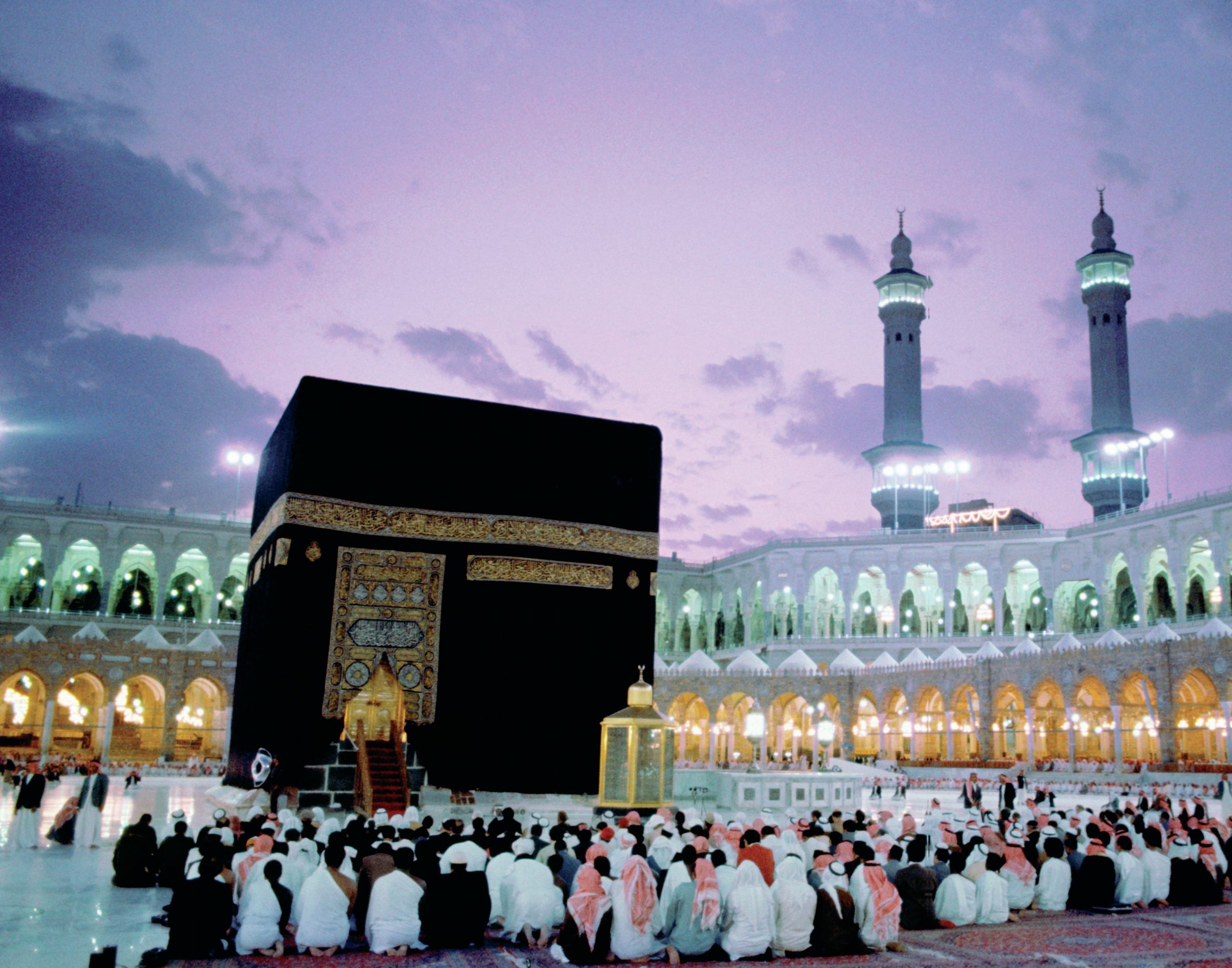
The hajj takes place in Makkah (Mecca) and the focus of the hajj is the ka’ba. This is a square-shaped building, constructed of grey stone and marble, which stands in the centre of the great mosque. It measures 12 metres (length) × 10 metres (width) × 15 metres (height).
At the eastern corner is the famous black stone (hajar al-aswad) that pilgrims long to touch or kiss. It is believed that Hagar and Ishmael (Ibrahim’s wife and son) are buried under the northwest wall. Tradition recounts that it was Ibrahim who first introduced the rites of hajj and that this pilgrimage had eventually become corrupted. Hajj is derived from a word meaning ‘circle’ and refers to the practice of going around the stone.
The hajj itself is not simply a visit to the ka’ba. The whole process of hajj is much more involved and takes several days to perform. It also has, like the other four Pillars before it, a deeper significance than the mere physical act. It is a journey that describes ‘the temporary physical movement of the individual from the “this-worldly” to the “other-worldly” while still on earth’ (Colin Turner).
The talbiyah prayer that remembers God’s command to perform hajj marks the beginning of this journey.
The best way to understand hajj is to chronologically investigate the route that is taken. Overall, it takes 7 days to perform.
Day 1
The first day is a day for preparation: every Muslim must be in a state of ihram, that is, to be pure and clean before God. To symbolise this, white clothing is worn. The two simple white sheets symbolise not only purity but also modesty, equality and obedience. It is symbolic of a physical, mental and spiritual purity. To signify this, every Muslim must abstain from sex, violence and even any thoughts of such sinful action, thinking only of God and goodness.
Day 2
On day 2 the pilgrims enter the great mosque and perform seven circumambulations of the ka’ba. This is done anticlockwise and starts from the black stone. This represents the centrality of God in their lives. Every pilgrim offers two rakahs of salah in submission to God. Then, following this, sai (exertion) is performed by walking between the two hills of al-Safa and al-Marwa. This emulates the trials and tribulations of Hagar in searching for water for herself and her son Ishmael. At the end of sai, pilgrims take some of the zamzam water (a spring that God caused to miraculously appear), which has suggested healing properties. At midday there is a move to Mina for prayers.
Day 3
The third day sees a move 9 miles east to the plain of Arafat. Here wuquf is practised, which means ‘standing’, and represents a believer standing before his or her creator and asking for forgiveness. A sermon is delivered which remembers Muhammad’s sermon on his final pilgrimage. During the evening there is a move to Muzdalifah, where evening prayers are performed and each pilgrim stays out all night in the open air.
Day 4
From here, day 4 sees a move to the valley of Mina for the ‘stoning of Satan’. This involves the throwing of stones at three stone pillars in order to renounce evil. It commemorates Ibrahim rejecting Satan’s suggestion that he should save his son instead of following the command of God. A pilgrim is encouraged to sacrifice a sheep, goat or camel just as Ibrahim did. It is at this point that male Muslims are encouraged to shave their heads and the 3-day festival of Eid-ul-Adha begins, marking the culmination of hajj.
Days 5 and 6
Pilgrims spend 2 days moving between Mina and Mecca, doing circumambulations and performing more ritual stonings.
Day 7
Pilgrims return to Mecca for the final time. In essence, there are three or four significant rites that mark the official completion of hajj:
■ ihram
■ talbiyah prayer (‘At your command… without equal…I am here’)
■ tawaf (circling)
■ wuquf (standing)
Those who complete hajj are given the honourable title haji.
Pure intentions
Hajj can only be truly done with pure intention and without self-interest. Indeed, it is said that one is in a better state not doing hajj than if hajj is done with wrong intentions and motives. True, there are always temptations and distractions — for example, today the shops and ‘commercialism’ involved with hajj may draw one away from the real reason for its existence. Nonetheless, a true pilgrim has all this in perspective. The whole journey is like a return home to the essence and source of Islam.
It is this ‘perspective’ that triumphs when one considers the busy nature of hajj, such as the sheer practicality of it happening today with stones hitting people and potential crushes at certain points along the way. The Saudi royal family has responded by building better routes, and any conflicts about Hajj being commercialised must be viewed with this in mind.
A series summary
We can now summarise by considering the contribution of the Five Pillars to the development of the ideal Muslim character and of the Ummah.
‘In all, prayer, alms, fasting and pilgrimage combine the Muslim’s acknowledgement of his or her submission and obedience to the will of Allah, and comprise his or her deepest expression of gratitude for his bounty.’
David Waines
Colin Turner has observed that the Pillars are like ‘emblems’ that ‘point to deeper truths’. In other words, they are simply the surface of Islamic practice as all life in its entirety is seen as an act of worship (ibadah) towards God. In terms of symbolism and unpacking the theological significance of the Pillars it has also been commented that there are as many interpretations as there are Muslim scholars.
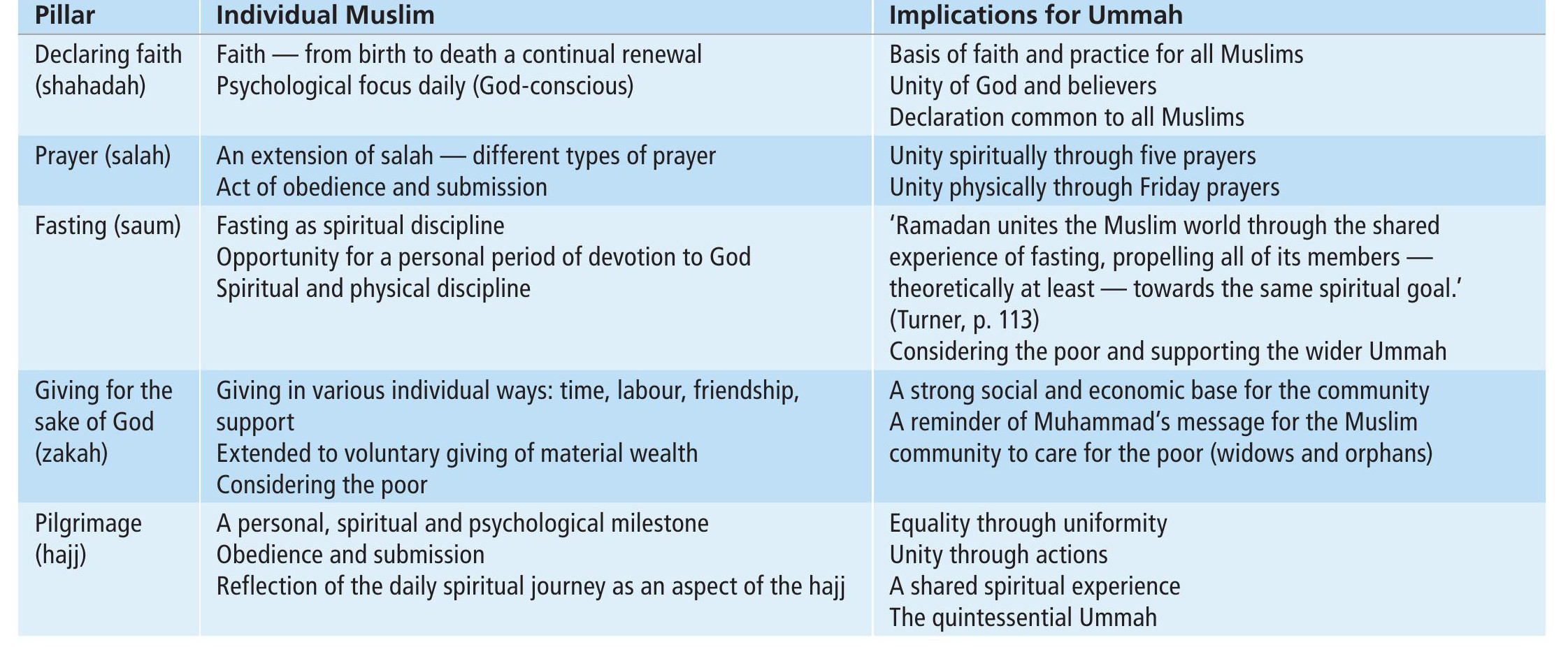
Despite this, there is a broad consensus as to the basic implications that the Pillars have for Muslims individually and collectively. Table 1 highlights the different ways in which each Pillar extends to, and influences, the daily life of a Muslim, but also how each Pillar impacts upon the Muslim community (Ummah).
This ‘AQA special’ is the responsibility of RELIGIOUS STUDIES REVIEW and has been neither provided nor approved by AQA.
RSReviewExtras
Go to www.hoddereducation.co.uk/ rsreviewextras for a revision PowerPoint on zakah and hajj.
References
Turner, C. (2005) Islam: The Basics, Routledge.