
Deprecated: mb_convert_encoding(): Handling HTML entities via mbstring is deprecated; use htmlspecialchars, htmlentities, or mb_encode_numericentity/mb_decode_numericentity instead in /mnt/storage/stage/builds/pugpig-site-subs-server/latest-1.2.0-1753096337.768322/pugpig-site-subs/content.php on line 225
God of the philosophers and the biblical God: Gunton’s later theology
Nir Shaki explores the relationship between the God of classical theism (the God of the philosophers) and the God of Abraham, Isaac and Jacob. Was Colin Gunton right in thinking they had been hopelessly mixed up?

GUNTON ATTEMPTS THE SPECIFIC TASK OF DECONSTRUCTING AND REBUILDING THE DOCTRINE OF THE DIVINE ATTRIBUTES AROUND A MORE BIBLICAL NOTION OF REVELATION AND DIVINE PERFECTIONS.
Athanasius asked: ‘What has Athens to do with Jerusalem?’, adding fuel to the controversial question of the relationship between theology and philosophy. Athanasius’ question was rhetorical in that his intention was to poke at those he thought were using unjustifiable philosophical concepts in their theology (something he thought was theologically wrong).
Gunton’s aim in Act and Being
Colin Gunton’s theological project, including the work Act and Being, follows in this long tradition of attempting to separate theology and philosophy, which gained its most famous contemporary voice in Karl Barth, a figure much admired by Gunton. It is therefore no surprise that Act and Being continues in this genre.
In this work Gunton attempts the specific task of deconstructing and rebuilding the doctrine of the divine attributes around a more biblical notion of revelation and divine perfections. His central claim is that the traditional attributes found in classical theistic notions of God (e.g. Aquinas) have created a ‘hybrid deity’, one that is not true to the biblical God of revelation. The work itself can be understood as an attempt by Gunton to ‘do surgery’ on this deity — in other words to cut out and leave behind the philosophical contamination of theology of the divine attributes.
Gunton’s method is twofold:
■ First, he diagnoses the historical roots of the classic doctrine of God’s attributes. Here he finds that a particular philosophical epistemology that presumes knowledge of God is not possible has taken hold in the tradition.
■ Second, and as a corollary of this epistemology (the via negativa) there has been a substantive effect on our ontological understanding of the divine attributes. Gunton thinks that if the epistemology can be discredited, then the ontology will naturally come apart also.
‘We shall then approach the topic with an initial theory or hypothesis in mind…that so far as the divine attributes are concerned, the doctrine has been approached using the wrong method, developing the wrong content…and…treating things in the wrong order.’
The best way to review Gunton’s work is make an analysis and evaluation of its strengths ’to and weaknesses, using Gunton’s own schema as described above and in the summary in Table 1.
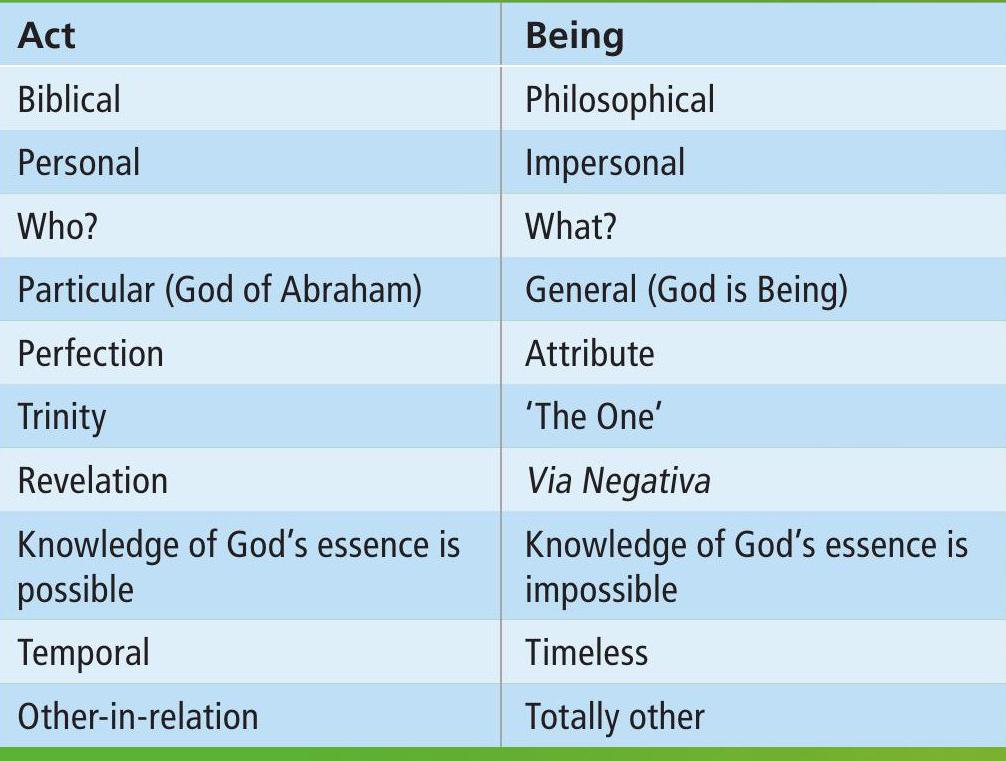
Strengths and weaknesses
Gunton’s initial diagnosis might be called methodological.
‘The burden of the critique is perhaps predictable: that much of our inherited doctrine appears to owe too little to biblical and Trinitarian considerations, too much to a priori philosophical decisions about what God may be conceived not to be.’
Gunton is clear about who he thinks is responsible for this error. He points to those theologians, such as Origen, Augustine and pseudo-Dionysius, who have been influenced by Greek currents of thought (p. 14). He highlights several features of their theology. Of Dionysius he says:
■ First, there is an ‘elevation of timeless, metaphysical causality over the temporally and economically structured biblical characterisations of God’s action in the world’.
■ Second, there is a ‘relentless concentration on what God is not’.
Gunton claims that the symptoms of this underlying disease are that there are no references to the ‘revealed names’ of God, that there is an ignoring of God’s ‘particular divine actions’, and that a form of modalism has taken hold of this theology. What we can say of God with this theology is essentially abstract, and rather than the names of God telling us how God acts, we end up with Neoplatonic abstractions and generalities. Crucially we end up losing what the attributes mean.
Robust description
There is little doubt that Gunton constructs a robust description of the influence of neo-Platonism on the theology of the patristic period and beyond. He provides three main consequences for theology of this particular method, which take up the remainder of the book:
■ ‘The knowledge of God given in the economy of creation and redemption…have been occluded in many treatments of the divine attributes.’
SPEAKING OF THE UNKNOWABILITY OF GOD IN THE TRADITION, GUNTON CONFUSES THE ESSENTIAL NATURE OF THE VIA NEGATIVA FOR HIS OWN AGENDA.
■ ‘The divine attributes have been conceived largely cosmologically…to the exclusion of the attributes suggested by divine action in time.’
■ There is a ‘conception of the relation of God and the world which has seen them as opposed to one another rather than as realities which are positively related in their otherness’ (he never clarifies what he means by this).
We have here an excellent historical diagnosis of different threads within the theological tradition. And what recommends the book — even if in the final analysis you do not share the negative conclusions of the author — is that it allows us to take a fresh perspective on how the doctrine of the divine attributes became possible.
Weak critique
However, problems soon arise when we look in more detail at the history being portrayed. There are several weaknesses, but here I will cover just two.
■ First, the criticism of figures such as pseudo-Dionysius, to take just one example, is very general and inconsistent. Gunton often seems to set up a ‘straw man’ only to knock him down and claim a victory for his hypothesis. He speaks derisively of theologians and shows little sensitivity to the struggle they had to go through, and the often very good historical and theological reasons for doing what they did.
■ Second, although Gunton’s critique of the influence of philosophy on theology can help us understand possible pitfalls in our theological methodology, he offers almost no positive understanding of how philosophy might be used (as it surely must, for reasons given below) by a theologian. This ultimately undermines the work.
Let us start with the former problem and trace how it works through the book, and then do the same for the second.
Too general
Speaking of the unknowability of God in the tradition, Gunton confuses the essential nature of the via negativa for his own agenda. The via negativa (in pseudo-Dionysius at least) is the belief that language and thought about God are not adequate to express or grasp what God is. It is a specific theory about the capacity of language and thought, and not a belief about whether God can ever be known. Consider the following passage:
‘My argument now rises from what is below up to the transcendent, and the more it climbs, the more language falters…it will turn silent completely, since it will finally be at one with him who is indescribable.’
Later Gunton quotes Dionysius again: ‘the way of negation is the way of union’ and words we use about God…must not be given the human sense. We should be taken wholly out of ourselves and become wholly of God’. Notice the critique of the power of language and the concomitant claim that we can unite with God. However, at times Gunton claims this is a doctrine that teaches that God cannot be known by mankind and that this is the reason language cannot express him. But this is to misrepresent the doctrine.
‘It is a dogma whose truth is almost everywhere stated or assumed that the human being cannot know the essence or being of God. One consequence of this for our language is that, as they stand, our words are simply incapable of speaking of the creator. That is the truth underlying what is known as negative theology…’
To be fair to Gunton his real qualm w negative theology is not so much whether God is known but how this comes about. He wants to support the biblical belief that no one can ‘know the father except through the son’. And so he claims that although the via negativa suggests we can ultimately know God, it is the fact that it conceals a ‘promethean hidden agenda’ that disturbs him (p. 154). He wants to maintain that God is known because he ‘gives himself to be known’ and that it is beyond the human capacity to achieve this alone. ith
Where’s the philosophy?
To come to what might be the real weakness of the book however, we should consider the fact that Gunton gives little or no credence to the historical, theological and philosophical reasons as to why Greek thought became and still remains entangled with more biblically centered theology. It will not do to simply place the burden at the foot of past theologians without some consideration of its underlying causes.
This lack of interest can be found in two ways through Act and Being (fundamentally it comes down to a lack of understanding about the very origins of philosophy), the presumption that:
■ theology does not really need philosophy
■ his own work does not really need philosophy
Consider the following passage that questions the papal defence that theology needs to have ‘foundations in a general philosophy of being’ (p. 5):
‘Moreover the supposition that one particular philosophy…is necessary for Christian theology is an odd one…[Jenson] points out that Greek philosophy and its descendants have no more claim to universality than any other set of doctrines.’
There are two major problems with this thesis, and they naturally lead into the crux of the problem of the whole work. First, the ‘particular philosophy’ that he is speaking of is a ‘general philosophy of being’. The philosophy of being is sometimes referred to as ‘fundamental ontology’. It is a shorthand way to describe any thoughts that claim to speak of the cosmos and our place in it as a whole (be they theological, philosophical or scientific). Gunton himself admits this (‘Greek philosophies are in point of fact theologies’). This is precisely why fundamental ontology is necessary for Christian theology, or any theology for that matter, and exactly why it is not ‘particular’.
Philosophy as inevitable
The reason that philosophy has a claim to universality is that it is a natural tendency of thinkers within any system to ask questions and seek answers to conceptual or other problems. This was what lay behind the early Church controversies and the need to seek clarification with the help of Greek philosophical terms.
Gunton himself might agree with the point, but claim that the issue is exactly where we find the clarification. While some argue we should seek clarification from Athens, he thinks it can be found only in Jerusalem, meaning only in scripture. The problem here is that scripture only provides a finite number of definitions and concepts, not all of them consistent and coherent. The opening of Act and Being illustrates the issue further:
‘To speak of God’s attributes is to attempt to speak of the kind of god that God is…of the things that characterize him as God…rather than some other being or kind of being.’
Without a doubt this must be a central theme of theology. Much of this can be understood and clarified and must even originate in scripture. However, questions such as whether we speak of God as a ‘kind of being’ and therefore subsume him under a particular category, or what it means to speak of ‘God as a being’, will inevitably and naturally be asked. At one stage Gunton himself concedes the point:
‘No victory can be won by simply bombing the opposition out of existence. For example, suppose that we do wish to oppose the dominance of theories of being with those of action. Is what we mean by action so selfevident, in our case let alone God’s?’
Theology needs a handmaid
To conclude, that is precisely the point. Act and Being draws distinctions from its very title and right through the whole work, as can be seen in Table 1. These distinctions are valid and useful, but none are so self-evident as to require no more thought, or are such that questions will not be raised about how they are set together and kept apart.
Even if we are happy to confine ourselves to the biblical side of the table, the words on this side cannot be understood fully without the other side — for example, we can only understand the particular because we have a provisional notion of the general, and we can only understand the temporal because we have a provisional notion of the eternal. This is why Socrates was speaking truthfully when he said in the Phaedo ‘for by nature my friend man’s thinking dwells in philosophy’.
This is not to claim that theology should be philosophy’s handmaid, but that theology does need a handmaid. And theology forgets this at its peril.
References
Gunton, C. (2003) Act and Being: Towards a Theology of the Divine Attributes, SCM Press.