
Deprecated: mb_convert_encoding(): Handling HTML entities via mbstring is deprecated; use htmlspecialchars, htmlentities, or mb_encode_numericentity/mb_decode_numericentity instead in /mnt/storage/stage/builds/pugpig-site-subs-server/latest-1.2.0-1753096337.768322/pugpig-site-subs/content.php on line 225
stretch and challenge
How is ethics shaped by knowledge?
The question ‘How do we know what is good?’ is concerned with how we know what we know about ethics and informs a serious approach to moral theory. Peter Manning looks at how moral philosophy addresses this question
All exam boards: ethics options
When studying ethics we often focus on the detail of individual theories and then make comparisons between them. At one level this is fine, and it can be fun to justify why you prefer utilitarianism over Kantian ethics or vice versa. However, this approach may not do justice to an analysis of ethics. Ethical theory does not exist in a vacuum, and this article will show how it finds its form and structure in relation to how we define what knowledge is.
RSReviewExtras
Go online (see back cover) to test yourself on the concepts in this ‘Stretch and challenge’.
Normative ethics
Divine command ethics
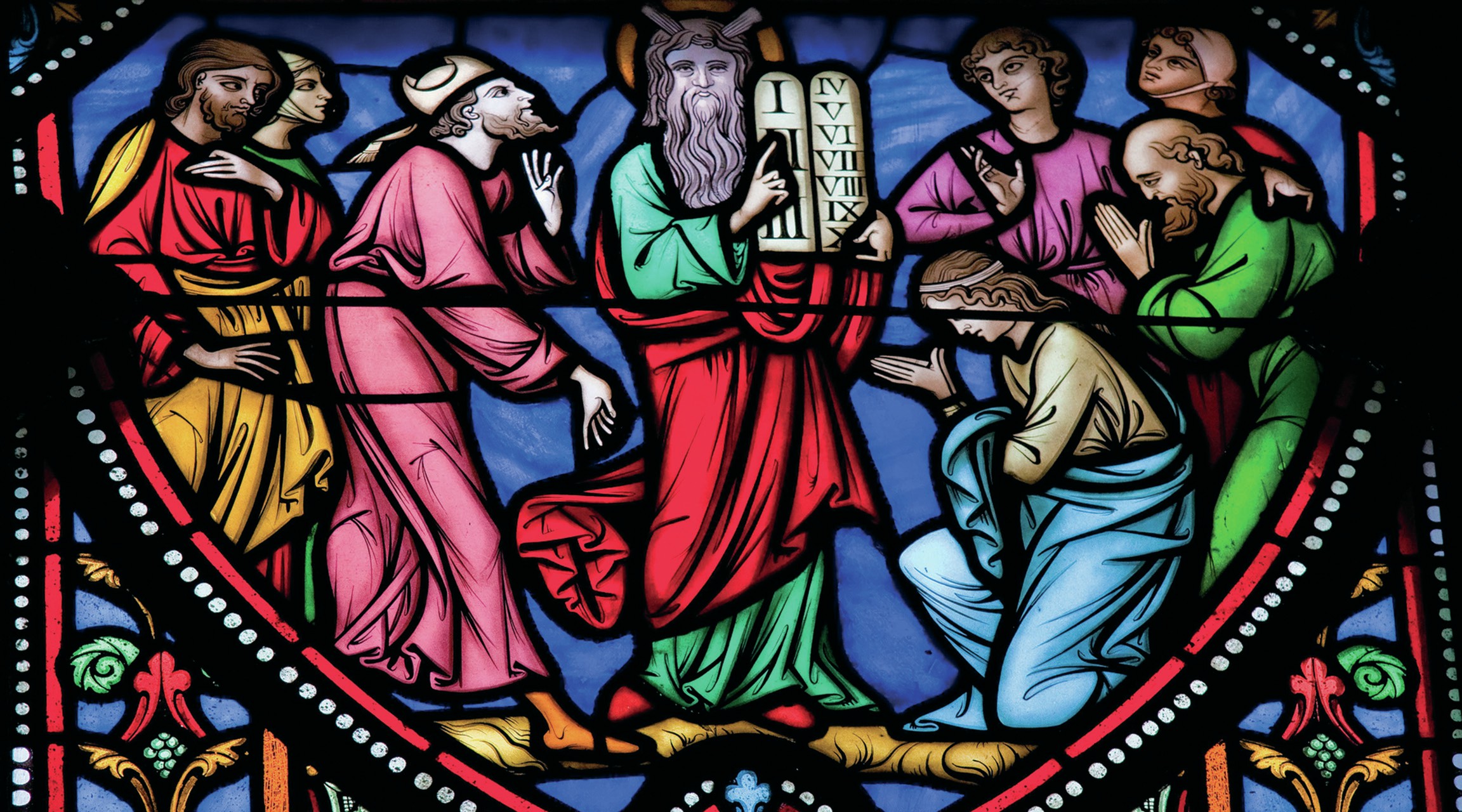
During the Middle Ages authority on ethical matters in Europe rested with the Church. Christian ethics was founded on a divine command approach in which, through the Ten Commandments and the teachings derived from Jesus’ life, people were guided on how to live their lives. This was mediated in various ways through the Bible, the pope and Church tradition.
Natural law ethics
Another influential approach to Christian ethics called natural law was developed by Thomas Aquinas (1224–74). In natural law theory it is argued that human nature has universal characteristics which form the basis upon which ethics develops. Humans are rational, thinking beings, who through reason discern that the purpose of life is to survive, reproduce, learn, live well in society, and worship God. The development of character traits or habits of thought and action which do good and avoid evil are key to the fulfilment of ourselves.
Our internal motives matter in judging the goodness of what we do. Helping someone revise for an exam (an external act) is judged good by the motive we have (an internal action). Is it the joy of helping or an opportunity to show off? Good character is witnessed by our virtues: prudence, temperance, fortitude, justice, faith, hope and charity. The more virtues we possess the more we are able to live in harmony with the natural law.
Challenging old authorities
The Reformation was a cultural movement that challenged the authority of the Church in the sixteenth century. It started as an argument within the Church when Martin Luther (1483–1546) questioned the kind of authority the pope should continue to have. The Reformation tied in with the Renaissance movement of the fourteenth to seventeenth centuries, which rediscovered the classical ideas of Greece and Rome and offered new ways of understanding human nature, politics and values. Both movements fostered a renewed interest in the ability of reason to discern the truth of things apart from Church approval.
Montaigne and Sextus
One of the most influential philosophers of the last 500 years was the French philosopher Michel de Montaigne (1533– 92). He in turn was heavily influenced by the writings of Sextus Empiricus (c. 160–210 AD). Sextus was part of a tradition in classical philosophy known as Pyrrhonian skepticism. The thinking of Sextus might best be summed up by the phrase ‘What can I know?’ Sextus, looking for certainty in knowledge, finds that no criteria of truth is ever beyond question or calls for a suspension of judgement. In such a situation belief cannot be shown to be true by reason.
Realising this, we should live by the habits we have and thus attain our own peace of mind. As Montaigne muses:
‘To judge the appearances…we would need a judicatory instrument; to verify this instrument, we need a demonstration; to verify the demonstration, an instrument: there we are in a circle. Since the senses cannot decide our dispute, being themselves full of uncertainty, it must be reason that does so. No reason can be established without another reason: there we go retreating back to infinity.’
Montaigne makes it clear that ‘Sensation runs in a circle; reason regresses forever. In a world of coming-to-be and passingaway, the apprehension of being [reality] is as inconstant as water running through our fingers’ (Copenhaver and Schmitt, p. 258).
Descartes and autonomous reason
If the Church was no longer able to provide foundations for knowledge then what was humanity to do? Ironically, towards the end of his life Montaigne perhaps wrote the words that might have inspired as answer: ‘I study myself more than any other subject. That is my metaphysics…that is my physics.’
René Descartes (1596–1650) defended belief in God in his version of the Ontological Argument while also accepting the spirit of his age that knowledge started with man. In answer to skepticism, Descartes proclaims his now famous statement ‘I think therefore I am.’ Only a madman would doubt the self-evident experience of thinking even if all else was doubted. From this starting point, using the mathematical certainty of geometry which finds its home in the innate ideas of the mind, Descartes builds new foundations for our knowledge of the world.
Hume, pleasure and utility
In opposition to Descartes, John Locke (1632–1704) argued against starting with innate ideas, claiming instead that the mind is born as a ‘blank slate’ upon which experience writes and reason contemplates.
But even if Descartes is rejected and Locke accepted we still need an individual self to be the sure ground of our knowing.
This premise was undermined by David Hume when he proclaimed in the spirit of Montaigne:
‘For my part, when I enter most intimately into what I call myself, I always stumble on some particular perception or other, of heat or cold, light or shade, love or hatred, pain or pleasure. I never catch myself at any time without a perception, and never can observe anything but the perception.’
Hume argues that we have no way of marking out what is essential in human nature as we have no way of knowing it. We cannot even be sure of cause and effect relationships as they could just be ‘habits of mind’ through which we have linked two things together that may not be so related.
So how are we to live?
Faced by a seemingly insurmountable skepticism in our knowledge about the world, how are we to live? What is to define our values? Reason cannot provide a foundation for morality, which leaves us with feelings and our individual desires. We cannot suspend our beliefs as Pyrrhonian skepticism suggests we should, for we grow up in a society and our social relations with others induct us into a particular tradition which is easier to follow than fight against.
Tradition and its culture form our habits of mind and desires. Desire is driven towards pleasure and away from pain. Desire motivates us to action, and reason helps us find the best way of fulfilling our desires. For Hume, ‘Reason is, and ought only to be the slave of the passions and can never pretend to any other office than to serve and obey them’ (Treatise II, iii, 3).
Sympathy
Hume explored the concept of sympathy as a means of checking the unreasonable demands of desire and pleasure in our social relations. Sympathy aroused in us for the effects of our actions on others informs our feeling, through our habits of mind, towards that action as a cause of pleasure or pain in ourselves. Hume introduces the term utility into ethics and argues that we do what is useful to us and in accord with our sympathies. It is at this point that reason is applied to guide us to act with the greatest utility. Ethics is personal and not universal. However, it was the Irish-Scottish philosopher and church minister Francis Hutcheson (1694–1746), who had influenced Hume, who coined the phrase ‘the greatest good for the greatest number’.
Utilitarianism
While the thinking of Hume or Hutcheson cannot be called utilitarian, they inspired utilitarianism’s development. The notion of sympathy declined in importance as it became clear that justifying the basing of ethics on such a sentiment was itself problematic — rather than ‘sympathy’ why not ‘greed’? Instead, the implications of the phrase ‘the greatest good for the greatest number’ as a universal starting point for ethics were explored by various philosophers in relation to Hume’s idea of utility.
■ Utilitarianism was popularised through the book Principles of Moral and Political Philosophy (1785) by William Paley (1743– 1805), who also became well known through his defence of Christian belief with the Design Argument.
■ Jeremy Bentham (1748–1832) gave expression to what we now know as act utilitarianism. Bentham focused on assessing the consequences of specific actions by judging them against the criteria in his Hedonic (pleasure) Calculus. On the analysis of the act, general moral laws could be developed.
■ Rule utilitarianism followed in which John Stuart Mill (1806–73) emphasised that some acts could be counted as higher pleasures and more important than lower, more everyday pleasures. Mill coined the memorable phrase ‘It is better to be a human being dissatisfied than a pig satisfied.’ Mill also proclaimed that utilitarian principles were in accord with Jesus’ teaching about loving your neighbour as you would yourself. For Mill, general rules should be developed under the rubric ‘the greatest good for the greatest number’ to then inform which acts are judged morally good. Consequentialist-based ethics have continued to develop on this basis.
Kant’s theory of mind and reason
In exploring the concept of sympathy Hume was trying to find a basis on which to fund ethics without its foundation being in reason. The idea that all our knowledge is based on perceptions that are products of habits of mind awoke the philosopher Immanuel Kant (1724–1804) from his so-called ‘dogmatic slumbers’.
To escape from the failure of Descartes’ rational foundation for knowledge in the light of such skepticism, Kant turned inward to the structures of the human mind. He argued that what looked like accidental ‘habits of mind’ to Hume were in fact evidence of the ordering structures of the human mind that existed as part of our nature. Our minds intuitively make sense of time and space, and in understanding the world we perceive categories such as quantity and quality. These abilities are separate from experience.
However, this new rational foundation for knowledge has one sting in the tail: our understanding of the world is conditioned by the mind. Kant called the world as we perceive it through the mind the phenomenal world. The world as it exists in itself not mediated through the human mind, that we therefore cannot know, is called the noumenal world.
The good will
Within the context of his theory of knowledge Kant argued that instead of desire driven by concerns for pain and pleasure, morality is grounded in the good will of the self as a free agent acting in the world. We act in the world according to our will. But the good will, as free, will not be guided in its actions by our desires for happiness or concerns over consequences because this would be to make our will less than fully rational.
Rational morality
For Kant, morality, if it is to be universal, must be rational. If the rules of morality are rational then these rules must be the same for everyone, in the same way that mathematical rules are universal. Our wills are duty bound to follow the moral dictates of reason whatever the situation. Rational morality as universal is held by all men and thus can and ought to be followed.
The categorical imperative
Kant argues that an ethical maxim by which moral laws may be tested and created offers itself straight from the idea of the good will being in accord with universal reason: can we consistently will that everyone should act in the same way? This is what Kant called the categorical imperative.
Any specific universal law that we might apply to our lives sits at the judgement seat of this guiding, rational principle. This law also demands that individuals are never treated as a means to an end but as ends in themselves. Within this rational framework we act in the world. This is a duty, lawbased ethic upon which deontological and rights-based ethics have continued to develop.
The turn towards the self
With the development of various ethical systems (normative ethics) in relation to different answers to the problem of knowledge, philosophy seems unable to find a sure footing on which to base ethics. We are left to decide which answer to the problem of knowledge most appeals to us and follow that decision and its corresponding ethical tradition.
With the failure of philosophy to reach enlightenment, two thinkers charted nonsystematic ways of answering the ethical conundrum. For Søren Kierkegaard (1813– 55) and Friedrich Nietzsche (1844–1900), ethics is located in the individual self rather than provided by some wider system of understanding.
Kierkegaard and the love of God
Reason demands that God be justified by its logic. But this is to subvert God by placing him at the feet of human reason, and makes God less than he is. The Danish Christian thinker Kierkegaard rejected the whole idea that ethics was based on reason. Ethics defines itself through relationship with God. God is known through relationship not reason.
Although he was a deeply committed Christian, Kierkegaard rejected the divine command approach, natural law ethics and Kantian ethics. He called belief in Jesus as the God-Man the absolute paradox which offends reason. There can be no empirical justification for Christianity. Faith takes priority over reason and we must go with our lives where reason cannot take us —a leap of faith towards God is needed. But even once we make the leap our experience of relating to God could be deluded, so faith is a risk. For Kierkegaard the risk is worth taking, because in making the leap we display a purity of heart that allows us to know ourselves better.
The leap of faith demands such courage and self-reflection that we are no longer hostages to the vagaries of the pursuit of pleasure, or the robbing of our individuality by the Kantian ethical imperative. We assert our own individuality and accountability before God. The values we live by are not whimsical and selfish, but neither should we allow them to be pressed upon us by the rules of others. Rather, to choose faith in God allows God to transfigure all our personal relationships that we may become more Christ-like in our motivations and intent, whatever the consequences of our actions. Ethics is about personal action inspired by the love of God. Such faith is passionate and committed both in its beginnings and in its living out. Ethics becomes deeply personal and allencompassing.
Nietzsche and recreating the self
The originality of Kierkegaard’s turn towards radical decision and individual accountability in ethics was continued by Nietzsche.
Whereas Kierkegaard attacked the Church for its substituting ethical living for a true relationship with God, Nietzsche attacked the whole idea of belief in God. Relating to God as a foundation for ethics was not an option. Neither was utilitarianism.
Nietzsche, using the language of caustic hyperbole to evoke responses from his readers, sees in all forms of Christian ethics and utilitarianism a slave morality that puts limits on how life should be lived. People allow themselves to be deceived, downtrodden and carved by their circumstances, but self-honesty allows us to be strong-willed and become our own masters. We are to live our lives in the face of the meaninglessness of reality and shape ourselves through the passion and creativity with which we live.
In willing ourselves to be one way rather than another we don’t act without constraint — we are already who we are, our character and life situation already impinge on us. But within that context Nietzsche calls for us to apply our strength of will to a revaluation of all values.
Owning our own lives
In discussing this Nietzsche does not create any new values and instead turns to the heroic virtues of Homer and the ancient Greek epics. Perhaps, rather than calling all of us of strong will to live by such noble and militaristic virtues, this acts as its own metaphor for us to take courage and live with passion however we choose to live. Nietzsche expresses a profound love of life which he finds ill-served in the compromises most of us make. Above all, the revaluation of values speaks of a change of attitude, that we own our own life and embrace enthusiastically whatever becomes of it, for we would not have lived any other way. Montaigne had also developed a personal ethic that focused on the importance of how we live our lives, rather than whether or not we find the truth.
Philosophy for Montaigne and Nietzsche is about the practice of free judgement. Nietzsche remarks in Schopenhauer as Educator (1874) that Montaigne was ‘the freest and highest of souls’ of whom he can declare ‘that such a man has written, joy on earth has truly increased… . If my task were to make this earth a home, I would attach myself to him.’
Ethical language (meta-ethics)
Founding ethics on pleasure, reason, passion and the self all seem to be problematic in one way or another. Claims about the nature of reality and the self are made and a corresponding concept of the ‘good’ is provided. Such claims stretch beyond the warrant that establishes their credibility and in doing so they become metaphysical. They are beliefs with questionable foundations in this world even as they seek to tell us what this world is.
Even Kant does not avoid this charge. First, he makes his particular vision of ethical rationality a universal property of human beings when this is clearly disputable. Second, to imagine the rational will as so divorced from the messiness of everyday life, in order to protect its freedom to be rational in formulating ethical principles, is an otherworldly ideal. As Robert Solomon put it: ‘instead of morality we have cosmic self-righteousness — the transcendental pretense’ (Solomon, p. 41).
Of Nietzsche’s reliance on the notion of the self, Nietzsche himself proclaims in the notes that were collected and published after his death as The Will to Power (p. 370) that ‘the ego of which one speaks when one censures egoism does not exist at all’. If the self is the foundation of ethics what happens when the self fragments into incoherence? If too much is claimed how else are we to find a way of understanding what the ‘good’ is if we move past normative ethics and the self? What is left but language? In this situation moral philosophers became more interested in language, how we use it and how it provides or shows meaning. Such concerns dominated ethics from 1900 to the 1950s.
Intuitionism and G. E. Moore
G. E. Moore (1873–1958) considered that the concept ‘good’ can be understood in several ways. First, as a complex concept it could be related to pleasure, happiness or duty as normative ethics had continued to do. But that way seemed a dead end, as of ‘…the complex so defined’, as Moore states in his Principia Ethica (1903), it could always be asked ‘whether it itself is good’ (p. 14). To not recognise this and continue to derive an ‘ought’ from an ‘is’, to get values from facts, was to commit what Moore termed the naturalistic fallacy.
But ‘good’ also seems to be more than a meaningless concept. Good seems to be grounded in something outside of language. Moore uses the colour yellow to illustrate his idea that good is a simple concept which is not defined in relation to anything else. Although you can point toward, experience, show and have a sense of what yellow is, it also defies capturing in words. For good, as with yellow, it is self-evident and we know it when it is before us. There can be no empirical proof of the ‘good’. Yet we cognitively intuit the ‘good’ ends we seek by recognising ‘…the most valuable things we know or can imagine…are certain states of consciousness, which may roughly be described as the pleasures of human intercourse and the enjoyment of beautiful objects’ (Principia Ethica, p. 188). This is what ‘good’ is, whatever that is.

Logical positivism
In the 1930s a group of philosophers who became known as the Vienna Circle argued that if something was to be meaningful it had to be self-evident. Tautologies such as ‘all bachelors are male’ meet such criteria. An analytic statement like ‘2 plus 2 equals 4’ is also accepted. Other claims made through language which don’t meet these criteria could be shown to be meaningful through repeated observations using the scientific method. This is known as the verificationist approach to knowledge and the school of thought became known as logical positivism.
For positivism, religious, metaphysical and ethical claims became unverifiable and therefore meaningless. This reduction of ethics to meaninglessness marks the blooming of Pyrrhonian skepticism, mediated through Montaigne and Hume, within the modern world. The ‘good’ has become truly incomprehensible.
Emotivism, prescriptivism and positivism
If ethics is meaningless in linguistic terms, why does talk of ‘good’, ‘rights’ and ‘duty’ still play such a large part in cultural life? Alfred Ayer, influenced by logical positivism, suggested in Language, Truth and Logic (1934) that we need a non-cognitive view of ethical language. To say that something is ‘good’ is little more than to say ‘I like this’ or ‘I agree’. Ethical language is emotional, an expression of feeling. C. L. Stevenson (1908–79) in Ethics and Language (1944) builds on this and argues that we use the language of ethics to persuade others by its very emotive force towards siding with our own points of view. Using the word ‘liar’ is more emotional than the descriptive ‘purposefully said something that is not true’. Ethics and the ‘good’ on this understanding are no more than expressions of personal values. Five hundred years earlier Montaigne can be found musing on the embarrassment the cynic philosopher Metrocles (c. 325 BC) felt about farting while teaching until his friend and fellow philosopher Crates visited him and started a farting contest, as a witness to personal freedom. Montaigne in his own reflections wonders whether philosophy is little more than a farting contest, as reason is powerless and humiliated by the problems it faces (Montaigne, p. 440). If we do run the road of skepticism through logical positivism it might seem that philosophical ethics has expanded the consequences of this philosophical inarticulation to our moral understanding.
To recover some philosophical poise and purpose for our ethical language, R. M. Hare (1919–2002) suggests in The Language of Morals (1952) that our moral statements, although emotive, serve a wider social function in that we are prescribing to others the course of action that they should take in similar circumstances. Ethical statements, upon this emotional, non-cognitive foundation, harbour within them a universal intent which echoes Kantian ethics.
In his book Moral Thinking: Its levels, method, and point (1981) Hare develops these ideas within the context of utilitarianism. Preference utilitarianism argues that ‘the greatest good for the greatest number’ is served by choosing duties and laws according to what the majority influenced by a decision choose. When the interests of different groups conflict, we should seek to maximise the opportunities for everyone’s preferences to be satisfied.
Alasdair MacIntyre and the incoherence of ethics
Alasdair MacIntyre argues that the philosophy of ethics is in a mess (MacIntyre 2013). Normative ethics has thrown up competing interpretations of what good is and how we should live. The turn towards language has made the situation worse by reducing ethics to inarticulate intuition before giving that up for various forms of emotivism. In this ethical confusion it is no longer clear what ‘to live the moral life’ means. Without a clear ethical tradition our culture has been so impacted by emotivism that three general sensibilities can be seen to be influencing how people live today:
■ The first is that of the bureaucratic manager who manages resources and treats people as a means to serve the ends (goals) of business. ‘Human resources’ is an apt replacement for the older ‘personnel department’ as the name of a company’s department looking after its employees. Efficient management rather than more personal or moral concerns is the focus.
■ The second sensibility is that of the rich aesthete who lives for the pursuit of pleasure in whatever way they choose to find it. Being manipulated by these two morally bankrupt characters into doing what they want everyone else to do is all the rest of us.
■ The third type is the therapist who the rich aesthete or bureaucratic manager can afford to pay to soothe over their troubles and help them feel better about themselves.
The rest of us can find distractions with whatever television or the cinema offers for our emotive fancy. In the words of the title of a book by Neil Postman, we are Amusing Ourselves to Death (1985).
Conclusion
What are we to do? Is this the death of ethics in the sense that beyond emotivism even in its prescriptive form there is nothing left to say? MacIntyre argues a new way ahead based on a reappraisal of virtue ethics. While that might be part of the answer it cannot do the job alone. Its emphasis on character does not go deep enough to address the problem of knowledge in relation to ethical theory. His wonderful book After Virtue fails to tackle Montaigne and skepticism yet the seeds of relativism in knowledge and hence ethics are found there. Normative ethical theories perhaps agree in a general way about what the good life entails more than MacIntyre portrays. The state of play is not so incommensurable. G. E. Moore, even with talk of intuition, hints at as much.
Given this we should not give up on ethics, for it might be that it can be cognitive, meaningful and normative. The arguments about how a reappraisal of the problem of knowledge in relation to virtue ethics, evolutionary theory and natural law ethics can establish this must be left for another time.
References
Copenhaver, B. and Schmitt, C. (1992) Renaissance Philosophy, Oxford University Press.
MacIntyre, A. (2013) After Virtue, Bloomsbury Academic.
Montaigne, M. (1965) The Complete Essays of Montaigne (trans. D. Frame), Stanford University Press.
Solomon, R. (1988) Continental Philosophy Since 1750: The Rise and Fall of the Self, Oxford University Press.