
stretch and challenge
Cosmology and religious creation stories
Creation narratives and religious interpretations of the world raise perennial questions about their relationship with scientific interpretations. Peter Manning explains how they may work together and separately
OCR AS Unit G571: Philosophy of religion AQA AS Unit D: Religion, philosophy and science Edexcel AS Unit 2: Investigations
How we conceive of the world’s place within the universe has undergone immense change over the last 500 years. Much of the ancient world believed in a ‘three decker’ universe of heaven, earth and hell in some form or other. Such an idea is implausible to modern understandings of the universe. A medieval synthesis of the ideas of the Greek astronomer Ptolemy (c. 100–70 CE) with Christianity is no longer sustainable. We know the earth is not flat and motionless.
Such a view has been impossible since 1522 when Juan Elcano completed the first circumnavigation of the globe by finishing the expedition originally led by Magellan. We also know the heavens above are not shaped like a sphere with the dwelling place of God beyond them. Since Galileo built his telescope in 1609 and turned it on the moon it has been clear that the heavens and the moon’s bodies are not uniform. Furthermore, they are not perfect, as change happens in the heavens above. Galileo and others pointed this out with observations of crater formation on the moon and sunspots. This all seems so commonplace to us today that we find it hard to grasp the cultural shock that such discoveries originally generated.
Our understanding of cosmology today
In modern times, with the Hubble telescope and its successors we see ever deeper into the universe. As we look at more distant stars we travel back in time. Light travels at 186,000 miles per second. Given the almost unimaginable size of the universe, it still takes 2 million years for light from the largest galaxy in the local cluster of galaxies (which our own is part of) to reach us. Yet in cosmic terms the Andromeda galaxy (M31) is really not that far from our Milky Way. Even within our own galaxy, which is about 100,000 light years from end to end, our sun and its solar system inhabit an outer spiral arm, called the Orion arm, which is about 32,000 light years from the galactic core.
We seem to be on the fringe of things rather than at the centre. Instead of being the focal point of creation, the earth seems to be little more than a grain of sand floating in the vastness of the Pacific Ocean. While estimates change, the universe may contain 10,000 million galaxies or more. Not only that, we can now imagine the destruction of our own planet in the death throes of the sun in about 5,000 million years, with the sun presently being middle aged. Perhaps contemplating such statistics helps bring home to us something of the wonder of the world we live in.
How and why?
The philosopher Leibniz (1646–1716) posed the question: ‘Why does something exist instead of nothing?’ While religions have provided answers to this question throughout the ages, modern man, with knowledge of the complexity of the stars above our heads, has sought to explain how that something may exist in cosmic terms.
The question ‘why’ is often taken to entail purpose or personal agency. Many scientists are more comfortable with the question ‘how’, seeing their work in a descriptive sense. They leave the ‘why’ to be discussed with reference to arguments over the implications and meaning of their work which possibly takes us beyond the methodology of science as strictly conceived. Let us take a look at religious creation stories and scientific theories of the universe and afterwards discuss how these might be related to each other.
Religious creation stories
The new understanding of the cosmos seems to stand in stark contrast to religious stories about its origin and nature. However, such stories can be linked to an underlying sense of time. We can ask which religious traditions see creation as an unending process of creation and destruction, and which religions see creation in a more linear sense as having a definite beginning and ending.
Hinduism
In the ancient religious texts of the world we find various stories about the way the world came into existence. Hinduism places, within its scriptures the Puranas and Vedas, emphasis on the idea of an eternal cycle operating within all that exists. The universe is portrayed as moving from a time of creation to a time of destruction. Such a cycle takes place over a vast period of time, 311 trillion years. Brahma, the Hindu god of creation, initiates each new cycle once destruction has completed its phase. This is a cyclical view of existence.
Genesis
In contrast to the Hindu perspective stands that of the Genesis creation story found in the book of Genesis in the Bible. The book of Genesis contains two creation stories:
■ In Genesis 1:1 to 2:3 the creation of the world and the stars takes place over 6 days.
■ In Genesis 2:4 to 2:25 the focus is on the creation of humanity, and, through the naming of animals in creation, man’s special stewardship role towards creation under the authority of God.
Humanity’s relationship with God
Rather than a cycle of creation and destruction encompassing all that exists, such a cycle is relocated within the context of humanity’s relationship with God. This is seen with:
■ the fall of Adam and Eve from the Garden of Eden in Genesis Chapter 3
■ the story of Noah and the flood in Genesis Chapters 6 to 9
■ the Tower of Babel story in Genesis Chapter 11
■ the rescue of Lot from the destruction of Sodom and Gomorrah in Genesis Chapter 19
Instead of a cyclical view we have a focus on beginnings and covenant promises between humanity and God.
By the time the ancient Jewish nation, Judea, was conquered by the Babylonian empire around 600 BCE, beliefs about a messianic future age find expression. In Old Testament books such as Isaiah, Jeremiah and Ezekiel a time of future judgement is portrayed in which the faithful will be saved, the dead resurrected and a new heaven and earth created. Such themes are picked up by Christianity through the New Testament book of Revelation within the context of an expected second coming of Jesus Christ. The Semitic religions of Judaism, Christianity and Islam each in their own way relate to end-time events as the completion of history and the perfection of creation. The portrayal of time is linear rather than cyclical.
Scientific theories of the cosmos
When attempting to explain how the universe has come to be the way it is, scientific theories are also split on whether the cosmos should be understood within a linear or cyclical framework. There are many variations within the different models of cosmology, but here we give a general outline of the main ones.
Steady state theory
In light of his general theory of relativity Albert Einstein suggested that the universe existed in a static state. However, Edwin Hubble, in 1929, observed that light coming from distant galaxies had been stretched to longer (redder) wavelengths. The significance of this finding was indicated by the fact that such a shift occurs if the object emitting the light is moving away from the observer at high speed. Such a ‘red shift’ indicates that the universe is expanding.
In the light of this finding and Einstein’s theory of a static state universe, Thomas Gold and Hermann Bondi argued in the late 1940s that the universe had always existed in a ‘steady state’ and had no beginning. To account for the observed expansion in the universe they proposed that the universe continuously created new matter at the rate of one atom of hydrogen per cubic metre every 300,000 years. Fred Hoyle developed a mathematical model to show how new matter being created could still be consistent within a steady state universe. Within such a universe galaxies would be in varying states of formation and disintegration and thus allow a constant average density of matter to be maintained.
This steady state view, with acts of creation and destruction built into its eternal existence, seems to echo something of the cyclical view of existence found in Hinduism. But in another sense it is discordant with it, as the cosmos taken as a whole exists in a steady state. Not everything is created and destroyed at the same time. Acts of creation and destruction are dispersed among the cosmos through the life cycles of individual galaxies.
Challenges to the steady state theory
Further scientific discovery challenged the validity of the steady state theory. During the 1960s, surveys of deep space with large radio telescopes allowed us to see that the universe looked very different in the past. As we look further back into the past we see more and more galaxies in earlier states of formation compared to the number we see today. This indicates that the universe is evolving rather than being held in a constant state.
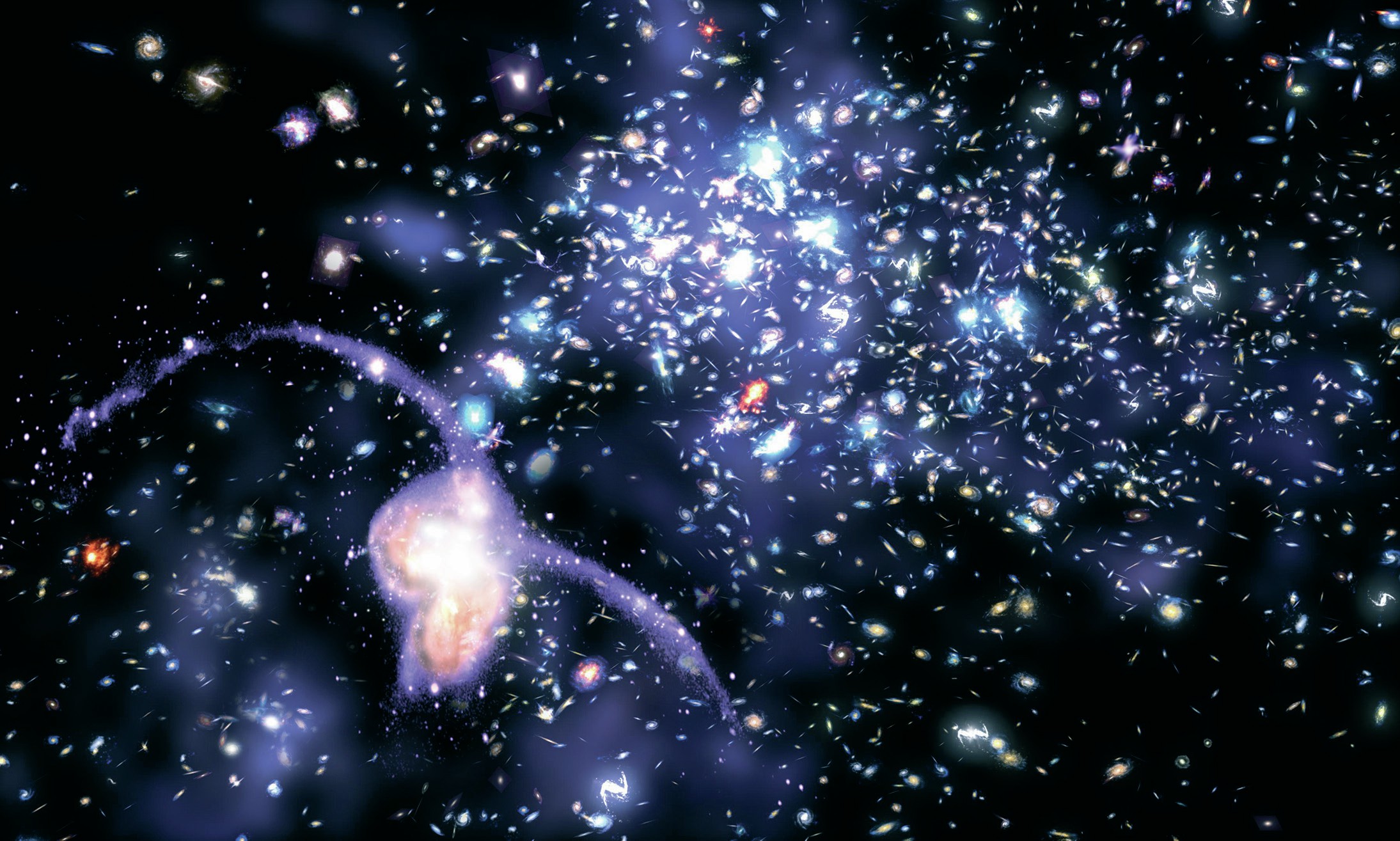
In January 2014 the journal Nature reported that the star SMSS J 031300.36-670839.3, which is around 13.6 billion years old, has evidence within its light spectrum of conditions of formation not found in later star formation. In essence, the light spectrum shows production of less heavier elements, like iron, than later stars. Variations in lithium content within different time periods of the universe’s existence also point to these older stars being larger and exploding with less energy than later stars.
While researching radiation being received from varying locations in the universe, Penzias and Wilson made an influential discovery in 1965. A faint hissing noise, present across their data from all locations at about 3 degrees above absolute zero, was the presence of the afterglow of an explosion that must have originally encompassed all locations. In other words, they had discovered the background radiation of a universe creating ‘big bang’. The steady state theory could not account for this.
Another theory was needed to account for the universe.
Big bang theory
In 1948 George Gamow, Ralph Alpher and Robert Herman had suggested a competing theory to that of the steady state approach. Under their proposal the universe started from a space-time singularity, an infinitely small and dense ball of energy, which exploded outwards. After around 300,000 years of cosmic expansion and cooling from the initial singularity, the previously uniform nature of space was differentiated by changes in density and temperature.
The four forces of physics through which the nature and dynamics of matter are understood became discernable and mathematically operational. These four forces are:
■ gravity
■ electromagnetism
■ weak nuclear forces
■ strong nuclear forces
At around 400,000 years after the explosion of the singularity, sub-atomic particles already created by the explosion began to form atoms of hydrogen and helium. By 1 billion years, stars formed out of the continually cooling cosmic material as clumps of matter coalesced to form more densely into galaxies. At 10 billion years planets formed for the first time, and at about 12 billion years the earliest life forms came into existence, allowing the beginnings of evolutionary biology.
Evidence for the big bang theory Although the primordial plasma that the big bang created could not transmit light until the electromagnetic force emerged, evidence to support the big bang model has been provided by analysing the light spectrum. Edwin Hubble’s observations of red shift in the light spectrum fitted with the idea of an expanding universe. By observing the degree of red shift in stars, astronomers can calculate their speed of travel and derive from this their past positions in the cosmos.
It has been concluded that stars have moved apart from the same origin point and that the universe came into being around 14 billion years ago. Analysing the light spectrum of older and younger stars also confirms that lighter stable elements like hydrogen are present throughout the universe. This is what physicists would expect from an evolving universe, as such elements would have been produced earlier in the formation of the cosmos. At the same time heavier elements like iron would be seen in greater quantities in older stars. This has also been found to be the case.
The big bang theory clearly provides a viable model for understanding the origin of the universe. But what existed before the big bang remains a problematic question for scientists, as the mathematical modelling of high-energy physics cannot describe physical processes within the first moments of the explosion of the singularity. The known laws of physics cease to operate when the universe is the size of an atom. Despite this, various suggestions have been made using mathematical models and metaphysical speculation as to the context within which the big bang could be understood. These ideas are suggestive of both linear and cyclical views of the cosmos.
Oscillating universe theory
As early as 1922, the Russian meteorologist Alexander Friedman (died 1925) had challenged Einstein’s idea of a static universe. The mathematical equations of general relativity could be construed to support the idea of an expanding rather than static universe. Although Einstein resisted the expansionist model of cosmology, the work of a former student of Friedman called Gamow showed that what became known as the big bang theory was the best supported from observations of the universe.
Linear or cyclical view?
Two views about this expansionist model persisted. One suggested that the universe would keep expanding until it dissipated into nothingness. This offers a linear view of the universe as it would seem to have a definite beginning moving toward a rather drawnout end point.
The alternative view proposed that if the universe had enough matter within it to create enough gravity to overcome the expulsive force of separation caused by what we now refer to as the big bang, then the universe would contract back in on itself. This folding back on itself would so compress matter that it would initiate another big bang. This model provides a cyclical view of the cosmos. Whether such a cyclical perspective would be perpetually maintained is a point of debate as it is possible that each new big bang–crunch–big bang cycle would have less energy than the last cycle. As we cannot make observations going back to the beginning point of our own universe, let alone from before it existed, whether this oscillating perspective is correct is a matter of metaphysical debate.
That said, measurements of the speed at which the universe is expanding have, since 1998, thrown more weight behind the idea of an eternally expanding universe rather than one that is going to collapse in on itself. Indeed, the rate of expansion is speeding up rather than slowing down. While various ideas have been suggested to account for this finding, one in particular has stirred much debate. This is multiple universe theory.
Multiple universe theory
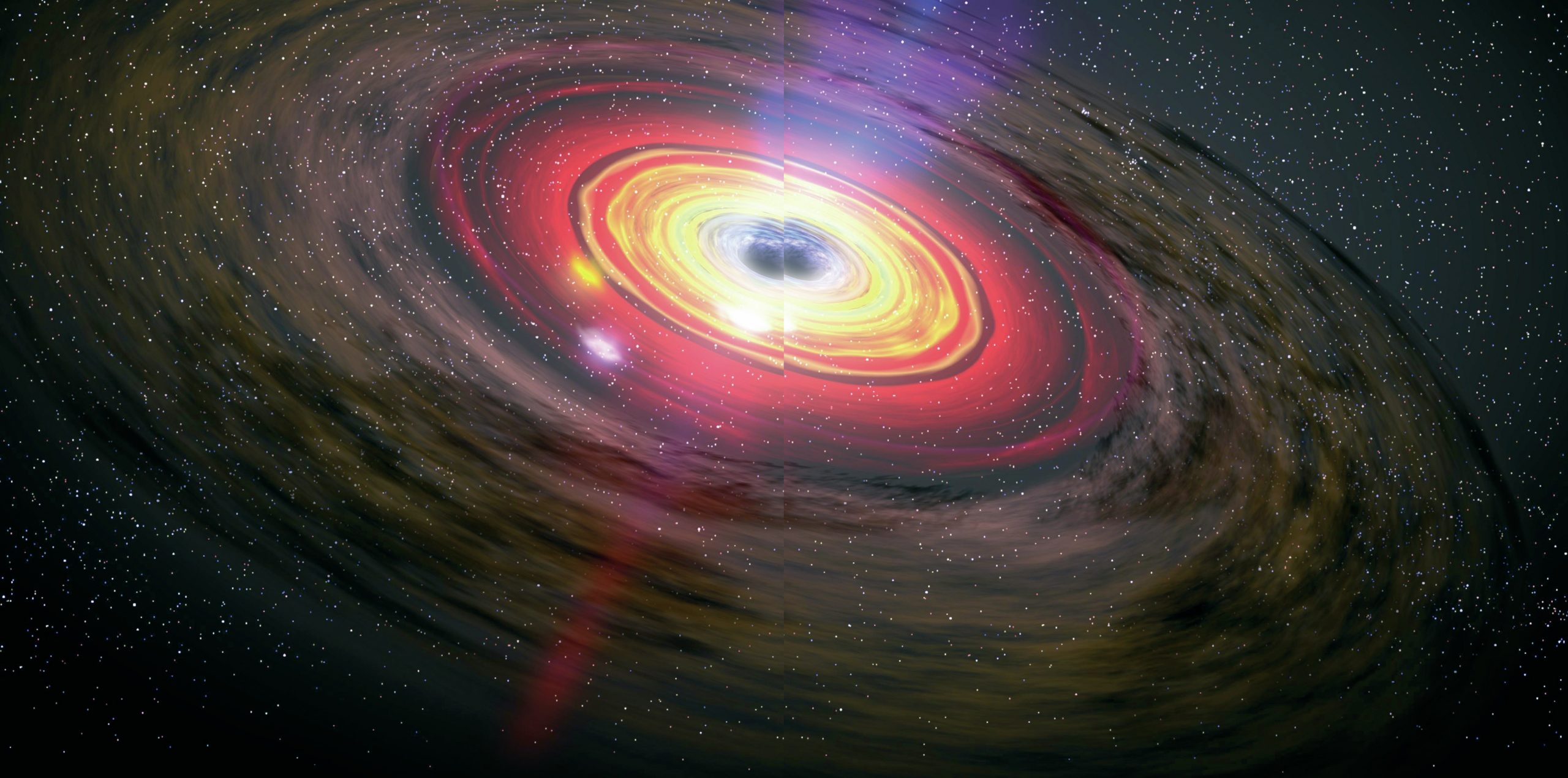
Various models for a multiple universe have been put forward. One approach suggested by the physicist Andrei Linde argues that there is a cosmic void within which many universes exist due to its infinite extension. In his model a parent universe can give birth to another universe due to the elasticity of space provided for in the general theory of relativity. It is argued that space can stretch to a point at which the only connection between two parts of the original universe is perceived as a black hole from the perspective of observations from the parent universe.
From the point of view of the new universe, instead of a black hole observers would perceive the presence of an origin point of their universe, a singularity. In their turn this ‘new’ universe may bear witness to its own creation of other universes through the presence of black holes within it. Each universe would exist at different stages of cosmic evolution.
Reinterpretations and reworkings
Such suggestions are radical and require reinterpreting many ideas within physics such as the nature of black holes, singularities and Einstein’s problematic but thought-provoking idea of a cosmological constant. The cosmological constant originally represented a calculation of the force that needed to operate in the universe to keep it static and not be drawn back in on itself by gravity within Einstein’s general theory of relativity. In linear big bang models since the discovery of an accelerating expansionist universe in 1998 the concept is used to add a small amount of acceleration to the values provided for within the general theory of relativity so that the mathematical model fits with present observations.
What might account for such an added drive towards cosmic expansion is hotly debated among cosmologists. However, within some multiple universe theories the idea of a cosmological constant has been reworked yet again. Only so much energy can exist at any given point in the cosmic void. This is the ‘new’ cosmological constant.
When energy spikes occur in the cosmic void, matter is created in the form of a singularity and its big bang. As the universe explodes into existence the forces of gravity binding it together are overwhelmed by the pull of the cosmic void seeking to return itself to its optimum energy density or state. What wider role dark energy and antimatter may have in all this is even more highly speculative.
Challenge to religious scriptures
In light of our modern understanding of the world, how we understand religious stories about its origin can be related to in three ways, broadly characterised as literal, conservative and liberal. They have not just developed in response to the challenges of cosmology. They have also been inspired by general reflections on the nature of religious truth claims and the role of human experience and reason in producing the religious texts we have across the varying religious traditions.
A literalistic approach
Semitic religions tend more easily to literalistic understandings of their religious texts than Indian religions. This is because in general Indian religions tend towards a non-propositional approach to their religious texts, which sees them as valuable witnesses and guides to religious experience rather than as fixed statements of truth. Spiritual truth is revealed through experience more than words. Semitic religions in contrast tend towards a more propositional view of their holy books which sees their text as making truth claims about the nature of reality. Spiritual truth is revealed more through words than experience.
That said, there exists a great diversity across each religious tradition and while this propositional (Semitic) and non-propositional (Indian) characterisation is a simplification it does represent general trends found between the religious traditions.
A literalistic approach sees the text as the word of God which cannot therefore be in any error. Stories are to be understood as factual and historical. For example, when Genesis portrays creation taking 6 days it actually means 6 24-hour days. Under this approach the holy book is the authority on questions of belief. When scientific understanding and the religious truth differs, scientific truth is seen as deficient and corrupt in some way.
A conservative approach
Another approach, sometimes labelled as conservative, sees religious texts and their stories as reflecting the personality of the writers and their historical time periods. That the text portrays belief in a threedecker universe is seen as a cultural product of the writers in time and place. Such culturally-bound beliefs are not seen as authoritative upon the truth of the religion. Instead, stories such as Genesis portray deep theological insights into the relationship of God with creation.
Some reinterpretation or harmonisation of the text may be undertaken to see how it might be held as true alongside scientific beliefs. Hence, the 6 days of Genesis might be taken as a way of speaking about six ‘periods of time’. God is often thought of as guiding the writers of religious texts. This allows them to be inspired to communicate through the holy book authoritative truths on matters of faith and spirituality within the limits of their historically bound context.
A liberal approach
A final approach, generally called liberal, sees religious texts as reflections of the author(s) on religious experience. In this case the Bible, for example, would not be the inspired word of God, or some kind of special revelation or revealed truth. Instead it acts as a witness and guide to past struggles to get to grips with the ‘God’ question, and provides ways to relate to some of the most profound questions we can ask about life. Under this approach the Genesis story may be seen as a product of its time, now outdated, but symbolically expressing a belief in a creator God who is also all powerful.
Depending on which of these three approaches is taken, the religious believer may be more or less interested in engaging with scientific theories of the cosmos and how it came into being or is understood to sustain itself. More literal approaches will probably see themselves at odds with scientific theories. Conservative and liberal approaches show greater levels of accommodation rather than conflict with science and might therefore pursue the question of which scientific theories support a linear or cyclical view of the cosmos. At this most general level the religious and scientific theories might be said to echo a similar basic belief about the nature of reality, however much they might otherwise disagree.
Uncertainties
It is often supposed that science provides facts which are certain in contrast to the unverifiable myths of religion. While religious truth claims are clearly disputable, arguments within the scientific community do not provide certainty regarding the nature and origin of the universe. The big bang model is very plausible in light of present scientific evidence but whether this is understood within an overall linear or cyclical framework moves us beyond science and into the realm of worldview commitments. Whether humanity will ever be able to fully answer the question posed by Leibniz is debateable even as it invites us to ponder reality and its meaning.
As we consider what the ancient wisdom of the different religious traditions might be saying to us, and listen to modern scientific research, it might be best to go with the simplest explanations that make the most sense of what we know. The problem is that what we can agree on knowing depends on our framing of how knowledge works. The belief commitments generated by our view of knowledge might predispose us to believe in a multiverse or some notion of God as creator. Theists and atheists sometimes decry each other for the fish that is too big to swallow on the opposing side.
Crying out for a beginning?
Perhaps what most offends human reason is that whether we commit to a multiverse (cyclical) or creator God (linear) there is no ultimate beginning to everything, for something or someone has always existed. Our minds, evolved for life in this world, cry out for a beginning of everything even as they struggle with the idea of something coming into existence out of absolutely nothing. Mind relates cause and effect together and looks back, with that rule, into the mists of time. That something could have always existed is as mysterious as the idea of an ultimate beginning. Can minds shaped and conditioned by the universe we live within hope to comprehend the ultimate nature of the cosmos?
Perhaps, whether we are religious or not, scientific or not, what we do need to remember is the humility of man faced by the awesome reality that confronts us in the cosmos.