
Deprecated: mb_convert_encoding(): Handling HTML entities via mbstring is deprecated; use htmlspecialchars, htmlentities, or mb_encode_numericentity/mb_decode_numericentity instead in /mnt/storage/stage/builds/pugpig-site-subs-server/latest-1.2.0-1753096337.768322/pugpig-site-subs/content.php on line 225
Is religion all about money?
Gordon Reid examines the role of money in the concept and function of religion

WJEC RS3: Studies in Religion in Contemporary Society Edexcel Unit 2A: The Study of Religion
What has been the function of religion in the development of human society? Is it all about money? Scholars have long pondered the effect religion has had on the creation of social structures and on the lives of individuals. For some, religion has been essential in maintaining a peaceful and coherent social structure, while for others religion is about deceit and manipulation — and at the centre is the thorny issue of wealth.
Émile Durkheim
Émile Durkheim believed that human societies are held together by religion, which serves to unite and preserve the community. In Elementary Forms of Religious Life (1912) he describes religion as:
‘A unified system of beliefs and practices relative to sacred things…beliefs and practices which unite into one single moral community called a church, all who adhere to them.’
Durkheim said that religion was a very real expression of society itself and that there has never been a human society that did not have a religious element. He felt that as lone individuals humans are weak, but in groups they are strong.
Therefore, humans express themselves religiously in groups. For Durkheim, religion is the human expression of a collective consciousness and creates a reality of its own. In Individualism and the Intellectuals he wrote:
’Religion does not necessarily imply symbols and rites or temples and priests…it is nothing other than a body of collective beliefs and practices endowed with a certain authority.’
He claimed that religion started when primitive communities got together to worship common gods. This led to a unified tribe or primitive clan worshipping a totem, which represented not only the clan god but also the unity of the clan itself, as expressed in shared rituals, values and a moral code. He wrote:
‘If religion has given birth to all that is essential in society, it is because the idea of society is the soul of religion.’
A social activity
Durkheim said that the gods were only projections of the power of the community and that religion was a social activity, where people celebrated festivals and sacred events. Over time, religion also helped these communities to develop a meaning for their lives, a sense of authority and a moral code to bind people together.
In this way, religion enables people to live together peacefully and with purpose. Durkheim observed that, as individuals became more aware of their own significance, so religious ideas turned to focus on individual salvation and conscience. However, he argued that modern societies should no longer be as dependent on religion and he encouraged people to:
‘discover the rational substitutes for these religious notions that for a long time have served as the vehicle for the most essential moral ideas.’
There are, however, criticisms of Durkh view. In particular, religious believers distinguish between membership of their religious community and belief in God. Significantly, Durkheim’s theory does not explain how religious believers are sometimes prepared to go against society and even to reject it. Moreover, society is constantly changing, whereas beliefs about the nature of God are timeless and unchanging.
Max Weber
Max Weber took a significantly different view, looking at the link between religion and economics. In The Protestant Work Ethic and the Spirit of Capitalism (1905), he said that religion helps people to gain an understanding and image of the world and how they live in it. Weber believed that religion provides the answer to the greatest human worries — why is there so much suffering in the world and what happens when we die? Religion offers a divine God of love and power in an imperfect world. But for Weber, religion is also about money.
DURKHEIM SAID THAT RELIGION WAS A VERY REAL EXPRESSION OF SOCIETY ITSELF AND THAT THERE HAS NEVER BEEN A HUMAN SOCIETY THAT DID NOT HAVE A RELIGIOUS ELEMENT.

RELIGION OFFERS A DIVINE GOD OF LOVE AND POWER IN AN IMPERFECT WORLD. BUT FOR WEBER, RELIGION IS ALSO ABOUT MONEY.
He understood that people want to know why some have good fortune and others bad and why there is so much suffering in the world. For Weber, religion offers the answers. Religion shows how people, especially the poor, can achieve salvation and gain eternal life — the pursuit of salvation, and therefore religion, is part of human motivation.
Capitalism
Weber went on to look at how religion was used to develop the modern capitalist system. He argued that capitalism began with the Puritans, whose religious view was that only a select and predetermined few, known solely to God, would be saved — notably, those who behaved well and worked hard. Those who grew rich were favoured by God. Weber coined the term ‘Protestant work ethic’ to describe a system whereby religious believers would work hard to gain financial success. They were to invest wisely to help the poor and those in need. In particular, if a person could gain wealth yet avoid the temptation it brought and give it away, then they would get to heaven:
‘Sell everything you have and give to the poor, and you will have treasure in heaven.’
Luke 18 :22
According to Weber, the system developed and the pursuit of wealth became the ‘spirit ’of capitalism’. But bad habits formed in the rush to gain wealth for its own sake and capitalism became a ‘religion’ of its own — encouraging greed, laziness and the desire to make as much money with as little effort as possible.
‘The experience of the irrationality of the world has been the driving force of all religious revolution.’
Yet Weber noted that religion did not always result in capitalism. Faiths such as Hinduism and Taoism have no reference to the acquisition of wealth and capitalism because they have no formal priesthood and focus on matters other than money — for example, spiritual awareness, good works and acceptance of things as they are. For Weber, there is a clear relationship between wealth and religion.
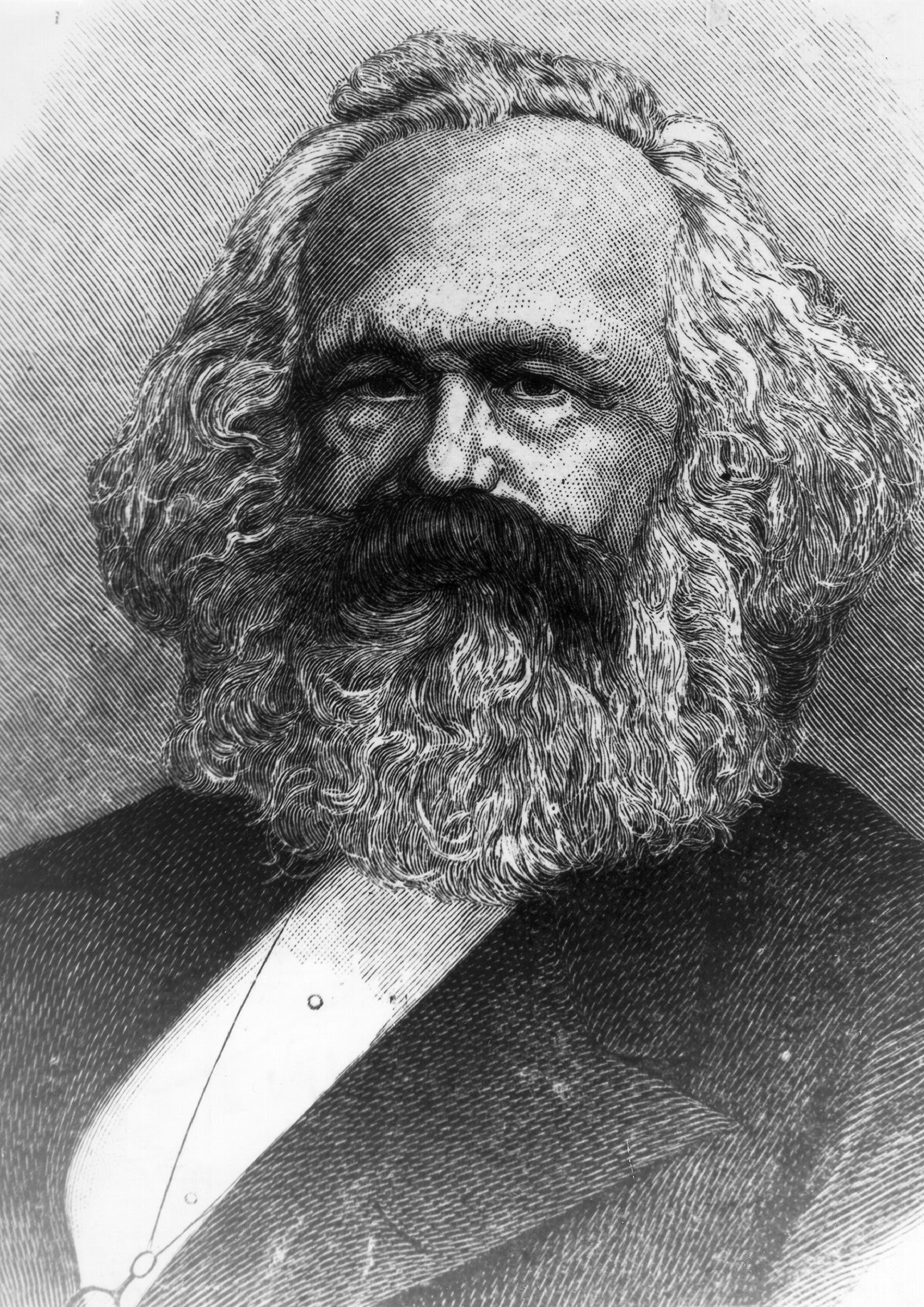
Karl Marx.
Karl Marx went further, claiming that religion is an illusion devised by humans to satisfy their emotional needs. These needs stem from the desire for money — for Marx, religion depends totally on economics. In Das Kapital (1867) he wrote:
‘religion is so fully determined by economics that it is pointless to consider any of its doctrines or beliefs on their own merits.’

Marx argued that religion is an illusion that creates fantasies for the poor and offers them the false hope of happiness in the afterlife. Religion is used by the rich to make the poor feel better. It provides peace and hope and keeps society functioning exactly as it is. In Critique of Hegel’s Philosophy of Right (1844) he wrote:
‘Religion is the sigh of the oppressed creature, the heart of a heartless world, just as it is the spirit of a spiritless situation. It is the opiate of the people.’
Marx put forward the view that religion takes the highest human values and places them ’ on a being called God. He believed that this led humans away from reason and sense and instead into the pursuit of fantasies. Religion actually hinders human development rather than helps it:
‘It eased pain even as it created fantasies.’
He wanted religion to be abolished so that poor could be liberated:
‘The first requisite for the happiness of the people is the abolition of religion.’
A delusion?
Marx believed that religion is a delusion that avoids facing the truth and reality of life. It takes away the dignity of humanity and replaces it with servitude. Religion sides with the rich, just as the Christian Church has, for centuries, sided with the rich and the powerful.
But is Marx right? Marx only focused on Christianity and seemed to ignore the fact that in other religions economics is not of such importance. Moreover, the Bible portrays God as loving towards the poor.
Marx’s views prompted the Roman Catholic Church to become wary of countries and religious movements with Marxist connections. In the Puebla Conference of Bishops in 1979, the then pope declared that:
‘Those who sup with Marxism should use a long spoon.’