
Deprecated: mb_convert_encoding(): Handling HTML entities via mbstring is deprecated; use htmlspecialchars, htmlentities, or mb_encode_numericentity/mb_decode_numericentity instead in /mnt/storage/stage/builds/pugpig-site-subs-server/latest-1.2.0-1753096337.768322/pugpig-site-subs/content.php on line 225
Machiavelli Prince of pragmatism
All boards: Ethics options
Moral theories tend to take it for granted that we should be moral and then seek to clarify why this is imperative, or to unpack exactly what constitutes morality. Utilitarianism, on the other hand, comes close to suggesting that we should do what is useful rather than moral. This can be seen as a sophisticated form of pragmatism.
Historically, pragmatism has had its proponents. Pre-eminent among them was the Italian political theorist Machiavelli. So hard line was the pragmatist stance he outlined in his bestknown work, The Prince, that Machiavelli has become a poster boy for amorality. The term ‘Machiavellian’ has entered into common speech, meaning cunning and immoral.
THE TERM ‘MACHIAVELLIAN’ HAS ENTERED INTO COMMON SPEECH, MEANING CUNNING AND IMMORAL.
Machiavelli
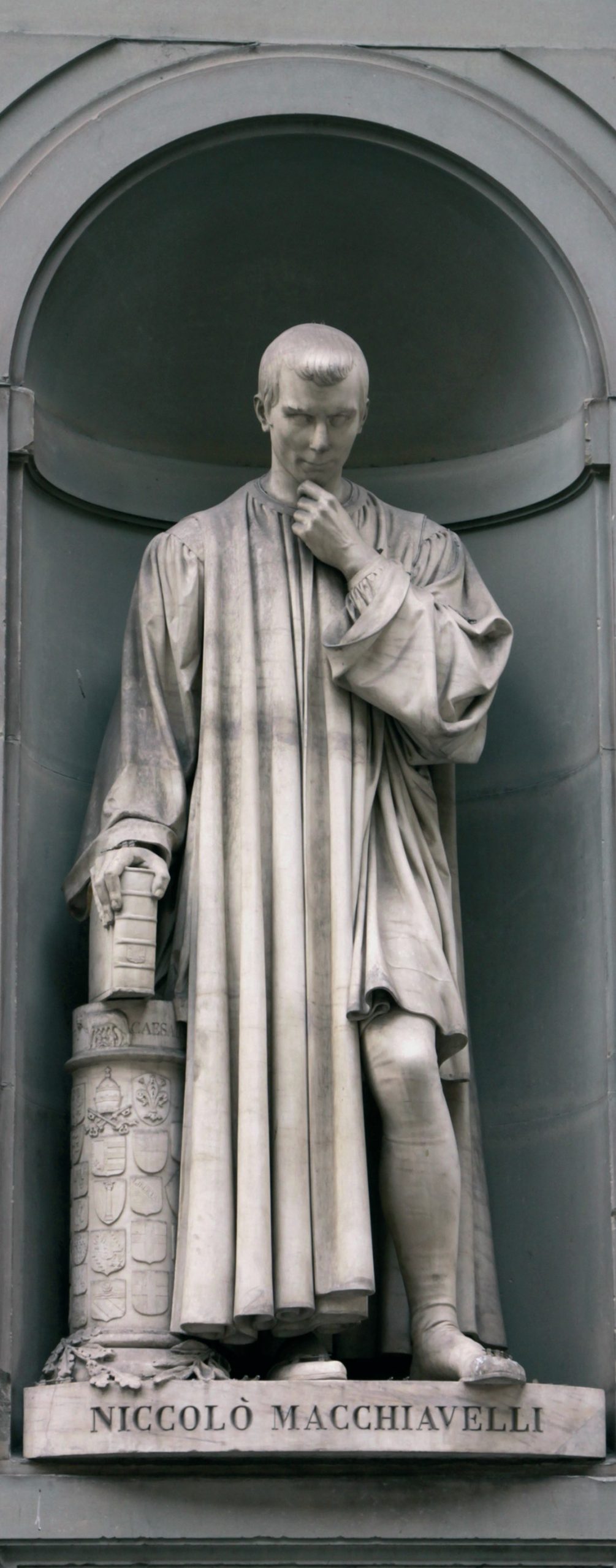
Nicollò di Bernardo dei Machiavelli was born on 3 May 1469. Little is known about his early years other than that he was the son of a lawyer and was brought up in the expanding city state of Florence, but was not a full citizen. Machiavelli’s background was affluent enough to ensure that he was well educated in the Renaissance Humanist tradition. He first entered the public arena at the time of the fall of Savonarola’s regime in the spring of 1498.
Savonarola was a great populist preacher with a forceful personality. He preached that, unless the Florentines mended their ways and returned to ‘the Ways of God’, their city of finery, luxury and pleasure would be doomed. However, the purity and independence of the regime irritated the papacy. Savonarola was summarily arrested, convicted and burned at the stake in early 1498.
Machiavelli’s earliest existing letter dates from this period and makes it clear that he detested Savonarola. Machiavelli had no patience with the puritanism that he stood for, but also thought that the preacher was a hypocrite. Savonarola appears as the Prophet Unarmed in The Prince, a seminal text on political philosophy that depicts the inevitable fate of the Prophet Unarmed as coming to grief.
A civil appointment
After Savonarola was executed in May 1498, new civil appointments were made, which included the 29-year-old Machiavelli. He became the second chancellor of Florence —a senior position for someone so young. In that role he progressed to secretary to the Dieci di Libertà e Pace, the Ten of War, who looked after the foreign affairs of the republic. From almost total obscurity, he became second secretary of the Florentine republic by the time he was 30. In the following years he proved to be an effective coordinator, managing several successful military campaigns for the republic. It is clear that he was thought to be an outstanding civil servant, as he was sent on many of the major legations that mattered most to Florence.
In this role, he wrote ambassadorial notes back to the Ten of War in Florence. After one note concerning his embassy to France, he was told that his tone was extreme and not the sort of civil service report they were used to, and he was instructed to be careful. As a diplomat he had proved to be a skilled communicator, prone to penetrating epigrams, but also to being too direct and pithy.
The end of a promising career
Machiavelli’s downfall, when it came, was the direct result of changes in political circumstances, rather than scholarly condemnation. In 1512, French infantry marched into Florentine territory and the republic collapsed. Those who had been in power before 1494, the Medicis, were brought back. Machiavelli had been working for their enemies and after a short while he lost his job. At the beginning of 1513 he was implicated in an abortive coup against the rulers and was immediately arrested and imprisoned. He was interrogated and repeatedly tortured with the strappado. It was the effective end of his career.
On his release in March 1515, Machiavelli retired to the country and pined for his previous political role, even dressing in his old finery on his farm at night to recreate past splendours. He wrote some literature designed to entertain, which was relatively popular at the time. The Prince, his master work, was not published during his own lifetime — he sent copies to friends, but its ideas were not widely disseminated. A printed version was published in 1532, 5 years after his death.
The Prince
Machiavelli produced three significant literary works, of which The Prince is the best known. Considering his modest oeuvre as a whole, he was a stylist —a writer who was enormously conscious of the power of words. He enjoyed literary antithesis and he appreciated the value of shock in both the words he used and the sentiments he expressed. He liked to see that he was having an effect on people.
At this time Florence was an immensely turbulent place, fearing invasion from Spain or France and the papacy. Political ideas, arguments and discourses prevailed some of the time, but it was also a time of extreme political violence. Even Machiavelli sometimes appeared stunned by the political ruthlessness that was thought necessary and thus acceptable at the time — though as an ambassador he clearly liked to keep a cool tone in his correspondence.
Machiavelli wrote that of all the men whom he encountered, the one who came closest to the naked ideal of power was the infamous Cesare Borgia. He witnessed Borgia’s ruthless approach to state building at close quarters. Borgia aimed to create a principality on the borders of Florence and the Florentines were extremely worried by this development. So Machiavelli was sent to Borgia’s court and was very impressed. He saw in his host a man of resolution, who would stop at nothing.
Machiavelli cited two examples of this prince’s modus operandi, which he says should be studied and emulated. In one, Borgia’s mercenaries met in a seaside town, reportedly to plot against him. Borgia arrived, cordial greetings ensued and a welcoming celebration was set up in a great hall. During its course Borgia’s guards emerged from concealment and murdered all the mercenaries.
From such examples, Machiavelli developed a model of how rulers should approach the practice of ruling, which he outlined in The Prince. As a guide to a new prince concerning how he should conduct himself, this work focused solely on how princes should behave, rather than broadening its scope to include every man. The main thrust of this work can be interpreted as ‘the ends justify the means’.
Politics and human nature
Machiavelli had a negative view of human nature, and arguably politics is an occupation in which human nature manifests particularly badly. He maintained that men are characteristically ungrateful, fickle, two-faced liars, and prone to sycophancy and rejection. He suggests that perhaps integrity is not as important as we have been persuaded by socialisation. It is better for princes to be more effective, in his view.
Machiavelli pays ironic lip service to the convention that it is praiseworthy for a prince to honour his word and not to be crafty. However, he goes on to write that history indicates ‘it is princes who have learned to trick people with their cunning who overcome those who abide by honest principles’. Lies and deception can be justified according to the national interest. Amorality is justified if acts are for the greater good in the end.
Furthermore, Machiavelli maintained there are no true friendships in politics. All politicians are sharks waiting for traces of blood to appear in the water. He argued that a prince should do whatever is needed to win, by whatever means necessary. However, he was not saying that you should win whatever the consequences — rather that you should be prepared to win, in order to do what is right. Machiavelli believed that what matters in politics are ends, not adherence to rules of practice. This runs contrary to the view that justice — and thus fair dealing — is a fundamental good in political affairs.
The reality of politics
In one passage Machiavelli maintains that it is those who are overtly forceful who win, not those who are honest, decent and nice. Arguably all he did was explain the reality of politics. He proposed that an effective prince cannot:
‘observe those characteristics by which men are considered good…he is often obliged to act against charity, against humanity…and must always be ready to adapt his approach according to dictates of changes of fortune and circumstance.’
As far as possible he should not ‘stray from good. However, he should be willing to turn away from it when necessity commands’.
The Prince suggests that in politics everybody is trying to do you down, even your allies. An example of this in the UK parliament was when, in the company of Winston Churchill, a young frontbencher looked across the aisle at the politicians before him and described them as ‘the enemy’. Churchill responded, ‘my dear boy, they are the Opposition; the enemy’s behind you’ — the message being that you need to be cunning in your dealings with both the opposition and your own side. ‘Injuries done to people should be done in such a way that you do not stand in fear of revenge.’ There is a fine line between the need to crush and the need for compromise in politics.
Fear, not love
Machiavelli wrote that:
‘it is much better to be feared than to be loved. Love is held together by a chain of obligation, which — as men are a sorry lot — is broken on every occasion where our own self-interest is concerned. But fear is held together by dread of punishment, which will never abandon you.’
In addition he held that princes should keep their hands the distribution of favours. However, in the enactment of unpopular measures should be seen to have been delegated to others. Then you can placate public disfavour by sacking an underling or two.
Machiavelli also counselled restraint where appropriate, advising the prince ‘to restrain himself from doing grave injury to those he has close to him in affairs of state’. For they are those people who can contribute most to his downfall. You should be careful about alienating people who could do you harm in the end.
Machiavelli counselled that the prince should remain mindful of the fact that he was put in power by dissatisfaction for the previous regime, rather than by natural affection for him. Also he should keep in mind that it is ultimately impossible to fully satisfy those who elevated him. However, princes who follow a path of neutrality, in order to avoid immediate danger, usually come to grief. A prince should appreciate the power of his position, apprehend threats in advance and pre-emptively strike against them.
The Prince proclaimed that ostentatious displays of a leader’s abilities would pay political dividends. So embarking on a successful war might be advantageous regardless of the physical suffering caused. It is worth observing that these observations have many contemporary resonances, closer to home.
Opposition
From his emergence as a public figure, Machiavelli was associated with a series of ideas that were difficult for contemporaries to take. There were elements in them that were thought to be anti-religious and an affront to the Catholic Church. Soon he had become the focus of considerable controversy, as he remains. He has been described as diabolical.
Antipathy to Machiavelli grew around the contention that he was an anti-Christian writer. He is cited in the first edition of the papal index of precluded books (the ‘Index Librorum Prohibitorum’) as an enemy of liberality, clemency and honesty, and is characterised as a preacher of evil in politics. He was a Catholic by upbringing, but he was not a ‘man of God’. The ways of traditional religion were not his ways; it appears that he simply was not interested. However, criticism of his amorality was not confined to Catholic orthodoxy — his views were also condemned by contemporary Humanists, among them Erasmus of Rotterdam.
Legacy
For centuries Machiavelli was derided and portrayed as an almost demonic figure — though apologists have argued that he was only honestly describing the reality of some, if not all, political interaction. With the rise of secularism and increased prominence of science in the last century, the criticism that he was irreligious is no longer, in itself, a damning argument. Also, with the rise of Darwinism and its emphasis on the imperative to survive, it has become more difficult to account for altruism.
Scholars from diverse disciplines have sought to account for altruistic inclinations, producing divergent responses. Apologists for Machiavelli would still cite a negative characterisation of human nature to underpin their approach. They may also refer to a wealth of historical examples of might (and cunning) triumphing over right. Closer to home, we only need to consider the complex, ruthless plotting and counterplotting surrounding the meteoric fall of Anne Boleyn, 9 years after Machiavelli’s death, to realise that the style of political dealing described in The Prince was not confined to the Italian city states. However, it should be noted that, since Machiavelli was himself a victim of torture at the hands of an oppressive regime, his work has also been interpreted as a satire on the methods of tyrants.
Closer to the present, commentators have suggested that rampant duplicity has characterised some much more recent political affairs. An ex-cabinet minister, Alan Clark, said ‘A real understanding of Machiavelli is as important to success in politics, as numeracy is to success in physics’. Many have suggested that you have got to be brutal to seek power effectively, asserting that a social conscience is counterproductive and that idealism and moral scruples heavily handicap politicians. Perhaps the suspicion that this is what politicians are really like puts many people off voting.
FOR CENTURIES MACHIAVELLI WAS DERIDED AND PORTRAYED AS AN ALMOST DEMONIC FIGURE
Steve McCarthy was formerly head of religious studies at Rainham Mark Grammar School and Blackheath Bluecoat School. He currently divides his time between London and New York.
References
Machiavelli, N. (2008) The Prince, OUP. All quotations are from The Prince unless otherwise indicated.